Dog grooming clients come from a small set of repeatable actions: reach the right local pet owners, make booking easy, and bring past clients back. Start by knowing who you serve. According to the
National Library of Medicine figures cited by Uprinting, 41% of dog owners groom at home, 30% use full-service salons, and 9% choose mobile groomers. Each group needs a different channel, offer, and budget.
→
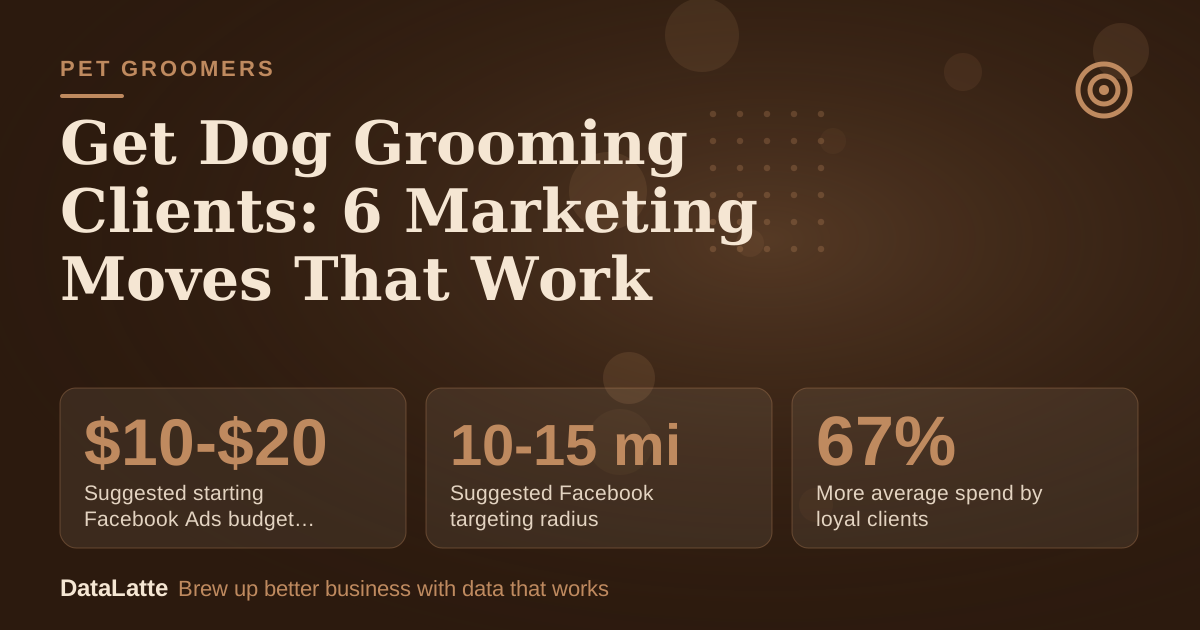
Suggested starting Facebook Ads budget per day
Barklead guide, raise only after top ads are found
→
Suggested Facebook targeting radius
around the groomer's location, per Barklead
↑
More average spend by loyal clients
Harvard Business Review, cited by EnvisionNow (secondary)
→
Dog owners who use full-service salons
National Library of Medicine, cited by Uprinting (secondary)
See Sources at the end of the article. Cards marked Assumption are examples, not results.
Which dog grooming clients should you target first?
Start with the customer types you already serve.
Gingr's pet grooming advertising guide describes four categories: busy professionals, families who spoil their pets, value-driven clients, and parents who prioritize the best care. Each group responds to different wording. A busy professional wants fast online booking. A value-driven client wants a clear price and a reason to try you.
Pick one group for your next campaign and write the ad, the landing page, and the offer for that person only. Mixing audiences makes results impossible to read.
Location matters as much as audience.
Barklead suggests targeting users within a 10-15 mile radius of the groomer's location and pet owners aged 25-60 who are likely to have disposable income. A mobile groomer should set the radius around the neighborhoods on their route, not the shop address.
How should your Google Business Profile support bookings?
Your listing is often the first impression.
Research cited by EnvisionNow says it takes just 50 milliseconds for a potential client to form an impression about a pet grooming studio. That makes the first photo, the service list, and the booking link the parts to fix first.
Check that photos show the space, the equipment, and finished dogs, not only one stock image. List the services you actually sell with clear names. Make sure the booking or call link works on a phone. Google's own profile help pages explain current listing options, so check them before changing settings, since features change often.
How much should you spend on Facebook Ads for grooming?
Barklead recommends starting with a modest budget of $10-$20 per day and increasing spend only after you identify high-performing ads. Its sample offer, 10% off your first grooming session, gives a new client a reason to act without discounting every visit.
The article also notes that Facebook has over 2.9 billion active users, so the audience is large. Size is not the goal, though. A campaign is only useful if it fills appointment slots at a profit. Use the worked example below to decide whether a budget is worth testing.
What does a grooming ad budget need to earn back?
Assumption: a solo groomer charges an average of $65 per groom. Assumption: the Facebook budget is $15 per day, which sits inside Barklead's $10-$20 range. Assumption: the month has 30 days.
Monthly spend is $15 x 30 = $450. Break-even on revenue is $450 / $65, which is about 7 new grooms in the month. If the campaign books 4 grooms, it loses money on the first visit alone. That does not automatically mean the campaign failed, because repeat visits carry more value.
Assumption: each new client also gets a 10% first-visit discount, which costs $6.50 per visit. Assumption: 2 of those new clients rebook once more in the next year. Then each rebook adds $65 of revenue. Track the number of new bookings from each ad set against spend every week, and stop any ad set that does not reach break-even within 60 days.
Are flyers and posters still worth printing?
Print is still useful when it is targeted.
Uprinting advises distributing 500 to 1,000 flyers in the right neighborhoods, which it says usually works better than handing flyers out all over the city. Choose streets near existing clients, vet clinics, and pet stores, and use one clear offer per flyer.
For posters, the same source notes that most people only look at posters for a few seconds. Use large, easy-to-read text: one service, one price or offer, and one way to book. Give the offer a tracking code or a special phone line so you know which print run produced the booking.
How do you turn one visit into repeat bookings?
Repeat clients are the cheapest growth you have.
EnvisionNow cites Harvard Business Review as finding that loyal clients spend 67% more on average than new ones.
EMTWO also cites a claim that attracting a new customer costs five times more than keeping a current one; that article is from 2018, so treat the figure as a directional benchmark.
Use a reward that matches your margins.
Gingr suggests a free groom after five visits or discounts on add-on services. Uprinting shows a reminder-card offer: book your next appointment within 6 weeks and receive a free nail trim upgrade. Draft the wording for reminder and review messages with a few tested prompts from
these ChatGPT prompts for local business marketing, then edit them to sound like your shop.
Do mobile groomers need a different plan?
Yes.
Mobile groomers usually do fewer dogs per day than a busy salon because of drive time, setup, and one-on-one handling. That means each booking carries more weight, and your marketing should fill the route, not the calendar alone. Group bookings by postcode so each day's stops are close together.
Software costs also matter.
Perform Pets reports that MoeGo lists plans for mobile groomers from $49 to $159 a month, with higher plans priced per van. That is third-party pricing as cited by the page, so confirm current prices with the vendor.
TailWerks states it works with grooming salons, mobile groomers, and franchises if you want outside help. Local sponsorships also work well for a route business;
event marketing for local businesses covers how to pick a community event with a real audience.
| Channel | Sourced figure | Best fit |
|---|
| Facebook Ads | $10-$20 per day to start | Solo groomers testing one offer |
| Flyers | 500-1,000 in chosen neighborhoods | Shops and mobile routes near existing clients |
| Reminder cards | Rebook within 6 weeks | Clients on a regular schedule |
| Loyalty reward | Free groom after five visits | Salons with steady repeat traffic |
Any tool that stores client names, phone numbers, or pet health details should meet privacy rules.
Builder Growth Engine recommends choosing a platform that complies with data privacy regulations and securely handles client information. Check the vendor's data policy and whether it supports the consent rules that apply in your country before you import a client list.
FAQ
Love Groomers cites Pet Business Magazine, which reports that 60% of pet owners discover new pet care services through social media. Treat this as a secondary figure and confirm it against the original report. Measure your own result by asking every new client how they found you.
How do I know if a Facebook campaign is working?
Count new bookings from each ad set and compare them with spend, as in the worked example above. Stop any ad set that does not reach break-even within about 60 days, and check your platform's current reporting guide for how to set up conversion tracking.
Which should I do first: ads or reviews?
Fix the basics first. Make your listing accurate, make booking easy, and ask recent clients for reviews. Ads send people to that page, so a weak listing wastes the spend. If you want a second opinion on where your budget leaks, a
free audit can show the gaps.
Do I need a big budget to start?
No.
Barklead's starting range is $10-$20 per day, and the print and loyalty moves above cost little beyond printing and time. Start with one channel, measure it for a month, and add the next only when the first one pays its way.
Sources
For a plan built around your own numbers, see
Google Ads management or start with a
free audit of your current listing, booking path, and ad spend.
Free for local businesses
Want this applied to your business?
I'll review your Google presence, local SEO, and ad accounts — and send you a specific action plan within 48 hours. No pitch, no pressure.