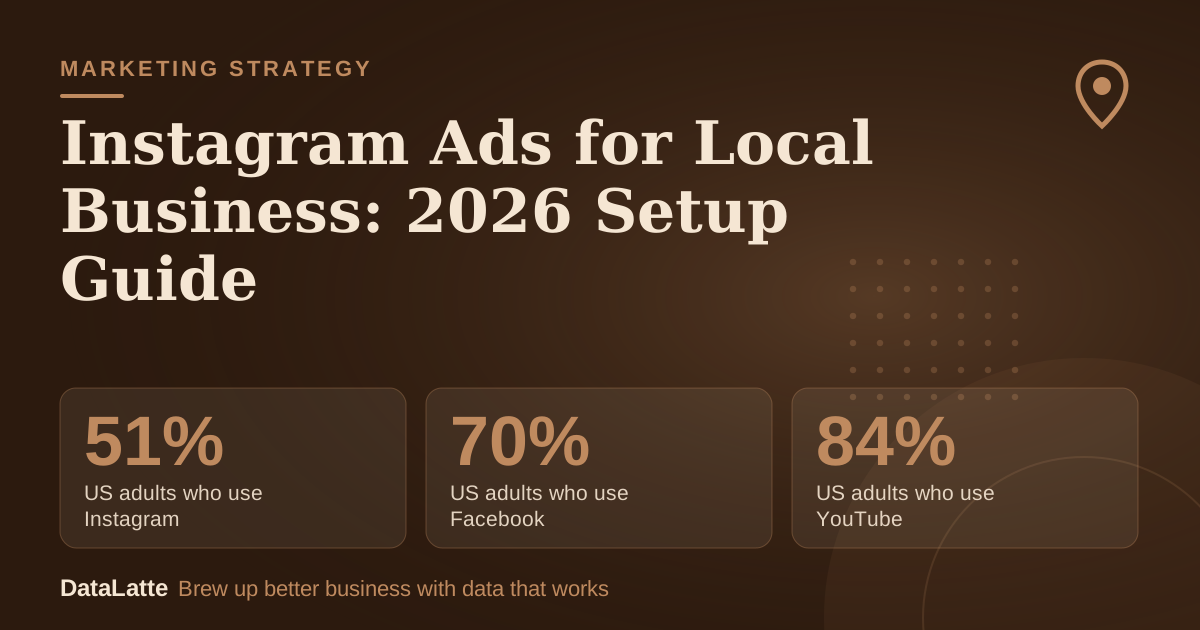
To set up Instagram ads for a local business, start with one goal (calls, bookings or store visits), a radius that matches how far your customers travel, one offer and a small test budget. A $300 test over 30 days is a reasonable starting point, though that figure is an assumption, not a rule. The audience is large: Pew Research's 2026 survey found 51% of US adults use Instagram, up from 50% in 2025. Judge the ads on cost per lead and cost per customer, not reach.
↑
US adults who use Instagram
Pew 2026, up from 50% in 2025
↓
US adults who use Facebook
Pew 2026, down from 71% in 2025
→
US adults who use YouTube
Pew 2026, unchanged from 2025
→
US adults who use TikTok
Pew 2026, unchanged from 2025
See Sources at the end of the article. Cards marked Assumption are examples, not results.
Is Your Customer Base on Instagram?
Pew's
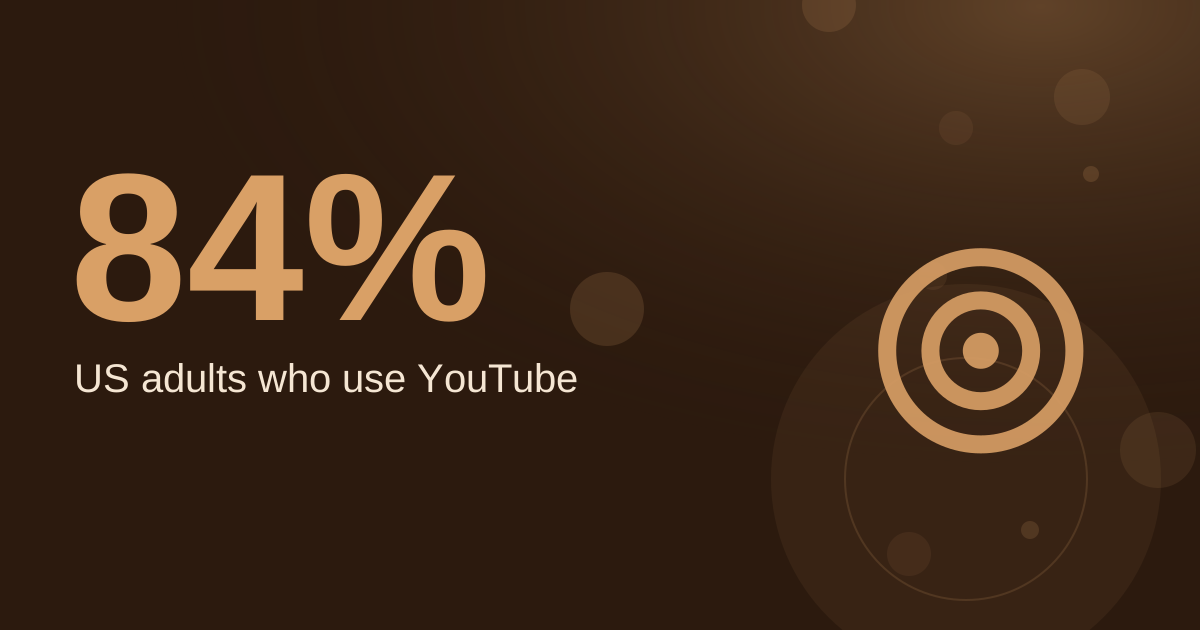
social media fact sheet puts Instagram use among US adults at 47% in 2023, 50% in 2024 and 2025, and 51% in 2026. Pew notes a change in survey method in 2023, so compare earlier years with care. In the same 2026 data, Facebook sits at 70% and YouTube at 84%.
These are national adult shares, not local ones. The figures reviewed for this guide do not confirm a specific age split, so do not assume one for your area. Check your own customer list instead. If most of your repeat customers are in their 20s and 30s, Instagram is a strong fit. If they are mostly older, test Facebook or Google alongside it, and compare the results over the same period.
Which Goal Should Your Ads Aim For?
Pick one result before you open Ads Manager. The three most useful goals for a local business are:
- Calls or messages from people nearby
- Bookings or form fills on your website
- Store visits, sending people to your site or map listing
Each goal needs a different ad and a different measure of success. A message ad is judged on cost per conversation. A booking ad is judged on cost per booking. Campaign objective names can change, so pick the objective closest to your goal and confirm the current names in Ads Manager before you launch. Writing the goal down before launch also gives you a fixed point for judging results later, which makes the weekly review in the measurement section far easier to act on.
How Do You Target People Near Your Business?
Start with location. Set a radius around your address that matches how far customers actually travel. Use the postcodes of your last 50 customers as evidence. A dentist whose patients drive 20 minutes needs a wider radius than a cafe that relies on walk-in trade. Keep interests broad and let the creative do the filtering.
If you hold a customer email or phone list and have permission to use it, upload it to build a custom audience. Exclude current customers from new-customer offers so the budget reaches people who have not bought from you. Meta's menus change, so look for the audiences section in Ads Manager rather than following a fixed path.
How Should You Test Creative?
Meta recommends A/B testing over informal testing. Its help page says informal methods, such as switching ad sets on and off by hand, can produce overlapping audiences and unreliable results. Each version of an A/B test is shown to a separate segment of the audience, so nobody sees both. Duplicating an existing campaign or ad set also duplicates its budget, and the same budget for both versions keeps the comparison fair.
Practical steps:
- Write one sentence that says what you sell, where, and what the customer should do next.
- Make two or three images or short videos of the real product, space or team.
- Change one variable at a time, such as the image, the first line of text or the offer, and run the variants with equal budgets until results show the winner.
Drafting the copy variants is quicker with a tested prompt set, and
ChatGPT prompts for local business marketing gives a starting point. Always check claims against what you actually offer before publishing.
What Does a $300 Test Look Like?
The table below is a worked example. Every input is an assumption for a hypothetical hair salon, not a forecast or a benchmark. Replace each one with your own numbers after the first week.
| Input | Value | Label |
|---|
| Test budget, 30 days | $300 | assumption |
| Cost per lead | $25 | assumption |
| Leads | 12 ($300 divided by $25) | calculated |
| Lead-to-customer rate | 25% | assumption |
| New customers | 3 (12 times 25%) | calculated |
| Cost per new customer | $100 ($300 divided by 3) | calculated |
| Average gross profit per customer | $180 | assumption |
| Gross profit from new customers | $540 (3 times $180) | calculated |
| Return on the test | 80% (($540 minus $300) divided by $300) | calculated |
The key number is the break-even point. In this example the test pays back only if cost per customer stays under $180. If your real cost per customer is higher, change the offer or the landing page before you raise the budget.
Should You Use Instagram Ads or Google Ads?
They reach people in different states of mind. Google's
Display campaign help page describes reach across websites and apps, plus YouTube and Gmail, with AI-driven targeting and bidding. Optimized targeting is the default for Display campaigns and uses information such as keywords on your landing page. Instagram places ads in a feed where people are browsing rather than searching. For automated Google campaigns, Google's help page points advertisers to Performance Max or Search campaigns, covered in
Google Performance Max for local business.
| Instagram ads | Google Search or Performance Max |
|---|
| Customer state | Browsing | Searching now |
| Best for | Visual products, offers, repeat visits | Urgent needs such as emergency repairs |
| Reach figure in sources | 51% of US adults use Instagram (Pew, 2026) | Display reaches websites and apps, plus YouTube and Gmail (Google) |
| Cost data | Your own test results | Your own test results |
Many local businesses run both. Start with the channel your customers already use when they need you.
What Should You Measure Each Week?
Count outcomes, not reach. Track cost per lead, cost per booking, the share of leads who become paying customers, and how many customers say they saw the ad. Add a "How did you hear about us?" question to your booking form, because platform reports rarely capture the full path to a sale.
Review results weekly and change one thing at a time. If you have no leads after a month of steady spend, check the offer and the landing page before increasing the budget. If you also post organic content, compare scheduling tools in
Hootsuite vs Sprout Social for small business so reporting stays in one place.
If you want an outside review of your account setup and tracking before you spend more, a
free audit is a practical first step.
FAQ
Do Instagram ads work for local businesses?
They can, particularly for businesses whose customers respond to visual offers. No source reviewed here proves results for a specific trade, so run a small test and measure cost per customer.
How much should a local business spend on Instagram ads?
A $300 test over 30 days is a sensible starting point, and that figure is an assumption. Scale only after you know your own cost per lead and cost per customer.
What share of US adults use Instagram?
Pew Research Center's 2026 survey found 51% of US adults use Instagram, up from 50% in 2025. Figures are national and do not describe your local area.
Should I test Instagram ads against Google ads?
Yes, if both channels fit your customers. Compare cost per customer over the same period and budget, and use the channel that delivers customers at a cost your margins support.
Sources
All pages checked 10 November 2026.
Free for local businesses
Want this applied to your business?
I'll review your Google presence, local SEO, and ad accounts — and send you a specific action plan within 48 hours. No pitch, no pressure.