Vancouver small businesses get the most from local marketing by fixing the free basics first: a complete Google Business Profile, neighbourhood-specific search terms, and a small paid budget aimed at those terms. Spending more on ads rarely helps if the profile is thin. Published figures specific to Vancouver small-shop marketing are scarce, so the numbers below are either sourced and labelled, or marked as assumptions in the worked example.
→
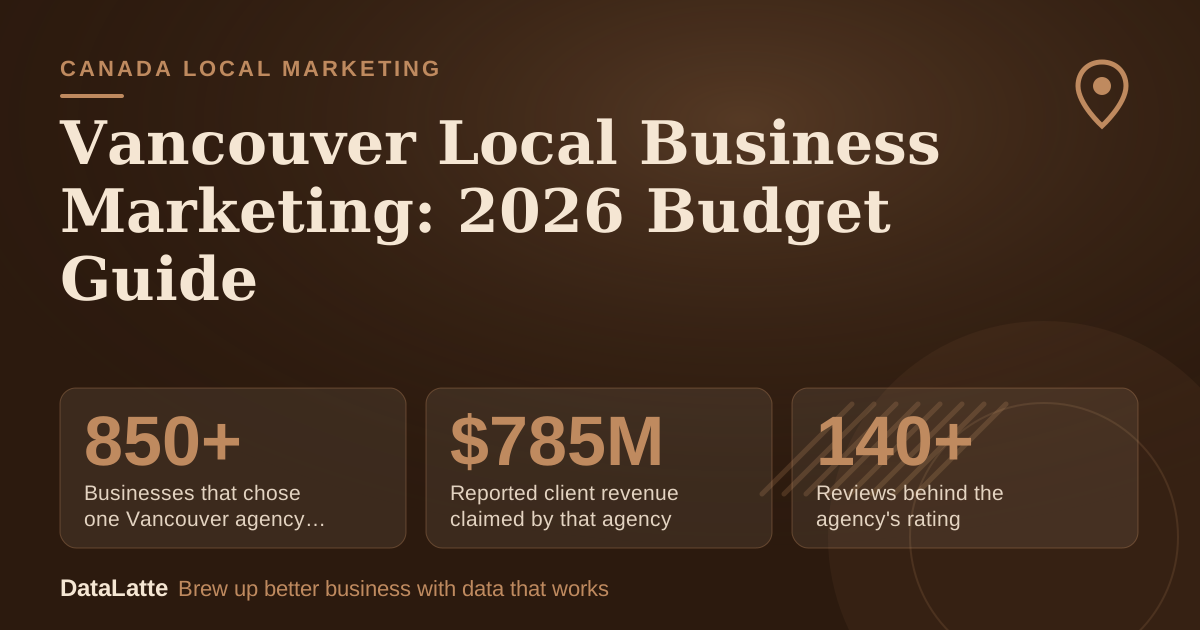
Businesses that chose one Vancouver agency as partner
S1 vendor claim
→
Reported client revenue claimed by that agency
S1 vendor claim
→
Reviews behind the agency's rating
S1 vendor claim
→
Rating out of 5 on the agency's page
S1 vendor claim
See Sources at the end of the article. Cards marked Assumption are examples, not results.
What does a realistic local marketing budget look like in Vancouver?
A useful starting point is a fixed monthly total split across three jobs: paid search, profile upkeep, and direct customer contact. The table below uses a $500 CAD monthly budget. Every figure in the Monthly CAD column is an assumption to replace with your own quotes and results.
| Line item | Monthly CAD (assumption) | Purpose |
|---|
| Google Ads, neighbourhood and service terms | $200 | Capture people searching near your address |
| Profile upkeep (photos, posts, review replies) | $150 | Keep your Google Business Profile active |
| Email platform and sign-up tool | $150 | Turn one-time visitors into repeat customers |
Worked example (all inputs are assumptions): at an average cost per click of $2.00 CAD, the $200 search line buys about 100 clicks a month. If 5% of those clicks book an appointment, that is 5 bookings. If an average booking is worth $60 CAD, the search line produces $300 in revenue, a 1.5x return on spend before costs of goods. Swap in your real cost per click and conversion rate before deciding.
Which neighbourhood keywords should a Vancouver shop target?
Vancouver customers often search by neighbourhood name plus a service. Terms like these tend to have clearer intent than a broad phrase such as "coffee Vancouver," because the person is close enough to visit:
- Neighbourhood plus service, for example "coffee Kits" or "yoga Yaletown"
- Landmark-adjacent phrases, such as "salon near UBC" or "studio near Lonsdale Quay"
- Activity-based phrases that match your offer, such as "post-hike coffee" or "trail running yoga"
Test each phrase for a few weeks and remove the ones that return clicks but no calls or bookings. Keep a short negative keyword list as well, so ads do not show for unrelated searches.
Seasonality matters in Vancouver's weather pattern. Patio and outdoor terms usually gain attention in spring and summer, while indoor and comfort terms gain attention during the wetter months. Your own search data is the best guide, so check it before shifting budget.
How do you set up a Google Business Profile for a Vancouver shop?
Your Google Business Profile is the free listing that appears in map results, and it often matters more than paid ads for a walk-in business. Work through these steps in order:
- Claim the listing and confirm the address, phone number and opening hours are exact.
- Choose the most specific primary category that fits your service.
- Write a description that names your neighbourhood and one clear differentiator, such as specialty, natural or dog-friendly.
- Upload current photos, including outdoor seating or your storefront in daylight.
- Pre-fill the Q&A with questions customers actually ask, and answer each one with specifics.
- Post updates at a cadence you can keep, such as twice a week, and reply to every review.
Review volume grows slowly. Ask customers for a review at the point of service, and track the count monthly rather than daily.
Should a Vancouver shop use Google Ads or Local Services Ads?
Standard search ads let you choose keywords and control the message. Local Services Ads suit certain trades and require a separate verification process, so check whether your category is eligible before committing. The
breakdown of whether Google Local Service Ads are worth it for local businesses explains the trade-offs in more detail.
If you run several locations or a broader catalogue, automated campaign types may suit you better.
Performance Max for local businesses covers when that setup makes sense and what to check before turning it on. For a single café or studio with one address, a small standard search campaign is usually easier to read and control.
How often should a Vancouver small business post on Instagram?
Post frequency is a planning choice, not a fixed benchmark. A realistic schedule for a single owner might be three posts a week: one carousel, one short video, and one customer photo repost. Batch the work once a week, then schedule it. A scheduling tool helps with that routine, and
this comparison of Hootsuite and Sprout Social for local businesses shows how the two tools differ on price and features.
Check your own insights every month. Track saves, profile visits and bookings from the link in your bio. Those numbers should decide whether to keep a format, not general advice from any single source.
Where do multicultural and seasonal audiences fit?
Vancouver's neighbourhoods serve different communities, and the right channel can differ by area. A shop near a largely Chinese-speaking area may need Chinese-language listings and messaging, while a family-focused suburb may respond better to email and Facebook. Ask your own customers which apps they use and which language they prefer, then test one channel at a time.
For a wider view of how the Canadian market fits together, the
complete 2026 guide to local business marketing in Canada covers the national context this city guide builds on.
FAQ
Should I split a small budget across several channels?
A small budget often works better split across two or three jobs: paid search for captured demand, profile upkeep for free visibility, and email for repeat visits. Put the biggest share where your own tracking shows the most bookings, and move money only after several weeks of data.
How long does a Google Business Profile take to show results?
Changes to hours, photos and posts can appear within days, but ranking movement and review growth usually take weeks to months. Track profile views and calls monthly and compare them against your own baseline rather than expecting a fixed timeline.
Do I need an agency to run local marketing in Vancouver?
Many owners handle the Google Business Profile, review replies and a small search campaign themselves. An agency becomes useful when you need more channels than you can manage in a week. Compare any agency's claims against its published evidence, and ask for reporting on bookings rather than impressions.
What should I measure first?
Start with three numbers: calls or bookings from your Google listing, cost per booking from paid search, and repeat visits from email. Those three show whether the budget is working before you add any new channel.
Closing
A Vancouver small business does not need a large marketing budget to start. It needs a complete profile, a few neighbourhood search terms, and a monthly check on what brings bookings. If you want a second opinion on where your current budget goes, a
DataLatte local SEO review is a practical place to start.
Sources
- [S1] Vancouver Marketing Agency, Longhouse Branding & Marketing (vendor, primary for its own client claims and rating)
- [S2] The 10 Best Local Marketing Agencies in Vancouver, Sortlist (secondary, directory listing; used only for context, not for the stat cards)
Free for local businesses
Want this applied to your business?
I'll review your Google presence, local SEO, and ad accounts — and send you a specific action plan within 48 hours. No pitch, no pressure.