An AI loyalty program for a coffee shop uses the purchase data your point-of-sale system already records to choose the right reward for each guest. You do not need to build an AI model. Start with a simple visit or points program, collect a phone number or email at checkout, and add a few rules, such as a nudge to guests who have not come in for several weeks. Vendor claims about retention gains vary, so measure your own results.
Large chains run this at scale. Starbucks said it had navigated a one-time transition to its new Starbucks Rewards program and planned its next marketing push around cold drinks, as
Diginomica reported (secondary).
→
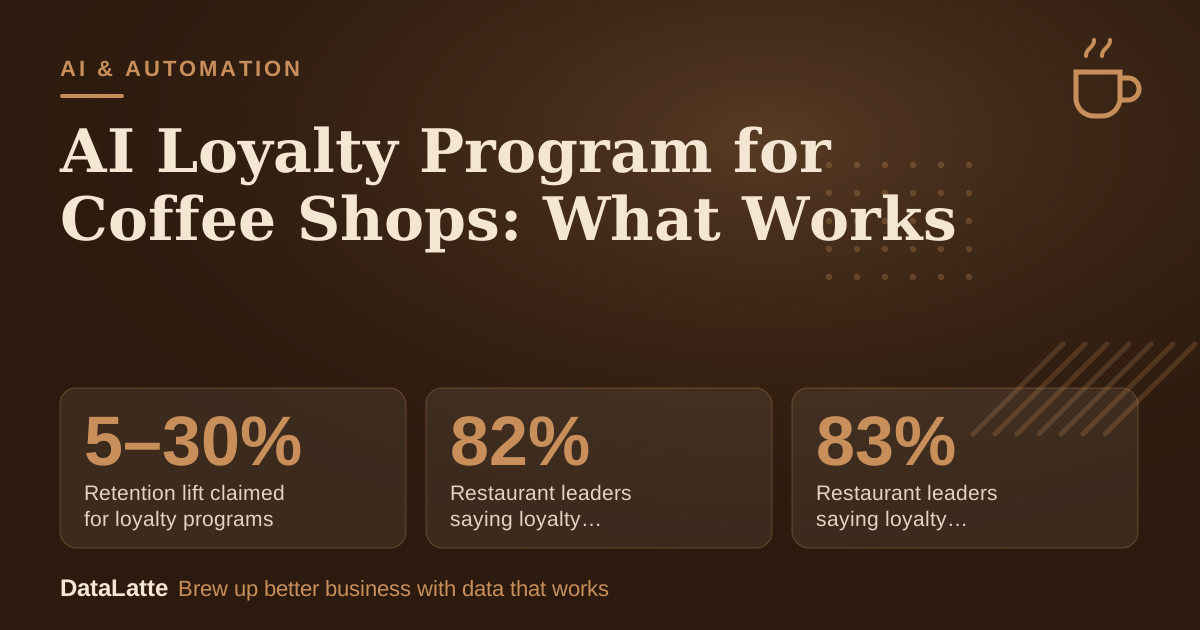
Retention lift claimed for loyalty programs
Winback Engine vendor claim (secondary)
↑
Restaurant leaders saying loyalty drives repeat visits
Square Future of Restaurants 2025 report
↑
Restaurant leaders saying loyalty boosts order size
Square Future of Restaurants 2025 report
→
Monthly budget suggested for most small businesses
CostBench 2026 (secondary)
See Sources at the end of the article. Cards marked Assumption are examples, not results.
What Does an AI Loyalty Program Actually Do?
In practice it does three jobs. It recognises returning customers, groups them by what they buy, and chooses an offer for each group. A small shop can run a manual version of all three using the reports its point-of-sale system already produces.
The case for personalised offers rests partly on customer expectations.
The Restaurant HQ states that more than 70% of consumers crave personalization from the brands they support, citing McKinsey (secondary).
Square's 2025 survey of restaurant leaders is more specific to loyalty. Per
Square's cafe marketing guide, 82% of those leaders say their program drives repeat visits and 83% say it boosts order size. These are self-reported views from restaurant operators, not coffee-only results, so treat them as direction rather than proof. For the broader approach, see
AI-driven customer retention strategies.
Which Loyalty Structure Should a Coffee Shop Start With?
Start with the simplest structure your POS supports.
Square Loyalty lets you choose whether customers earn points by visits, by amount spent, or by items or categories purchased. A visit-based scheme is easiest to explain at the counter.
Tiers add a second layer. Square's VIP example gives Bronze customers 1.5x points, Silver 2x and Gold 3x. A shop could start with one tier and add more only once it can see which guests keep coming back.
Rewards can be simple too.
The Small Business Expo suggests rewards after every fifth visit, and T2's Tea Society includes a free birthday brew as a member benefit, according to
a local marketing guide (secondary). For low-tech options that need no app, read
coffee shop loyalty program ideas without an app.
Which Simple Rules Can Stand In for AI?
Three rules cover most of what a small cafe needs. Each can be run from a spreadsheet export or a standard POS report. Treat them as suggestions to test, not proven results.
The first is a lapsed-guest rule. Filter for members whose last visit was more than a set number of weeks ago, then send a small offer. The second is a usual-order rule. Find the item each member buys most often and offer a free upgrade on it. The third is a slow-daypart rule, which gives bonus points for purchases in your quietest hours.
Review each rule after a month. Keep it only if redemptions rise and the discount does not wipe out the margin on the drinks involved.
How Much Does Loyalty Software Cost?
Prices change, so check each vendor's live pricing page before you commit.
CostBench's 2026 category listing counts 16 loyalty products. Monthly prices run from $0 to $999 across 12 priced tools, the median is $207 per month, and only 2 of the 16 offer free tiers for small teams or limited use.
Some named examples from the same listings: Marsello is listed at $60–$120 per month, Smile.io at $199–$999, and Yotpo Loyalty has a free plan with paid plans at $89–$169 per user per month.
CostBench's small business guide recommends budgeting $50–$150 per month for most small businesses.
Square Loyalty offers a free trial lasting 30 days, and Square says the built-in CRM tools it integrates with are free. Enterprise platforms sit well above a single cafe's budget.
Loop's pricing article cites a full destination platform from $5,000 per year, according to the vendor's own pricing page (secondary).
Is a Lapsed-Guest Offer Worth It?
The table below is a worked example. Every input is an assumption for one shop, not a benchmark. The member count, redemption rate and labour figures echo an illustrative cafe model in Loop's article, which the article says is not a typical result.
| Line | Assumption or calculation | Monthly amount |
|---|
| Members in database | Assumption: 300 | Not a cost |
| Redemptions | Assumption: 10% of members, so 30 | Not a cost |
| Free reward cost | 30 redemptions x $2 marginal cost (assumption) | $60 |
| Staff administration | 2 hours x $25 per hour (assumption) | $50 |
| Loyalty software | Assumption: $50, the low end of the $50–$150 budget range | $50 |
| Total monthly cost | Sum of the three costs above | $160 |
| Extra spend per redeemer | Assumption: $8 beyond the free drink | Not a cost |
| Extra revenue | 30 redemptions x $8 (assumption) | $240 |
| Net gain | $240 minus $160 | $80 |
The offer breaks even at about $5.33 of extra spend per redeemer ($160 divided by 30). If only 15 guests redeem, which is 5% of 300 (assumption), costs stay at $130 while extra revenue falls to $120, a net loss of $10. Measure your real redemption rate for at least a month before you scale an offer.
Where Does the Google Profile Fit?
A loyalty program brings guests back, but new guests find you on Google first.
Per Diem's coffee shop guide recommends answering common questions in the profile's Q&A section before customers ask, such as whether you offer free Wi-Fi, dairy-free options or dogs on the patio (secondary).
BrewRound's 2020 guide says creating a listing is free and needs a free Google account. Google verifies a location by mailing a letter with a code, and the profile does not appear in results until verified. A business can select only one category at first and add more later (secondary, dated 2020, so confirm current steps on Google's help pages). For the local search side, see
coffee shops that dominate Google Maps.
Answers to repeat questions also cut the volume of messages your staff handle. For a fuller approach, read
AI-driven customer service for local coffee shops.
How Should You Handle Customer Data at Sign-Up?
Tell guests what you collect and why, at the moment they join. Use their details only for the loyalty rewards and messages they signed up for. Avoid adding them to unrelated lists without a separate opt-in.
Privacy rules differ between US states, the UK, Australia and Canada. Check the guidance your local regulator publishes, and ask an adviser if you collect data from customers outside your own country. Clear notice at sign-up is the simplest habit to build early.
FAQ
Do I need AI to run a coffee shop loyalty program?
No. A visit-based or points program tied to a phone number or email already records what each customer buys. Simple rules, such as a lapsed-guest offer, can approximate the grouping and offer selection that AI tools automate.
How much should a small coffee shop budget for loyalty software?
CostBench recommends $50–$150 per month for most small businesses. Prices change, so check each vendor's current pricing before you sign up.
Does Square Loyalty offer a free trial?
Yes. Square Loyalty offers a free trial lasting 30 days, according to its product page.
Can a loyalty program really raise retention?
A vendor claims loyalty programs can increase retention by 5–30%, but that range is not controlled evidence for coffee shops. Run a test with a comparison group of guests before deciding the program works for you.
Sources
Want a second opinion on your loyalty setup and Google profile?
Book a free audit.
Free for local businesses
Want this applied to your business?
I'll review your Google presence, local SEO, and ad accounts — and send you a specific action plan within 48 hours. No pitch, no pressure.