June 30, 2026·Nataliia Rumiantsewa· 7 min read All posts
CTV advertising in India means buying video ads that run inside streaming apps on connected TVs. For a small business, the practical first step is a small, measured test with a fixed monthly budget and a clear success measure. The sources behind this guide do not include India-specific CTV prices, household reach, or regulatory rules, so none are quoted here. They do include Google's Display Network reach and US benchmark averages for display click-through rate and cost per click. Use those figures to frame expectations, then get local CPM quotes from each platform before committing budget.
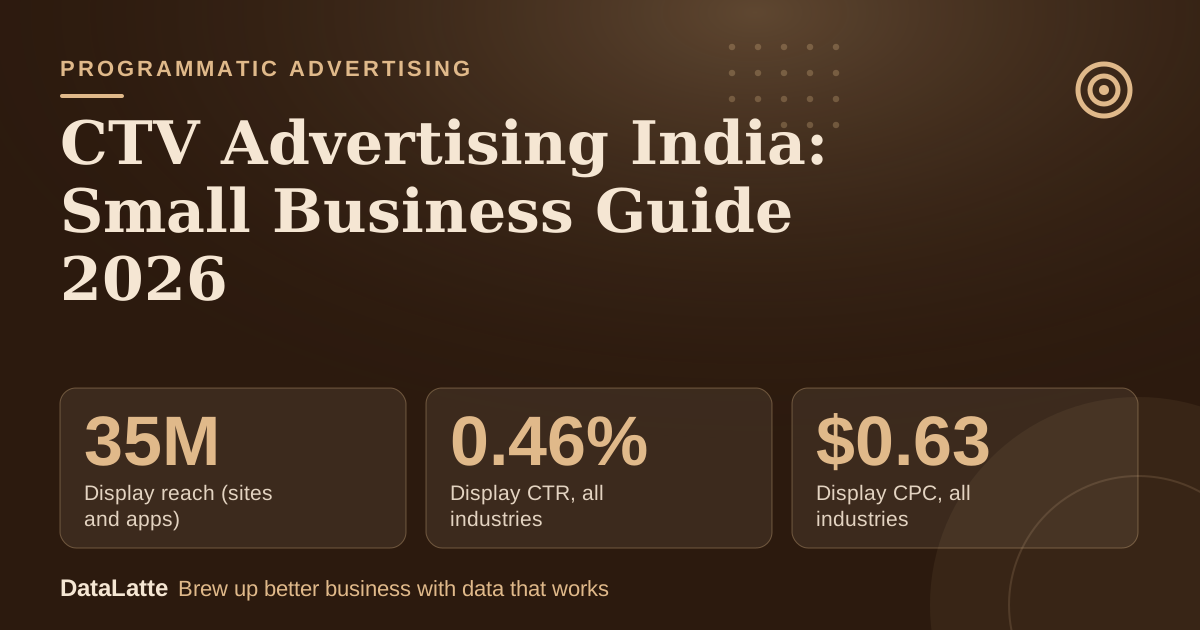
35M→
Display reach (sites and apps)
Google Display Network, primary source
0.46%→
Display CTR, all industries
US WordStream average, secondary and dated
$0.63→
Display CPC, all industries
US WordStream average, secondary and dated
3.17%→
Search CTR, all industries
US WordStream average, secondary and dated
See Sources at the end of the article. Cards marked Assumption are examples, not results.
How should a small business set a CTV test budget in India?
A worked example makes the budget logic visible. Every input in the table below is an assumption, not a benchmark. Replace them with real quotes from the platform you plan to use before you approve spend.
The calculation is simple. Divide the monthly budget by the CPM, which is the cost per thousand impressions, then multiply by 1,000 to get total impressions. Divide impressions by the average number of views per household to estimate reach.
Scenario
Monthly budget (assumption)
CPM (assumption)
Impressions
Households at 3 views (assumption)
Base quote
₹50,000
₹200
250,000
About 83,000
Higher quote
₹50,000
₹300
About 167,000
About 56,000
The gap between the two rows is the reason to start with a quoted CPM rather than a guess. A 50 percent rise in CPM cuts impressions by a third for the same money. Run the test for 4 to 6 weeks, then compare cost per visit or enquiry against your existing channels.
What do the Google Display benchmarks actually measure?
Google describes the Display Network as reaching people across 35 million websites and apps, plus Google-owned properties such as YouTube and Gmail, using visual ads (Google Ads Help, primary). Display ads are click-based placements, so a click-through rate and a cost per click describe what happens when someone clicks an ad.
CTV ads are usually bought per thousand impressions, which is a different unit. The 0.46% display CTR and $0.63 display CPC come from WordStream, a marketing firm that compiled averages from its client accounts (WordStream, secondary). These are US figures and the page is dated, so treat them as a rough reference point.
Their main use is a sanity check. If a CTV pitch promises click-through rates far above display averages, ask how the number was measured and whether it counts views, clicks, or site visits.
Which CTV platforms should a small business test first?
The sources for this article do not compare individual Indian streaming platforms, so this guide does not rank them. Instead, request each platform's current rate card, minimum spend, and audience reporting, then place the quotes side by side. The checklist below turns that comparison into a repeatable step.
Request the current CPM, minimum commitment, and test-campaign terms in writing.
Confirm which geographic targets are available, such as city, state, or language.
Ask whether the platform reports completed views, not only impressions.
Ask for a reporting sample so you can see the fields before you buy.
Score each quote against your monthly test budget using the table method above.
Pick one platform for the first test and keep a second quote as a fallback.
Free ad-supported inventory is often the cheapest way to learn whether the channel works, but cheaper impressions can mean weaker audience quality. Judge each platform on the leads it produces, not on impression count alone.
How should a local CTV campaign target and bid?
Google's display campaigns use optimized targeting by default. It uses information such as keywords on your landing page to find audiences likely to convert (Google Ads Help, primary). That feature belongs to Google's product, but the principle carries over: match the audience to the page they land on, and keep that page relevant to the ad.
Google also lets advertisers pay for conversions instead of clicks on Target CPA display campaigns (Google Ads Help, primary). Where a CTV platform offers a similar conversion-based option, test it only after you have enough conversions to measure. Bidding systems need data to learn, and a thin data set can make results erratic.
For a comparable market with its own local rules, the Canada CTV guide covers how local targeting works on connected TV. For a different format suited to local awareness, read the native advertising guide for small businesses. If you want to see how another national market approaches the channel, the Germany CTV guide is a useful contrast.
What compliance checks come before launch?
Before launch, confirm the current advertising rules that apply in India with the relevant regulator, and read the platform's ad policies. The sources for this article do not describe those rules, so none are summarised here. Pay particular attention to health claims, pricing statements, and offer language, because platforms reject creative that breaks their policies.
Keep a record of each approved creative version and the dates it ran. If a platform rejects an ad, the record shows what changed and why. That record also helps you compare results across creative versions during the test.
Do CTV and search work together?
CTV is best judged as an awareness layer, with search capturing people who are already looking. Keep your search budget running while the CTV test is live so you can compare the two channels over the same weeks. The US search CTR benchmark of 3.17% across industries is one reference point for search performance, drawn from the same secondary WordStream data (WordStream, secondary).
A simple check is whether branded search volume or direct visits rise in the areas where the TV ads ran. If they do, the CTV layer is supporting search. If they do not, the creative or targeting needs review before more budget goes in.
If you want help setting up that measurement, DataLatte's Google Ads service covers campaign structure and conversion tracking for local businesses.
FAQ
How much does CTV advertising cost in India?
The sources for this article do not include India CTV prices. Request current CPM quotes from each platform and use them in your budget calculation. The worked example uses an assumed ₹200 CPM only to show the arithmetic.
Is CTV advertising the same as display advertising?
No. Display ads are usually click-based placements on websites and apps, while CTV ads run on television screens and are typically bought per thousand impressions. The Google Display benchmarks in this article are a reference for display performance, not for CTV.
How long should a small business run a CTV test?
A 4 to 6 week test gives enough time to compare results against other channels. Set a fixed budget and a clear measure, such as enquiries or bookings, before the campaign starts.
Should I keep Google Ads running during a CTV campaign?
Many local businesses keep search running while testing CTV so they can compare the two over the same period. Google Ads provides conversion tracking, which makes that comparison easier to measure.
Local marketing strategist with 10+ years at global agencies — OMD, Dentsu, GroupM, and BBDO. Now helping small businesses get the same data-driven edge. Based in Europe, working with clients in the US, UK, Australia, and beyond.