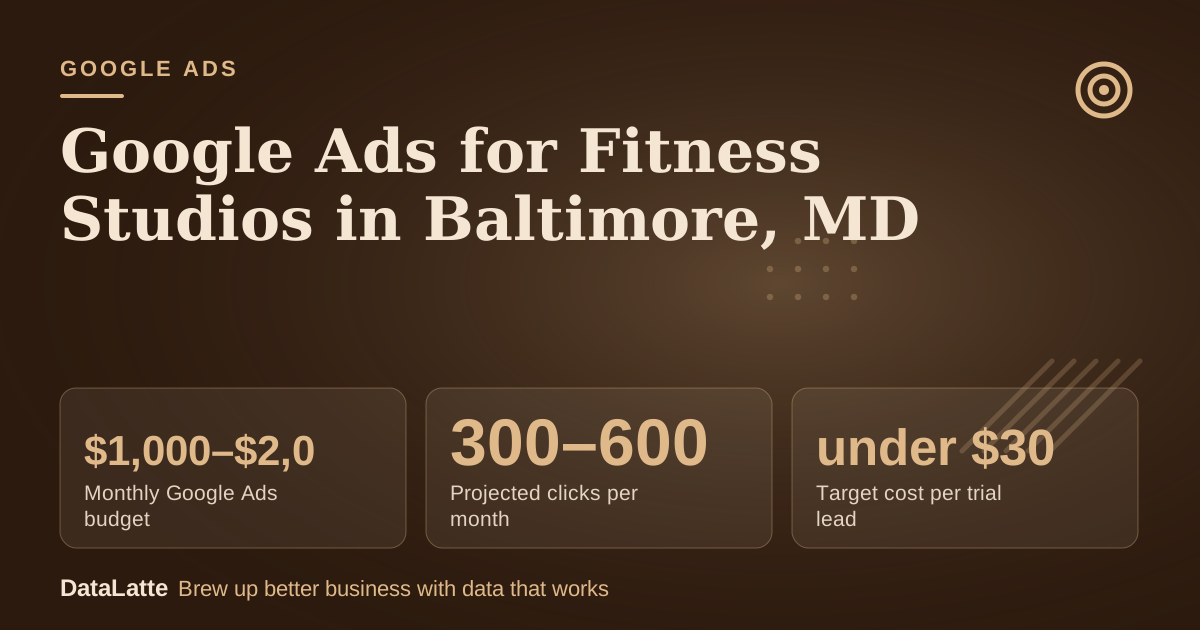
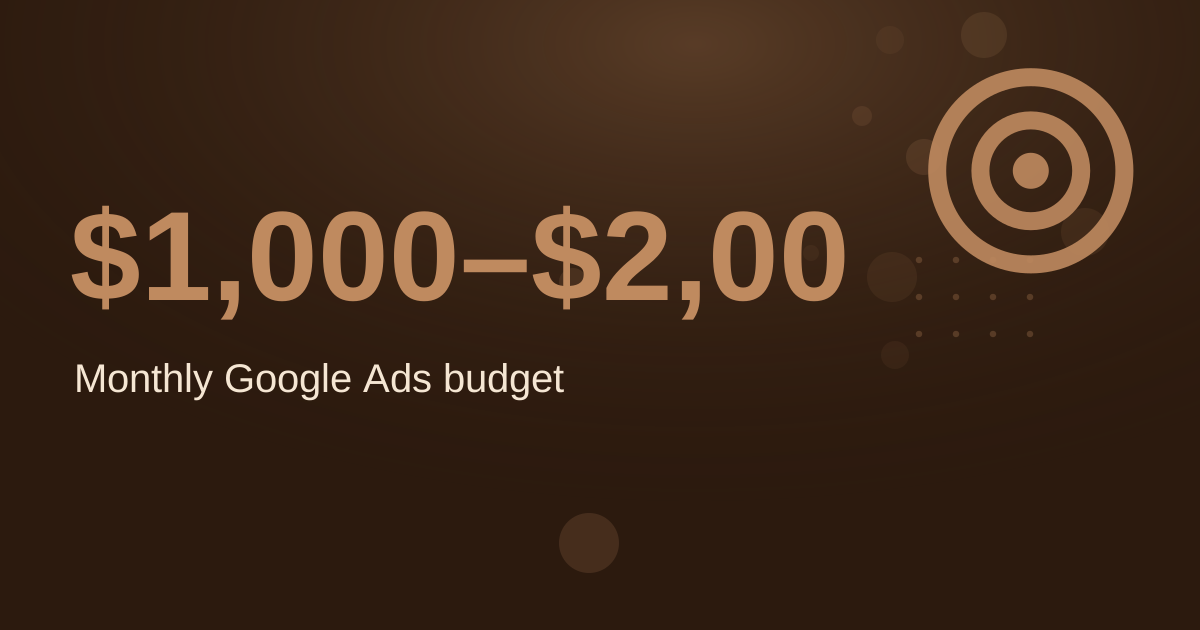
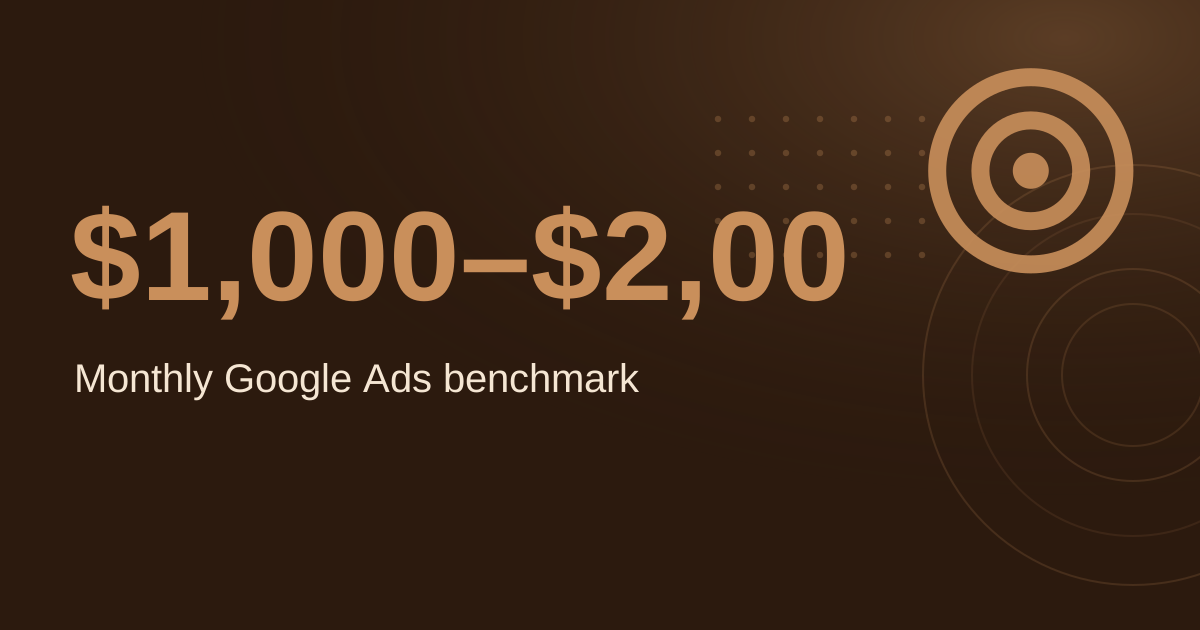
A fitness studio in Baltimore can run a well-optimized Google Ads campaign on roughly $1,000 to $2,000 a month, according to the benchmark in
Vertical Impression's fitness marketing guide (secondary). The same guide puts a small independent studio with under 200 members at $600 to $1,200 a month, and a mid-size gym with 200 to 600 members at $1,500 to $2,500. The right figure depends on how many trial sign-ups you need and what each one is worth to you. This guide covers how to set that budget, which keywords to start with, and how to measure whether the spend pays off.
→
Monthly Google Ads budget
Well-optimized campaign
↑
Projected clicks per month
At the $1,000–$2,000 budget
↓
Target cost per trial lead
Vertical Impression target
→
Small studio Google Ads budget
Studio under 200 members
See Sources at the end of the article. Cards marked Assumption are examples, not results.
How much should a Baltimore studio budget for Google Ads?
Budget depends mostly on studio size. The benchmarks below come from one published guide, so treat them as starting points rather than fixed rules. A small studio testing its first campaign can begin near the bottom of its range and raise spend only after it sees which keywords produce trial sign-ups.
| Studio size | Google Ads benchmark per month |
|---|
| Small independent studio (under 200 members) | $600–$1,200 |
| Mid-size gym (200–600 members) | $1,500–$2,500 |
| Well-optimized fitness campaign (general) | $1,000–$2,000 |
The guide projects that a well-optimized campaign in the $1,000 to $2,000 range can generate 300 to 600 clicks, with 3% to 6% of those clicks converting to trial sign-ups. Those are projections, not guarantees, so measure your own numbers from the first month.
What does a $1,200 monthly budget buy in practice?
A worked example makes the math concrete. The inputs below are assumptions for a hypothetical Baltimore studio, except where a source is named. Change them to match your own account once you have real data.
| Input | Value | Source of figure |
|---|
| Monthly Google Ads budget | $1,200 | Assumption, inside the small-studio range |
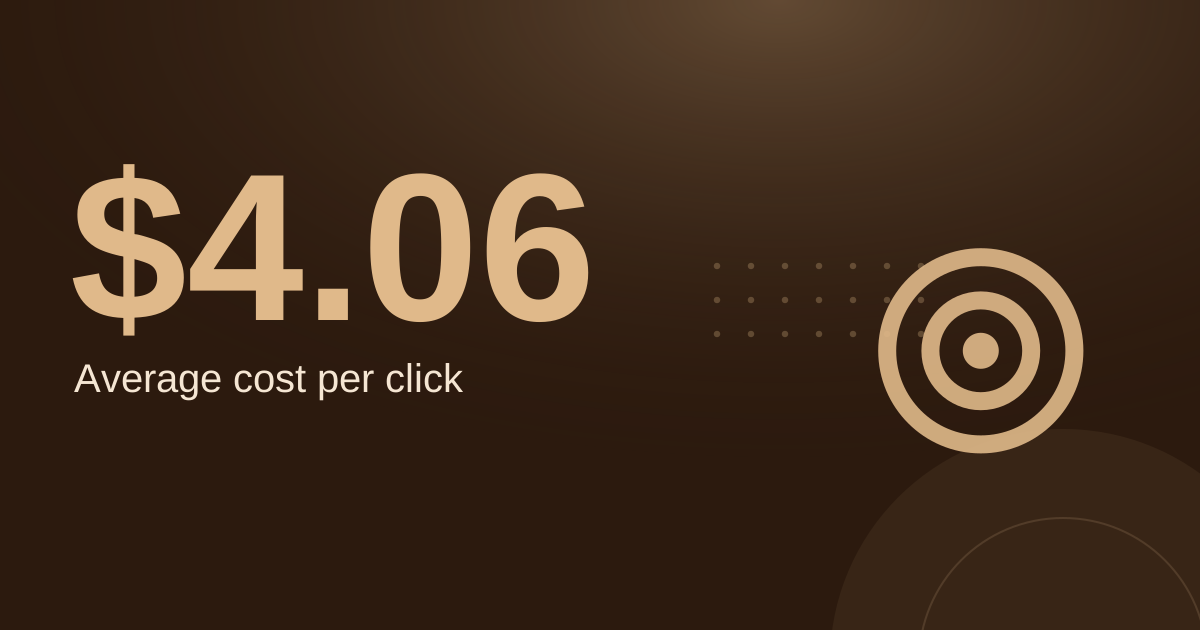
| Average cost per click | $4.00 | Assumption, not from a source |
| Click-to-trial sign-up rate | 3% to 6% | Range from Vertical Impression |
| Trial sign-up to paid member | 25% | Assumption |
At $4.00 per click, $1,200 buys about 300 clicks. A 3% to 6% sign-up rate produces 9 to 18 trial sign-ups. That works out to a cost per trial lead of about $67 to $133. The guide's target is under $30 per trial lead, so this assumed setup falls well short of that target.
To hit $30 per trial lead on the same budget, you would need 40 sign-ups from 300 clicks, a rate of about 13%. That is far above the guide's 3% to 6% range. The practical step is to tighten keywords and landing pages before raising spend. At the assumed 25% trial-to-member rate, 9 to 18 sign-ups yield 2 to 4.5 members, a cost per member of roughly $267 to $533. The guide's target is $150 to $200, so the gap is real and worth measuring before you commit to a longer contract.
Which keywords should a Baltimore studio bid on first?
Start with a small set of exact-match terms that show clear intent to book a class. Searches like "gym near me" or "yoga classes near me" come from people who already want the service and are comparing nearby options. Those searches usually convert better than broad discovery terms, so they belong at the top of the account.
| Keyword group | Example phrases | Why it fits |
|---|
| Near-me class searches | "gym near me", "yoga classes near me" | Shows immediate booking intent |
| Studio plus city | "fitness studio Baltimore", "personal trainer Baltimore" | Matches local service searches |
| Neighbourhood variants | Names your members actually use | Captures local phrasing |
Add negative keywords early. Terms such as "jobs", "career", "how to", "certification" and "franchise" tend to attract clicks from people who will never book. Review the search terms report every week during the first month and add new exclusions as they appear.
Why do Google reviews and the Business Profile matter for paid results?
Paid ads and organic local search work on the same surface. The Association of Fitness Studios describes Google Business Profile as a free tool that shows business hours, phone numbers, addresses, reviews and photos directly in search results. It also notes that the Google Map Pack lists relevant local businesses for queries such as "personal training studios near me" (published May 10, 2024).
Reviews take time to matter. Mariana Tek states that Google review volume can start influencing visibility within a few weeks, while its table lists a 6 to 12 month typical payoff timeline for local SEO and Google reviews (secondary). Ads can produce clicks in days, but the review base you build now will shape your results for much longer.
Before scaling spend, make sure your profile is complete. The
Google Business Profile optimization guide for fitness studios covers the fields to check. For the wider organic picture in Baltimore, see the
local SEO guide for fitness studios in Baltimore.
How much of your marketing should go to ads?
Mariana Tek notes that many boutique studios budget between 5% and 10% of monthly revenue for marketing overall (secondary). That figure covers all marketing, not Google Ads alone, so ads are one line within it.
Worked example with an assumption: if a studio earns $20,000 a month in revenue (assumption), 5% to 10% gives a total marketing budget of $1,000 to $2,000. Google Ads would take a share of that, and the rest would go to other channels such as email, social content and listings.
Ads send people to your site, but many leads need follow-up. Mariana Tek advises following up with pop-up contacts within 24 hours using an automated welcome sequence, because interest fades fast after a pop-up ends (secondary). The
email marketing guide for fitness studios covers how to set up that sequence.
How do you track whether Google Ads is paying off?
Set up tracking before the first click. Without it, you cannot tell which keywords produce trial sign-ups and which ones only produce spend. Use this order:
- Record trial sign-ups and booking form completions as primary conversions.
- Add a call tracking number to ads and to your Google Business Profile so phone bookings are captured.
- Track direction requests from the Business Profile as a secondary signal.
- Log "book now" and contact page clicks as micro-conversions.
- Divide monthly spend by trial sign-ups each month and compare it with the under $30 target. Then divide by new members and compare with the $150 to $200 target.
Review these numbers at 30 days and again at 60 days. The first month tells you which keywords to pause. Judge the campaign on at least two months of data before deciding whether the budget is right. For a broader view of how automation can handle follow-up and reporting, see the
marketing automation guide for local fitness studios.
If you want help building the campaign structure and tracking setup,
Google Ads management for fitness studios covers that work.
FAQ
How much should a fitness studio in Baltimore spend on Google Ads?
The benchmark from Vertical Impression puts a well-optimized campaign at $1,000 to $2,000 a month. A small independent studio with under 200 members falls in the $600 to $1,200 range, and a mid-size gym with 200 to 600 members in the $1,500 to $2,500 range. Start at the low end of your range and raise spend only after tracking shows trial sign-ups at a sustainable cost.
Can a small studio start with less than $1,000 a month?
The small-studio benchmark begins at $600 a month. At that level, the campaign can test a few exact-match keywords and a single landing page. Expect fewer clicks and fewer trial sign-ups, so the first two months are mainly about learning which searches convert.
What is a good cost per trial lead for fitness Google Ads?
Vertical Impression sets a target of under $30 per trial lead and under $150 to $200 per converting member. The worked example above shows that a $1,200 budget with a $4.00 assumed click cost can land well above $30 per lead, so the target is a goal to work toward, not a starting result.
Do I need a Google Business Profile before running ads?
The ads and the profile reinforce each other. The profile shows your hours, phone number, reviews and photos in search results, and reviews build over months. Complete the profile before scaling spend so people who click through see a credible listing.
Sources
Free for local businesses
Want this applied to your business?
I'll review your Google presence, local SEO, and ad accounts — and send you a specific action plan within 48 hours. No pitch, no pressure.