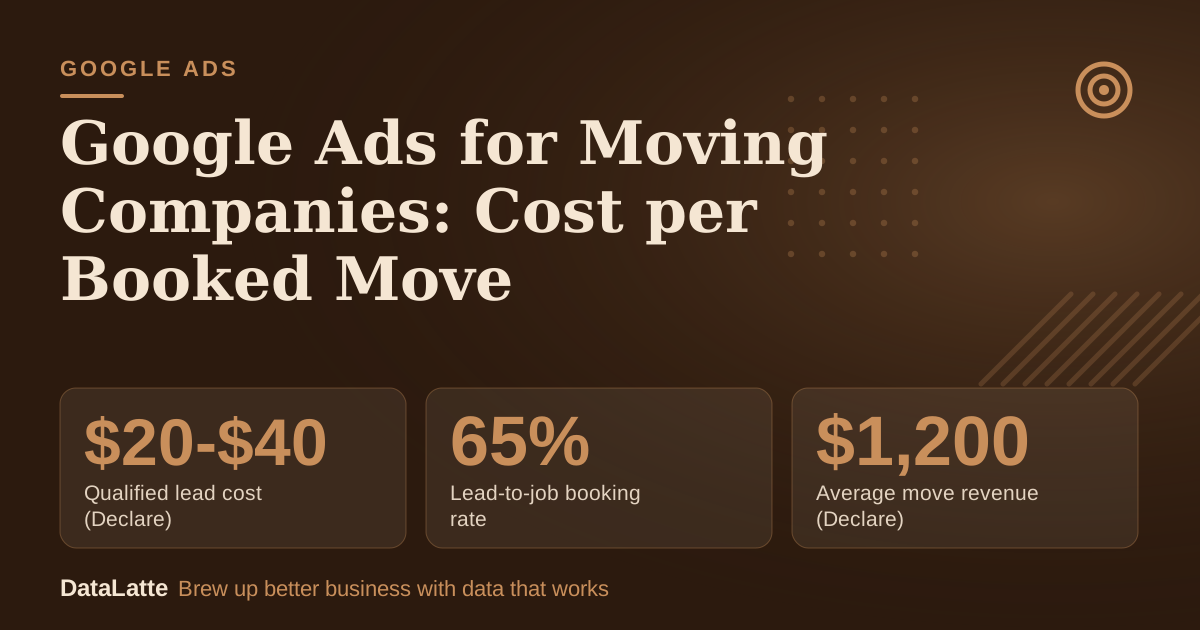
A booked move costs about $46 in Google Ads when a $30 cost per lead meets a 65% booking rate. Those inputs come from Declare Media, a Google Ads agency for movers, which puts a qualified moving lead at $20 to $40 and says it books about 65% of leads into paying jobs. Whether $46 is cheap depends on what one move leaves after crew, fuel and truck costs. This guide shows how to work out that figure for a specific business, which searches signal a ready buyer, and where campaigns usually leak money.
What Does a Booked Move Cost in Google Ads?
The formula is simple: cost per booked move equals cost per lead divided by booking rate. Declare Media's example uses 10 leads at about $30 each, which is $300 of spend. At a 65% booking rate, those leads turn into roughly six or seven paying moves. The agency values an average move at $1,200 and calls that conservative, citing a Forbes estimate of about $1,400 (
Declare Media, secondary).
The useful part is the ratio, not the revenue figure. If each move brings in $1,200 and costs $46 in ads, advertising is a small share of revenue. The real question is what the move keeps after operating costs, and that number changes the answer completely.
Declare Media also shares a California mover's results. The campaign spent about $3,000 a month, generated 651 leads at $36.35 each, and closed roughly 65% of them, which the agency puts at about 423 jobs from $23,664 in spend. It estimates an average move of $1,100 in that market. These figures are a vendor's account, not audited data, so treat them as one example.
The same numbers show the spread between cost and return. Ad spend was about 5% of the revenue the agency attributes to it, or roughly $56 per booked job. Ratios will differ by city, season and fleet size, so the test is whether the booked-move cost stays below profit per move.
What Does Break-Even Look Like for a Local Mover?
The table below uses sourced figures where they exist and labels everything else as an assumption. Replace the assumptions with real numbers before committing budget.
| Input or result | Low cost | Base | Weak booking |
|---|
| Cost per lead | $20 (Declare low end) | $30 (midpoint of $20 to $40) | $40 (Declare high end) |
| Booking rate | 65% (Declare) | 65% (Declare) | 30% (assumption) |
| Cost per booked move | $31 | $46 | $133 |
| Average move revenue | $1,200 (Declare) | $1,200 (Declare) | $1,200 (Declare) |
| Gross profit per move | $360 (assumption: 30% margin) | $360 (assumption) | $360 (assumption) |
| Break-even cost per lead | $234 | $234 | $108 |
Gross profit per move is what remains after crew wages, fuel and truck costs, before ads. The 30% margin is a placeholder. Break-even cost per lead is gross profit per move multiplied by booking rate. At 65% booking, a mover with $360 profit per move can pay up to $234 per lead before the ads lose money. At 30% booking, the ceiling drops to $108, and the weak-booking column is where a campaign can look busy and still lose money.
Which Search Terms Signal a Ready-to-Book Customer?
A moving search is not a single intent. Someone typing "moving company near me" is usually close to booking, while a search for "moving company" can come from people comparing prices or looking for jobs. CE Paid Ads lists "moving company near me" at 900 monthly searches with an estimated CPC of £6.00, and "moving company" at 1,700 searches with £5.00 (
CE Paid Ads, secondary, Ahrefs data in pounds).
Narrow terms cost more per click but often carry more intent. "Office moving company" shows 150 searches at £16.00 in the same dataset. Treat that as a signal to test, not a rule, since the higher price may still be worth paying if office moves carry the best margin. Build ad groups around local, property-type, urgent and long-distance intent, and keep broad "moving company" terms in a separate test.
How Does Quality Score Change What You Pay?
Quality Score is a diagnostic from 1 to 10 that Google calculates at keyword level. It combines three parts: expected click-through rate, ad relevance, and landing page experience. Each is rated "Above average," "Average" or "Below average," based on advertisers showing for the same search over the last 90 days (
Google Ads Help, primary).
Google states that Quality Score is not an input in the ad auction. It is a diagnostic, not a bidding rule. For a mover, the practical lesson is to send each ad group to a page that repeats its search. A "piano movers" ad should land on a piano movers page, not a generic homepage. Better relevance gives a clearer read on which keywords deserve more budget.
→
Qualified lead cost (Declare)
Declare Media (secondary)
→
Lead-to-job booking rate
Declare Media (secondary)
Assumption→
Average move revenue (Declare)
Declare Media, cites Forbes estimate of about $1,400 (secondary)
→
Quality Score comparison window
Google Ads Help (primary)
See Sources at the end of the article. Cards marked Assumption are examples, not results.
How Should a Moving Campaign Be Set Up?
Google's guidance for a lead-focused account starts with the goal. Set the campaign objective to leads so Google optimises for what matters, which for a mover is a booked job rather than a page view (
CE Paid Ads, secondary). Search campaigns fit this business because people actively searching for local movers are already in the process of moving.
Use ad extensions to show the phone number, location and a link to the quote page, so a customer can act without hunting. Check click-through rates and call volume weekly. If a different format is under consideration, compare the trade-offs in
Google Local Services Ads: a complete guide or
Google Ads vs Facebook Ads for local business before committing the whole budget.
What Should You Track Each Week?
Track cost per booked move, not just cost per lead. The ad platform counts leads, but only a booking log shows which leads turned into jobs and what each job earned. Keep the log simple and review it on the same day each week.
- Log each lead with its source campaign, quoted price, booked yes or no, and final job profit.
- Compare cost per booked move for local and long-distance work separately.
- Pause keywords that spend well beyond the break-even cost per lead with no bookings.
- Add negative keywords from the search terms report, such as job-seeker and truck-rental queries.
- Check whether leads are answered quickly, because a slow reply can lower the booking rate more than a bid change.
If a lead sits unanswered, the booking rate in the model drops. Improving follow-up is often cheaper than paying for more clicks. For ideas on capturing contact details before the first call, see
lead magnet ideas for local business.
FAQ
How much should a moving company spend on Google Ads?
Start from break-even. Declare Media's worked example reaches a booked move at $46 when a lead costs $30 and 65% of leads book. Spend only where cost per booked move stays under profit per move, and scale slowly from there.
What is a good cost per lead for movers?
The Declare Media range is $20 to $40 per qualified lead, which is a vendor claim. A good cost per lead is any figure below break-even: gross profit per move multiplied by booking rate. A $360 profit per move at 65% booking supports up to $234 per lead.
Does Quality Score affect what you pay per click?
Quality Score is a diagnostic, and Google says it is not an input in the ad auction. It does show whether ads, keywords and landing pages are relevant. Weak ratings are a prompt to improve the page and match keywords to the offer.
Should a moving business add schema markup?
Schema markup can help search visibility, but it does not replace paid search. For how local business markup works, see
local business schema markup for rich snippets.
Sources
Want a mover campaign built around booked moves rather than raw clicks? See the
Google Ads service or
book a free audit.
Free for local businesses
Want this applied to your business?
I'll review your Google presence, local SEO, and ad accounts — and send you a specific action plan within 48 hours. No pitch, no pressure.