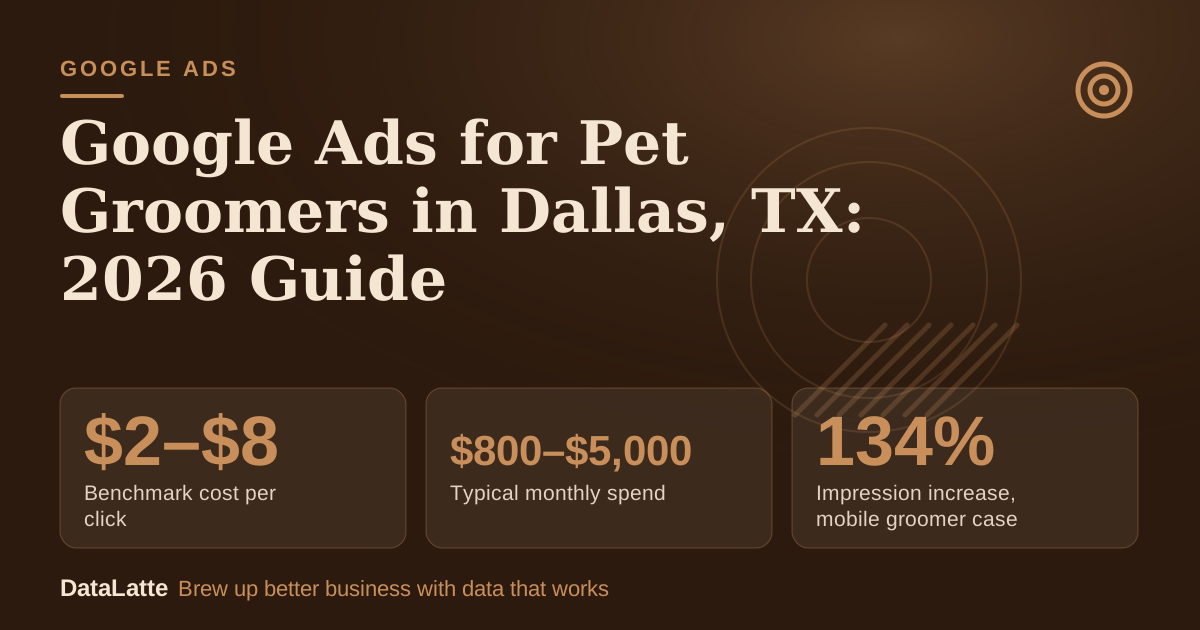
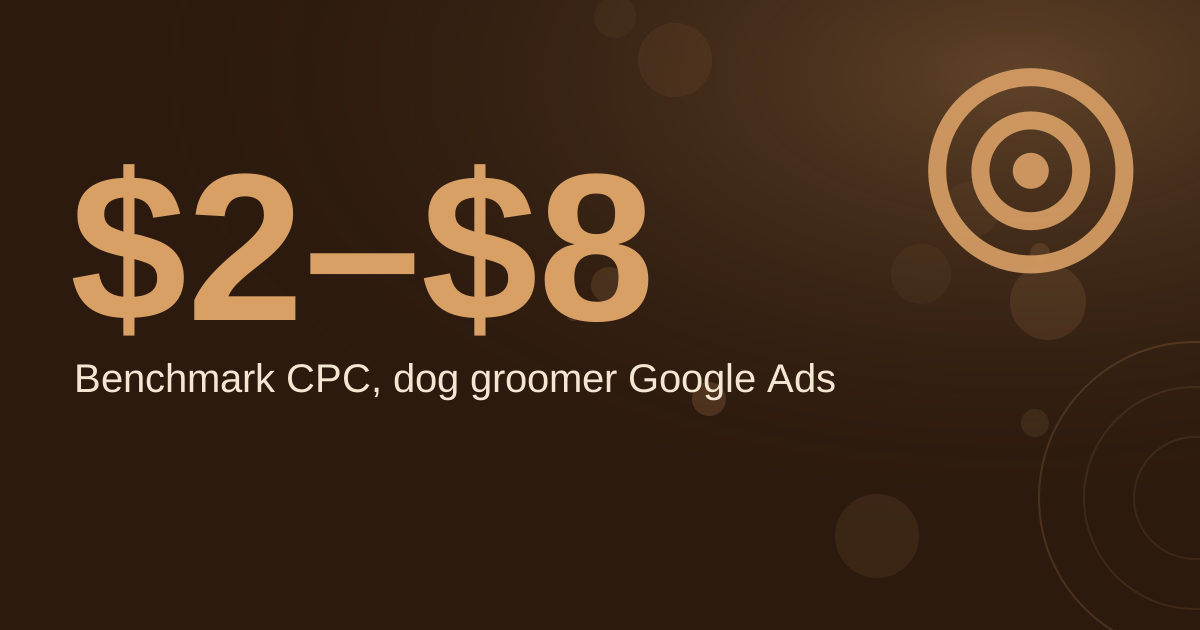
A Dallas pet groomer should size a Google Ads budget by the number of bookings it needs, not by a national average. Vendor benchmarks put dog groomer clicks at
$2–$8 each, and most advertisers spend about $800–$5,000 a month. Bid on high-intent searches such as "dog groomer near me", track booked appointments as the main conversion, and keep the service area tight. The figures below are national benchmarks, not a Dallas-only price, so check your own account data before scaling.
→
Benchmark cost per click
Dog groomer keywords, vendor benchmark
→
Typical monthly spend
Most advertisers, vendor page
↑
Impression increase, mobile groomer case
vs previous 6 months, as of 2023
↑
Click increase, same case
vs previous 6 months, as of 2023, agency case study
See Sources at the end of the article. Cards marked Assumption are examples, not results.
What does a click cost for a Dallas pet groomer?
The main cost input is the cost per click.
AdTurbo's dog groomer page gives a benchmark of $2–$8 per click, and warns that "a few wasted clicks add up fast." That range is wide, so a groomer should test which keywords sit at the lower end of it in their own account before committing a fixed budget.
Spend levels matter as much as click prices. The same vendor says most dog groomer advertisers spend around $800–$5,000 a month, which gives a sense of what competitors commit to, but not what any single Dallas business needs.
A
Marketing 360 case study of a mobile pet groomer reports a 134% rise in impressions and a 696% rise in clicks compared with the prior six months. The study ran on Facebook and Google, and it dates from 2023. Read the full page before treating those percentages as targets, because they describe one business in one period.
Which keywords should a Dallas groomer bid on first?
Start with the searches that show a booking intent. The AdTurbo page lists three terms worth bidding on for dog groomers: "dog groomer near me", "dog grooming near me", and "puppy grooming near me". These are close to the decision point, because the searcher already wants a groomer and is comparing nearby options.
Add a Dallas-specific variant such as "pet grooming Dallas" as a test term alongside them. Keep the first campaign small, with exact or phrase match on the near-me terms. Expand to broader variants only after the search term report shows that the terms convert into bookings.
Use neighbourhood names in ad copy only where they match your service area. A mobile groomer covering Northeast Dallas, for example, should name that area, while a salon in one district should not promise coverage across the whole metro.
How do you check whether a booking covers its ad cost?
Work backwards from the booking value before raising spend. The inputs below are assumptions, so replace each one with your own tracked figures.
| Input | Value | Source of figure |
|---|
| Monthly budget | $1,000 | assumption |
| Cost per click | $5 | assumption, inside the $2–$8 benchmark |
| Click-to-booking rate | 5% | assumption |
| Average booking value | $90 | assumption |
At these inputs, $1,000 buys 200 clicks (1,000 ÷ 5). Five percent of 200 clicks gives 10 bookings. The cost per booking is $100 ($1,000 ÷ 10), which is above the $90 value, so the return is $900 on $1,000 spend, or 0.9 times the budget.
If the click-to-booking rate rises to 7% through a tighter landing page or clearer booking button, the same budget produces 14 bookings. The cost per booking falls to about $71, and revenue reaches $1,260, a return of 1.26 times. The rate is the lever to test first, because it changes the result without raising the budget.
When should a Dallas groomer raise the budget?
Seasonality changes how much capacity you have.
AdWave's summary of Groomer to Groomer notes that November and December are traditionally a very busy time for groomers, "sometimes too busy." Check your diary and waiting list before increasing spend in those months, because extra clicks are wasted if no slot is free to fill.
If capacity is not the limit, scale in steps and review after each change. For a broader comparison of paid formats, see
Google Local Services Ads for pet groomers, which work differently from standard search campaigns.
How tight should the targeting radius be?
A
Barklead guide on Facebook ads for groomers suggests targeting users within a 10–15 mile radius of the groomer's location. That is a Facebook recommendation, not a Google setting, but it gives a practical starting radius to test against your own booking distances.
Radius targeting is more useful than a whole-city setting when the business is fixed-location. Check where booked clients actually live, then set the radius to cover that spread and no more. Mobile services should align the radius with the area they will drive to on a normal day.
Which negative keywords and booking rules matter?
Negative keywords stop spend on searches that will never book. Common exclusions include job-related terms such as "jobs", "hiring", and "salary", DIY terms such as "how to" and "course", and terms for other cities outside your area. One vendor advertises a list of more than 500 groomer negatives, which shows how many irrelevant terms can appear. Build your own list from the search terms report rather than relying on a generic list.
Booking rules also affect conversion.
Zoomin Groomin's Northeast Dallas page states that a pet parent or guardian must be home at the start of each appointment to greet the groomer and the pet, and that each appointment is one pet and one groomer in a cage-free setting. If your service has a similar rule, state it on the booking page so that clicks convert into appointments the client can keep.
What should you track as conversions?
Track booked appointments as the primary conversion. AdTurbo names booking a grooming appointment as the main conversion to track for dog groomer Google Ads. Secondary signals help you see what is happening before a booking completes.
Set up tracking for booking form submissions, phone calls from the ads, and direction requests from your Google Business Profile. Use the booking count, not clicks or impressions, when comparing months or changing bids.
Frequently Asked Questions
How much should a pet groomer in Dallas spend on Google Ads?
Work from the number of bookings you need. Use the worked example above: divide the monthly budget by cost per click to get clicks, multiply by your tracked click-to-booking rate, then compare the cost per booking with what a booking is worth. Vendor pages report that most dog groomer advertisers spend about $800–$5,000 a month, but that range does not tell you what your own business needs.
Are Dallas click prices different from national benchmarks?
The sources available here give national benchmarks, not a Dallas-only figure. The $2–$8 range from AdTurbo is a useful planning range. Your own cost per click depends on keywords, match types, and competition in your service area, so check the figures in your account after the first few weeks.
How long should I run a campaign before judging it?
Judge the campaign over a full booking cycle rather than a few days. Booking timing varies by service, so use a period long enough to capture repeat bookings and seasonal changes, and compare the cost per booking, not just the click count.
What is the biggest mistake pet groomers make with Google Ads?
Targeting too wide an area. A radius that covers the whole metro can pull in clicks from people who will not travel to you. Start with a tight radius based on where your booked clients actually live, and widen it only when bookings from the edge of that radius are strong.
Sources
Free for local businesses
Want this applied to your business?
I'll review your Google presence, local SEO, and ad accounts — and send you a specific action plan within 48 hours. No pitch, no pressure.