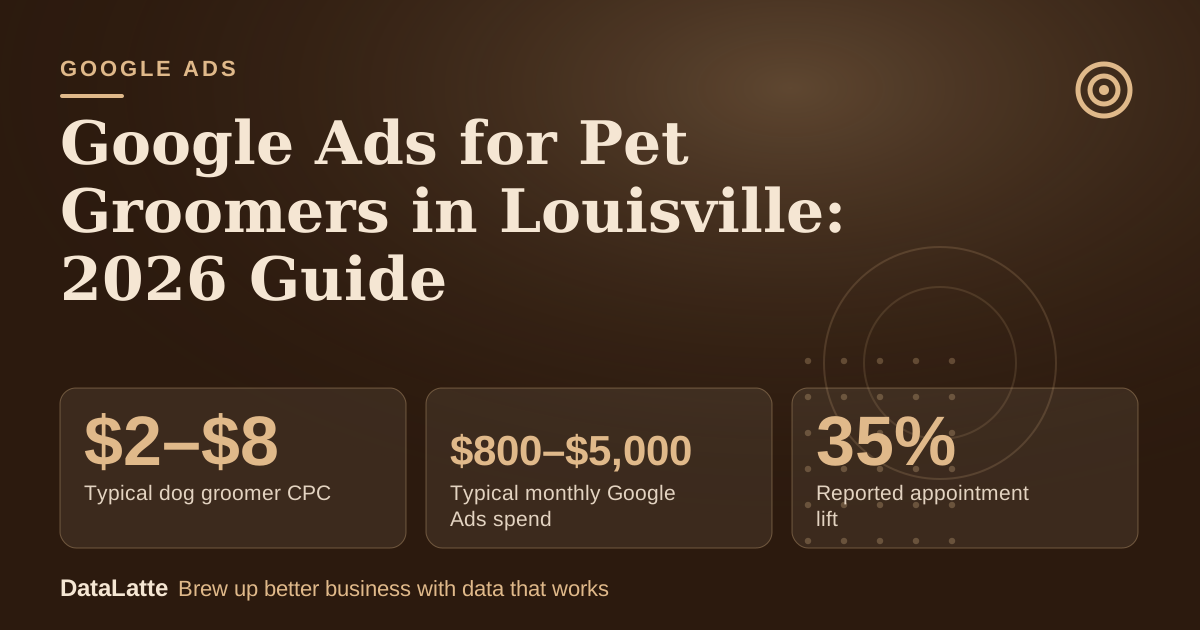
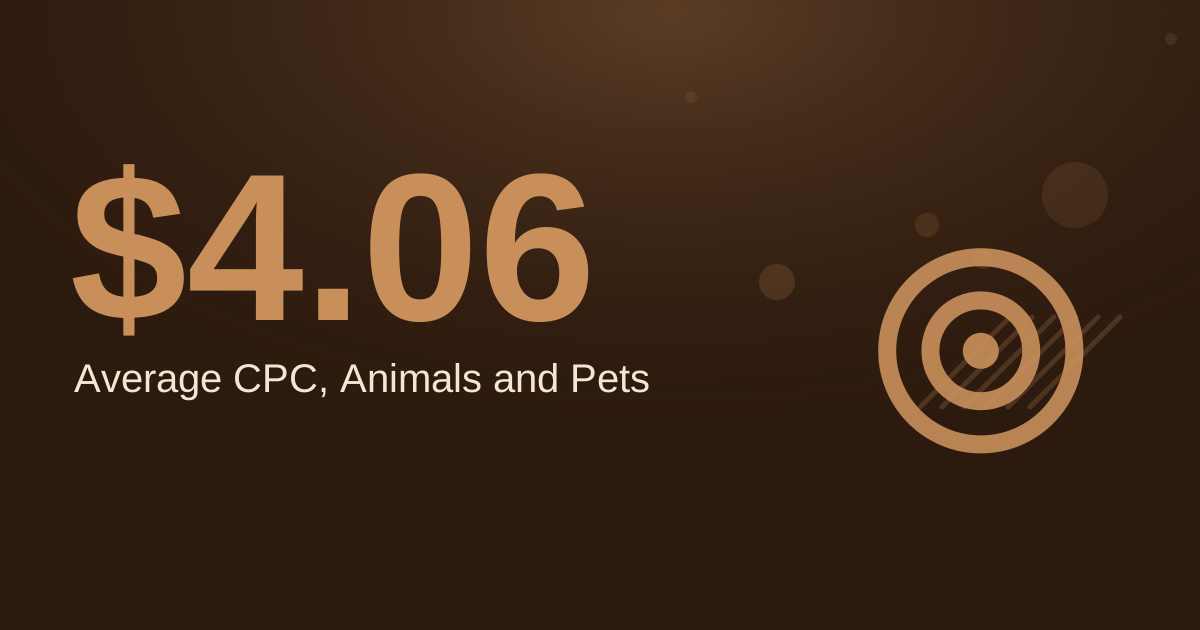
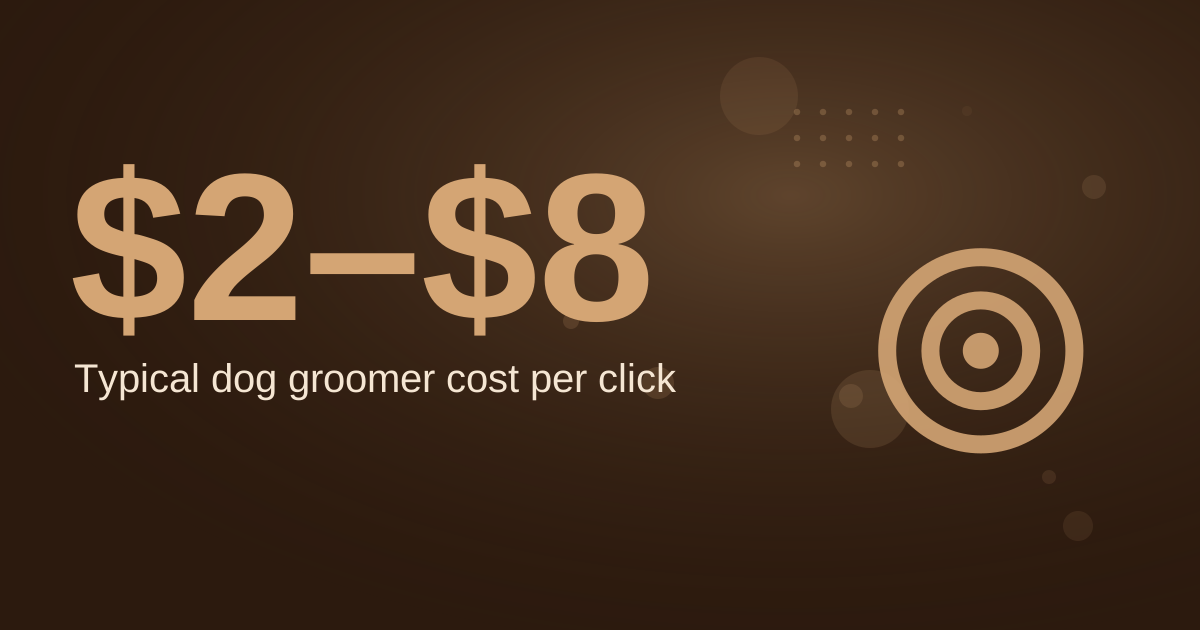
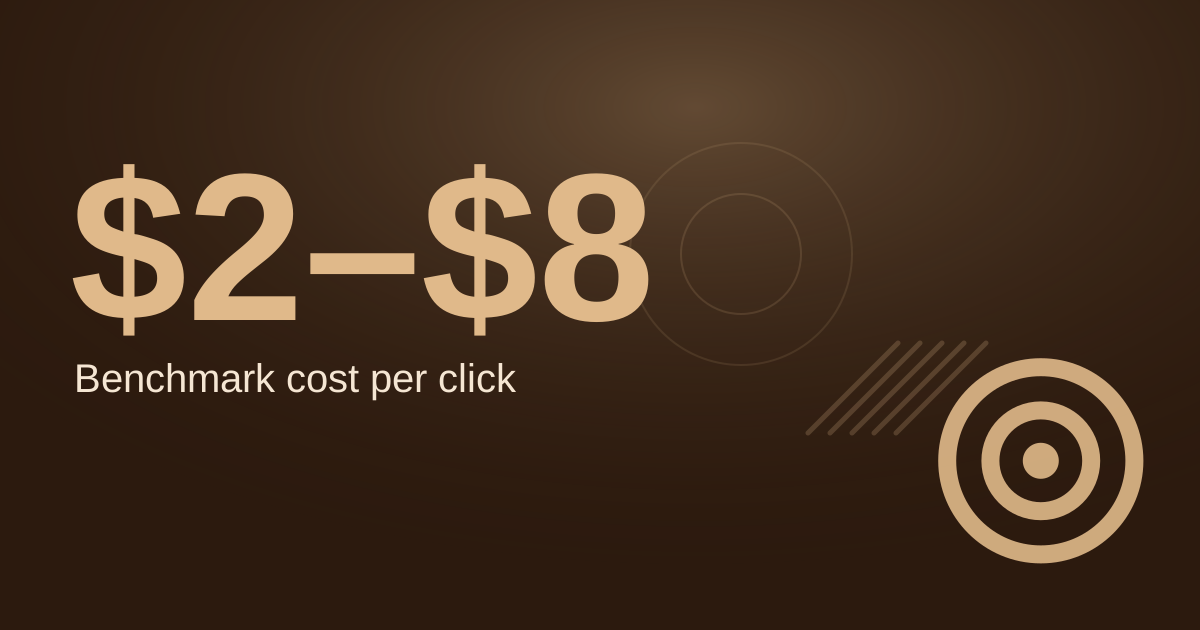
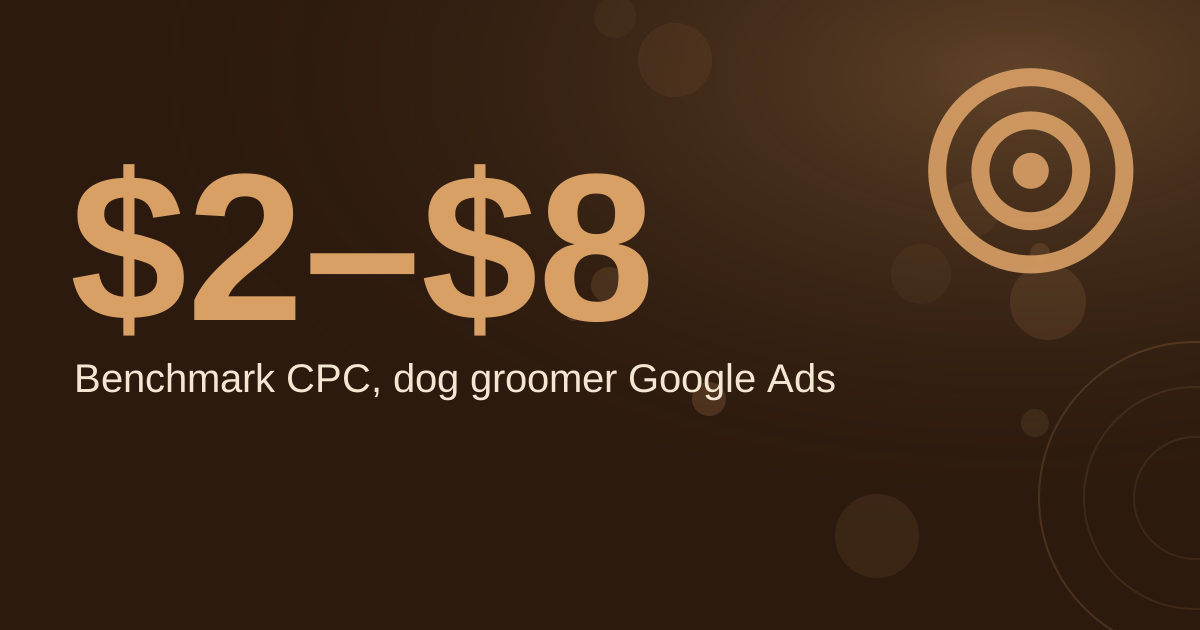
Google Ads can bring Louisville pet groomers bookings from people searching for a groomer right now. Published benchmarks put dog groomer clicks at
$2–$8, and most advertisers spend
$800–$5,000 a month. Start with booking-intent keywords, a tight local radius, and booked appointments as the main conversion. The figures here are general benchmarks, not Louisville-only data, so check your own auction numbers during a test period before scaling.
→
Typical dog groomer CPC
AdTurbo benchmark
→
Typical monthly Google Ads spend
AdTurbo benchmark
↑
Reported appointment lift
Vendor claim, AI answering system, not Google Ads
→
Negative keywords in one vendor list
GroomerGenie vendor page
See Sources at the end of the article. Cards marked Assumption are examples, not results.
How much should a Louisville pet groomer spend on Google Ads?
The most useful starting point is the monthly range that other dog groomer advertisers report.
AdTurbo's benchmark puts typical spend at $800–$5,000 a month. Start near the lower end so you can test which keywords and ad groups produce bookings before you raise the budget.
Compare channels before committing the full amount. If you are weighing ads against other paid options,
this comparison of Amazon Ads and Google Ads for local businesses explains the trade-offs. For a pet groomer, Google Search is usually the more direct route, because people searching "groomer near me" are close to booking.
Budget questions depend on your average booking value and how many bookings you can take each week. A budget that brings in more enquiries than your calendar can absorb wastes money, so check capacity before you increase spend.
Which keywords should a Louisville pet groomer bid on?
The benchmark keywords that
AdTurbo lists for dog groomers are:
- dog groomer near me
- dog grooming near me
- puppy grooming near me
These phrases signal service intent. Add your city or neighbourhood as a modifier in ad groups, such as a Louisville or neighbourhood name next to "dog grooming," so that ads match how local customers search. Keep the ad copy specific to the service you actually offer, whether that is a salon visit, a mobile van, or cat grooming.
Start with exact and phrase match on the phrases that already produce bookings. Broad match can find new searches, but it should wait until you have conversion data, because it spreads spend across loosely related queries.
How do you keep wasted clicks out of the budget?
Clicks in this category are not cheap. At
$2–$8 per click, a handful of irrelevant searches can use a large share of a small budget. The fix is a negative keyword list that removes searches that will never book.
Typical exclusions for a pet groomer include:
- Job searches, such as "jobs," "hiring," "career," or "salary"
- DIY and training terms, such as "how to," "course," or "certification"
- Supply and wholesale terms, such as "wholesale" or "supplier"
- Locations outside your drive area
One vendor says its own negative keyword list contains
more than 500 groomer negatives. That is a vendor claim, so treat it as a sign of how long a complete list can get, and build your own list from your actual search terms report.
Should you target a radius or the whole metro area?
A tight radius usually fits a grooming business better than a broad metro target, because customers choose a groomer by drive time. A
Barklead guide to Facebook ads for groomers suggests targeting users within a 10–15 mile radius. That article covers Facebook, not Google Ads, so use it as a reference point and set your Google radius based on the distance clients actually travel to your location.
Mobile groomers should set the radius around their service area rather than their home address, and should check that the area matches where they can reach customers within a normal appointment window.
What should count as a conversion?
Track booked grooming appointments as the primary conversion.
AdTurbo names booking a grooming appointment as the main conversion to track. Phone calls from ads, direction requests, and contact-page clicks are useful secondary signals, but they should not replace completed bookings in your reporting.
If you want a regular view of which keywords lead to bookings, a
monthly local SEO and ads report built from Google data makes it easier to spot changes in search terms and cost per booking.
What does a worked budget look like?
Published benchmarks give you a range, so the example below uses assumption-labelled inputs to show how the maths works. Replace the assumptions with your own numbers.
| Input or result | Scenario A | Scenario B | Source |
|---|
| Monthly budget | $800 | $800 | Assumption, within the $800–$5,000 range |
| Cost per click | $5 | $8 | Assumption, within the $2–$8 range |
| Clicks (budget ÷ CPC) | 160 | 100 | Calculated |
| Click-to-booking rate | 10% | 10% | Assumption |
| Bookings (clicks × rate) | 16 | 10 | Calculated |
| Cost per booking | $50 | $80 | Calculated |
| Average booking value | $120 | $120 | Assumption |
| Revenue from bookings | $1,920 | $1,200 | Calculated |
| Revenue per $1 of ads | 2.4 | 1.5 | Calculated |
The comparison shows why click cost matters. At the same budget and conversion rate, a higher CPC cuts bookings by more than a third. If your click-to-booking rate is lower than 10%, the cost per booking rises quickly, so improve ad relevance and landing pages before adding budget.
Do case studies show what to expect?
A
Marketing 360 case study reports a 134% increase in impressions and a 696% increase in clicks for a mobile pet groomer, compared with the previous six months. The study is from 2023, covers one business, and that business also advertised on Facebook, so the results cannot be attributed to Google Ads alone. Use it to understand what is possible, not as a benchmark for your own campaign.
Timing also matters.
Groomer to Groomer notes that November and December are traditionally very busy for groomers, sometimes too busy. Plan budget increases around periods when you have open appointment slots, and reduce spend when your calendar is full.
FAQ
How much should a pet groomer in Louisville spend on Google Ads?
Published benchmarks show most dog groomer advertisers spending
$800–$5,000 a month. Start at the lower end, measure booked appointments, and increase only when your calendar can take the extra bookings.
Does a vendor's appointment increase show what Google Ads will do?
No. One vendor reports a
35% increase in appointments from an AI answering system, which is a different channel from Google Ads. Treat vendor figures as claims to verify, not as expected results for your business.
Which conversion should I track first?
Track completed grooming appointment bookings first, as
AdTurbo recommends. Add phone calls and direction requests afterwards if you can measure them reliably.
Should I use broad match keywords?
Start with exact and phrase match on keywords that already produce bookings. Test broad match later, once you have enough conversion data to judge whether the extra searches are relevant. For help deciding how to manage that process,
this comparison of AI and human marketing for local businesses covers which tasks suit automation and which need a person.
If you want a review of your current Louisville setup, you can
book a free audit or look at
Google Ads management. For a related option, see
Google Local Services Ads for pet groomers.
Sources
Free for local businesses
Want this applied to your business?
I'll review your Google presence, local SEO, and ad accounts — and send you a specific action plan within 48 hours. No pitch, no pressure.