Google Ads can work for a wedding photographer when one booking pays for a useful share of the spend, so start with the arithmetic. Using assumed inputs of a $600 monthly budget, a $3.50 click, 5 clicks in 100 becoming an inquiry and 15 inquiries in 100 booking, you get about 171 clicks, 8.6 inquiries and 1.3 booked clients. That is roughly $467 in ads per booking, or about 16% of a $3,000 package. Every input is an assumption until you have your own data.
The practical question is not "how many clicks?" but "how many inquiries, and which ones booked?" This guide covers setup, qualification and tracking. Dollar figures are US-based; photographers in the UK, Australia and Canada can run the same formulas with local click prices.
Which Numbers Can You Trust for Photography Ads?
Very few. No photography-specific click or conversion benchmark was found in the sources for this guide, so any figure you see for "photographers" should be treated as a guess until your own account confirms it. The vendor figures available come from a photography marketing agency,
Photography to Profits, which publishes a case study and a calculator. Both are self-reported and unaudited.
↓
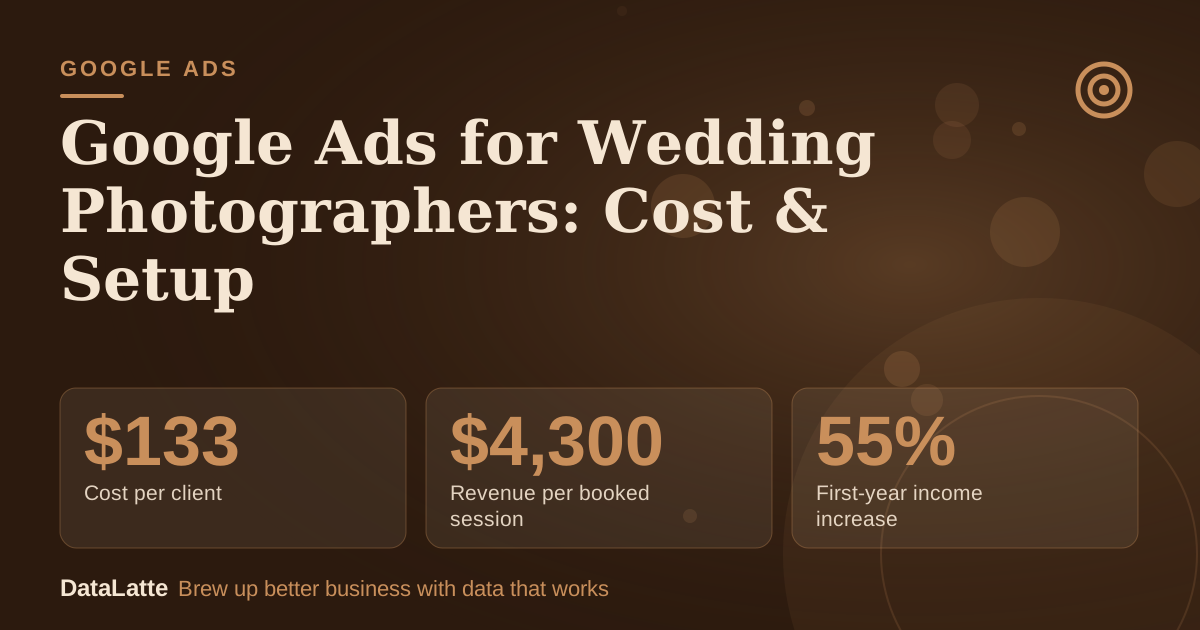
Cost per client
Vendor case study, derived from $1,200 over 9 bookings
↑
Revenue per booked session
Vendor case study, boudoir studio
↑
First-year income increase
Secondary: Lindsay Herkert, 2020
↑
Return per ad dollar
Vendor case study, self-reported
See Sources at the end of the article. Cards marked Assumption are examples, not results.
The vendor reports $38,700 in revenue from nine booked sessions, and a 2,400% ROI in its calculator. Those numbers describe one boudoir studio over under 60 days. They show what is possible, not what is typical, so do not copy the cost per client into your own budget. A separate photographer reports a 55% income rise in her first year of ads, but that is one personal account from a different market, not a benchmark.
What Does the Math Look Like for One Booking?
Start with a single month and a single package price. The table below uses three scenarios. Every row marked assumption is a placeholder to replace after your first month of tracked data.
| Line | Tough | Base | Strong |
|---|
| Monthly budget (assumption) | $600 | $600 | $600 |
| Cost per click (assumption) | $5.00 | $3.50 | $2.50 |
| Clicks | 120 | 171 | 240 |
| Click to inquiry rate (assumption) | 3% | 5% | 8% |
| Inquiries | 3.6 | 8.6 | 19.2 |
| Cost per inquiry | $167 | $70 | $31 |
| Inquiry to booking rate (assumption) | 10% | 15% | 25% |
| Booked clients | 0.4 | 1.3 | 4.8 |
| Ad cost per booking | $1,667 | $467 | $125 |
| Package value (assumption) | $3,000 | $3,000 | $3,000 |
The Strong column is better than most accounts will achieve, so do not plan around it. At a $600 budget, a good month might book one client and a weak month might book none. A single month proves very little, which is why tracking should run for two to three months before you judge the account.
The vendor's calculator uses different inputs: a $1,000 budget, a $25 cost per lead, a 25% lead-to-booking rate and a $2,500 booking value. It projects 10 bookings and a $100 cost per client. That is a useful template for your own sheet, but the inputs are the vendor's, not yours.
What Is Your Break-Even Click Price?
Work backwards from the most you are willing to pay for one booking. Maximum cost per click equals your target cost per booking multiplied by the click-to-inquiry rate and the inquiry-to-booking rate. Both rates become your own numbers once you have tracked data.
Using assumed rates of 5% and 15%, and a target of $450 per booking, the calculation is $450 x 0.05 x 0.15 = $3.375, or about $3.38 per click. Above that price, each click costs more, on average, than the acquisition spend you are willing to accept. Below it, the campaign has room to work.
The sensitivity matters. If the inquiry-to-booking rate rises from 15% to 25% (assumption), the ceiling rises to about $5.63 per click. Reply speed, a clear quote and consistent follow-up can move that rate more than any change inside the ad account.
How Should You Structure the Campaign?
Use Search campaigns with one ad group per service: weddings, elopements, engagements, and any event or headshot work. Each group should point to its own landing page, so a couple searching for an elopement photographer does not land on a wedding package page. Keep the campaign on phrase and exact match at the start, since broad match widens the search terms you pay for before you have data to control it.
Build a negative keyword list from day one. Photography searches attract students, job seekers and people looking for equipment. Add terms such as "jobs", "course", "free", "tutorial", "camera" and "rental" to the negative list. Review the search terms report every week and add new negatives as they appear.
Quality Score deserves attention here. According to
Google's Quality Score help page, it is rated from 1 to 10 at keyword level and combines expected click-through rate, ad relevance and landing page experience. Google also states that Quality Score is a diagnostic tool and not an input in the ad auction. Low ratings on landing page experience usually point to a page that does not match the search.
How Do You Qualify the Inquiry?
The landing page is where most of the budget is won or lost. It should show the best 10 to 15 images for that service, a short pricing guide, a plain list of what is included, and a short form that asks for names, wedding date, location and budget range. The date field does two jobs: it filters out visitors who are only browsing, and it lets you reply with real availability.
Photography inquiries often arrive by email, so the reply matters as much as the form. A couple who sends an inquiry on a weekend evening usually sends the same message to several studios. Replying within the hour, with a real answer about the date and a link to pricing, is the cheapest improvement available. Drafting those replies can be faster with a prepared set of prompts;
ChatGPT prompts for local business marketing covers that kind of drafting.
How Do You Track Bookings, Not Just Inquiries?
Set up conversion tracking for form submissions and for phone calls from the ad before the campaign goes live. Without it, the account shows clicks and spend but no answer to the question that matters: which ad produced a paying client.
Tracking an inquiry is only half the job. Couples often take weeks to sign, so the booking may happen long after the click. Keep a simple spreadsheet with the inquiry date, the source (ad group or keyword), whether a quote was sent, whether the couple booked, and the package value. Update it every Friday. That sheet gives you cost per booking even when the ad platform cannot see the final sale.
Stay on Search first. Search shows which keyword and which ad group produced each inquiry, which is what a wedding photographer needs while learning the account. Automated campaign types give the platform more control over targeting and assets, which makes tracked results harder to read. Once Search produces consistent booked clients at a known cost, you can test
Performance Max for local businesses as a separate experiment with its own budget.
For photographers who also use social media, the channels serve different purposes. Social ads reach people who are not searching yet, while search catches people who are. A comparison of the two is in
Google Ads vs Facebook Ads for local business. Photographers outside the US can check currency and market differences in the
local business marketing guide for Canada, which covers the Canadian context.
What Should You Check Every Week?
Read the search terms report and add negatives. Compare ad groups by booked clients, not by inquiries. Check that your form and phone number work on mobile, because many couples search from a phone. Raise the budget only in ad groups where cost per booking is on target, and do it in small steps.
Google's
Quality Score help page notes that the score is based on historical impressions for exact searches over the last 90 days. A new keyword may therefore show no score for a while. Judge a new keyword on cost per inquiry and booked clients, not on the score alone.
What Should You Do This Week?
- Work out your average booking value from your last 10 clients, and decide the most you will pay for one new booking.
- Calculate your break-even maximum cost per click using your own inquiry and booking rates, then compare it with the Keyword Planner estimate for your city.
- Build one Search campaign with ad groups for each service, phrase and exact match, and a starting negative list.
- Build or update one landing page per service with a date field, then set up form and call tracking before the ads go live.
- Start the inquiry spreadsheet and update it every Friday.
For a campaign built with inquiry tracking and weekly review, see
DataLatte's Google Ads service.
FAQ
How much should a wedding photographer spend on Google Ads per month?
No official figure applies to photographers. The $600 budget in this guide is an assumption, and the vendor calculator uses $1,000 as its own input. Start with the break-even formula: if your click price is above your ceiling, a bigger budget will not fix the problem.
Is "wedding photographer near me" worth bidding on?
It can be, because the intent is high, but the cost per click may be higher too. Run it alongside city-specific terms and judge it by cost per booked client rather than cost per click.
How long before ads bring bookings?
Inquiries can start within days. Couples often compare several studios over weeks, so judge the first month on inquiry quality and cost per inquiry, and judge bookings over two to three months.
Quality Score is a diagnostic. It highlights whether your ad, keyword or landing page is weak. Google's help page says it is not a key performance indicator to optimize on its own, so use it to find problems, then judge results by inquiries and bookings.
Sources