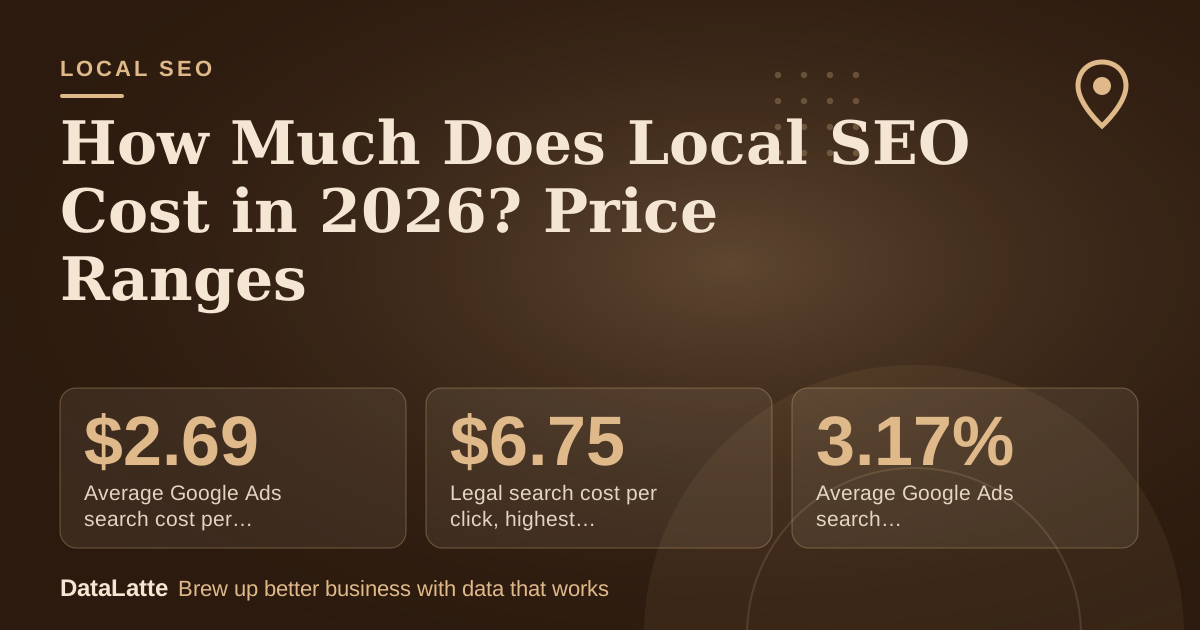
Local SEO has no single published price standard in the sources checked for this guide, so this article does not quote a market average. Instead, it gives you two verifiable anchors: the cost of buying clicks through paid search, and the break-even math that shows whether a monthly fee pays back. Google's SEO Starter Guide also says there are no secrets that automatically rank a site first, so budget for effort and reporting, not a promised position. Replace every assumption below with your own numbers before you sign.
→
Average Google Ads search cost per click, all industries
WordStream benchmarks (secondary)
→
Legal search cost per click, highest listed industry
WordStream benchmarks (secondary)
→
Average Google Ads search click-through rate
WordStream benchmarks (secondary)
→
Websites and apps reached by the Display Network
Google Ads Help (primary)
See Sources at the end of the article. Cards marked Assumption are examples, not results.
What does local SEO cost, and why are the public prices hard to verify?
Vendor price surveys often publish tidy averages, but none of the primary sources available for this update report local SEO fees. Those survey figures are therefore left out rather than repeated without a check. The practical answer is to request a written scope and price from each provider, then test that price against your margin.
Timing also affects cost. Google's guide notes that "some changes might take effect in a few hours, others could take several months." It suggests waiting a few weeks before judging results. A month-to-month trial of a few weeks will tell you little, so plan for a commitment long enough to see a real signal.
How do paid search benchmarks help you price local marketing?
Paid search is not local SEO, but its benchmarks show what a click costs when you buy it. Across the 16 industries in WordStream's latest table, the average search cost per click is $2.69, and the Legal industry sits at $6.75. Consumer Services is close behind at $6.40. The average search click-through rate is 3.17%.
Those numbers answer a useful question: what does a visitor cost you if you buy them instead of earning them through organic local visibility? The
Google Ads cost breakdown explains how these costs translate into a monthly budget. Use the same logic when you compare a local SEO fee to ad spend.
What does each budget tier usually buy?
No public standard menu exists in the sources, so these tiers are a planning frame. The dollar bands are assumptions, not market data. Use them to sanity-check a proposal, then ask the provider to confirm what is included.
- Under $500 a month (assumption): profile upkeep, basic listing checks and review follow-up for one location.
- $500 to $1,500 a month (assumption): adds service and location page work, plus regular reporting.
- $1,500 a month and up (assumption): adds content, outreach and planning for several locations.
Be cautious of any package that promises a fixed rank. Google's guide says there are no secrets that automatically rank a site first. You can check how Google sees your own pages for free with the URL Inspection Tool in Search Console, which is a useful first step before paying for any work.
Is local SEO worth it? A break-even worked example
Local SEO is worth buying when the extra customers it brings cover a meaningful share of the fee. Every input in the table below is an assumption for illustration. Replace each one with your own figures.
| Input or result | Coffee shop | Hair salon |
|---|
| Monthly local SEO fee (assumption) | $600 | $600 |
| Average ticket (assumption) | $9 | $85 |
| Gross margin on a ticket (assumption) | 65% | 60% |
| Margin per visit (calculated) | $5.85 | $51.00 |
| Extra visits to break even (calculated) | 103 per month | 12 per month |
The coffee shop needs about 3.4 extra sales a day to cover the fee. The salon needs about 3 extra bookings a week. The gap explains why local SEO tends to suit higher-ticket or repeat-booking services. A low-ticket counter business relies more on loyalty and repeat visits to justify the same fee.
Before you start, pull your last three months of calls, direction requests and bookings from your listing reports. Those records become the baseline you compare against after the work begins.
Should you do local SEO yourself or hire help?
Doing it yourself is sensible when your listing is not set up and you have spare hours. Hiring makes more sense when your time is scarce or the market is crowded. Your own hours still have a cost, so price them honestly.
- DIY: at an assumed $40 an hour, 10 hours a month equals $400 of time (assumption).
- Freelancer: suits one location with a clearly written scope.
- Agency: suits several locations or heavy local competition, with account management included.
- One-off fix: suits a profile or site repair, not ongoing work.
If you run a business in Australia, the
local marketing guide for Australian small businesses covers the same decision with local context. Businesses in Canada can compare options in the
Canada local marketing guide.
How do you check that local SEO spend is working?
Compare the same number of weeks before and after the work starts. Google's guide recommends waiting a few weeks before judging whether changes helped. Count calls, direction requests, website clicks and bookings, not only rankings. Rankings move, but customer actions pay the fee.
For a quick search check, use the site: search operator in Google to confirm your pages are indexed. Then use the URL Inspection Tool to see how Google renders them. If results stall, fix the basics before buying more work. For paid comparisons, the
Facebook ads budget guide shows how to test small budgets against measured results.
FAQ
How much does local SEO cost per month for a small business?
No primary source in this update publishes a local SEO fee range, so the tiers in this guide are planning assumptions. Confirm the price for your exact scope with each provider in writing.
Can paying Google improve my local search ranking?
Google's SEO Starter Guide says there are no secrets that automatically rank a site first. Treat any promise of a guaranteed position as a red flag, and ask providers what they will actually do and report.
How long should I commit to local SEO work?
Google's guide notes that some changes take a few hours to show, while others take several months. Plan a commitment long enough to judge results, rather than a short trial.
How do I know if the spend is working?
Compare calls, direction requests, website clicks and bookings across the same number of weeks before and after the work. Use your own break-even figure as the target.
Sources
Agencies pricing audits into a retainer can compare
local SEO audit tools for agencies. Want a straight read on your current listings before you commit to a fee?
Book a free audit, or see how a
local SEO service is scoped for small local businesses.
Free for local businesses
Want this applied to your business?
I'll review your Google presence, local SEO, and ad accounts — and send you a specific action plan within 48 hours. No pitch, no pressure.