A salon brand that attracts clients rests on three things: a specialty you can state in one line, one business name used everywhere without variation, and a look and tone that match on your door, website, Google profile and Instagram. Once those are set, make the experience repeat with reminders, rewards and reviews. Expect the brand to take time. One agency cites a common belief among marketers that a strong brand can take 2 to 5 years to establish fully. This guide covers each step, the free profile basics, and a worked budget example in which every input is labelled as an assumption.
↑
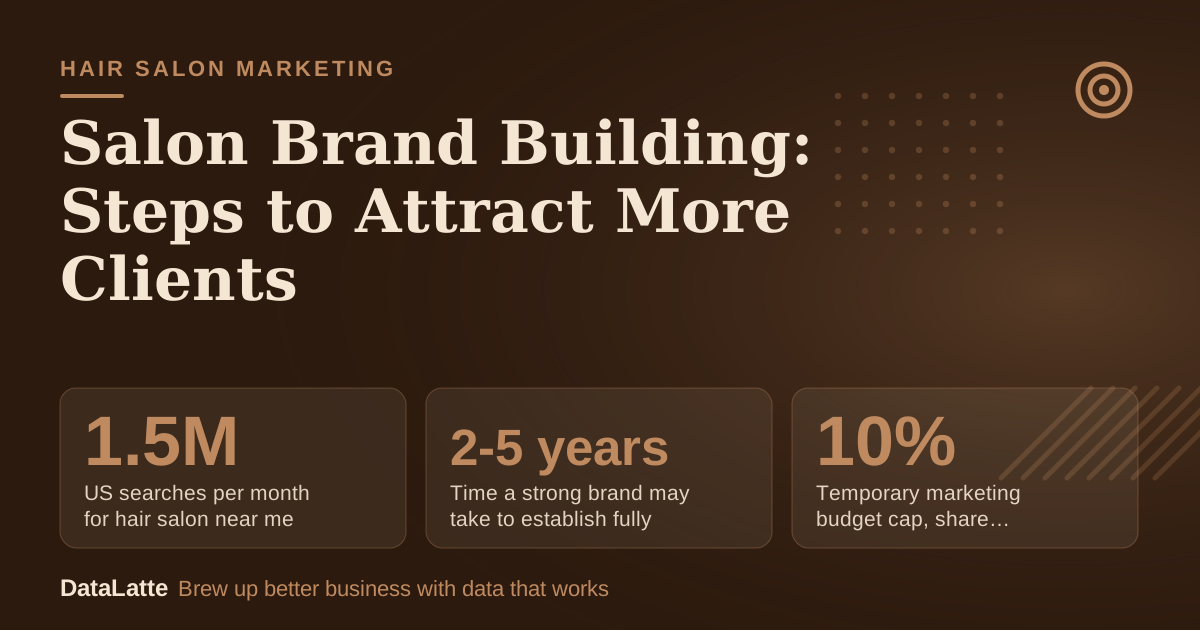
US searches per month for hair salon near me
Google Ads keyword data, April 2026 (secondary, vendor blog)
→
Time a strong brand may take to establish fully
Keen Ltd belief cited by marketers (secondary, agency page)
→
Temporary marketing budget cap, share of gross revenue
Booksy guidance for heavy growth phases (secondary, vendor blog)
↑
Time for a client to book through Reserve with Google
Booksy description of Reserve with Google (secondary, vendor blog)
See Sources at the end of the article. Cards marked Assumption are examples, not results.
What Makes a Salon Brand Recognizable?
A brand is what a client expects before booking. It comes from your specialty, your name, your photos, your prices and how you reply to messages. A salon known for color correction is judged on that record, not on being cheap or open late. The clearest brands are the ones a client can describe to a friend in a sentence.
Write one sentence in the form "a service for a specific client." Examples include balayage for clients with long hair or gentle cuts for children. If you cannot finish that sentence, your marketing will stay vague, and vague marketing gives a client no reason to pick your chair over the salon down the street.
How Do You Choose a Specialty Clients Will Book?
Start with three inputs: the work you do best, the services your highest-paying clients already book, and the services nearby salons do not offer. Your booking software can show which treatments have the highest ticket and the most repeat visits. Then search Google Maps and Instagram to see who else claims that specialty near you.
You do not need to drop other services. Put the specialty first on your website, in your Google categories and in your Instagram bio. A specialty can also be personal. Zeely cites Portland stylist Jules Heron, who built an authentic brand around inclusivity and visibility and shared consultations and transformations on TikTok. The lesson is a clear point of view that the stylist can keep delivering on, week after week.
Owners whose clients also book through chat apps can compare the
Brazil guide on WhatsApp and Meta with their current setup.
How Do You Keep the Name and Look Consistent?
Use the same salon name, address and phone number on your website, Instagram, booking page and online directories. Mismatches are common and easy to miss. RŌZ, a hair products vendor, says a salon owner can begin correcting common missing or inconsistent profile information in about ten minutes. That is a small task with a visible payoff, because clients and search engines both compare what they find.
Once the basics match, write the brand down. Keen, a branding agency in Malta, finishes its process with a comprehensive brand guideline book so the brand stays on track from day one. A one-page version works for a single chair: your specialty sentence, your approved colors, your typefaces, a photo style and the tone you use in replies. Share it with any stylist or assistant who posts for you.
Trademark rules and fees differ by country, and this guide does not quote them. Check your national trademark office directly before filing, and do so early if you plan more than one location.
How Do Google Listings and Reviews Support the Brand?
Your Google Business Profile is one of the few brand channels that costs nothing to set up. RŌZ lists the typical cost of a Google Business Profile as free, and it lists Google reviews as free too. Its comparison table ties the profile to calls, booking clicks and direction requests, and ties reviews to building trust.
Booking friction matters as much as visibility. Booksy says Reserve with Google lets clients book directly from Search and Maps in under 30 seconds. Availability depends on your booking software, so confirm with your provider that it supports the feature. Booksy also says its software automatically prompts clients to leave a review after their appointment, which keeps review requests consistent without extra effort from the front desk.
For a market where search habits differ, the
Germany Google Ads guide shows how paid search can sit alongside a listing.
How Do You Turn First Visits Into Repeat Bookings?
A brand is tested at the second visit. BonusQR recommends a digital punch card with a reward at 6 to 8 punches, which it says feels attainable to clients while still encouraging commitment. Choose a number that fits your typical visit frequency, and make sure the reward is one your clients will value.
Lapsed clients need a nudge. BonusQR suggests an automated "We miss you!" offer for clients who have not visited in 90 days. Booksy's guide uses a 12-week window for the same kind of message, so test the timing against your own rebooking data. Booksy also recommends automated SMS or email reminders for clients who have not rebooked in the salon, to catch them 48 hours later.
Your best clients can get a different kind of attention. BonusQR recommends giving top loyalty clients a 24-hour head start on any sale. A
New Zealand guide for small businesses is a useful comparison if your client base is smaller and mostly local.
How Much Can a Growth Budget Support? A Worked Example
Booksy says a salon in a heavy growth phase or opening a new location may need to scale its marketing up to 10% of gross revenue, but only temporarily. Treat 10% as a ceiling for a defined campaign, not a permanent rate. The table below uses a monthly gross revenue figure that is an assumption, not a benchmark.
| Line | Amount | Basis |
|---|
| Gross monthly revenue | $6,000 | Assumption |
| Temporary ceiling at 10% | $600 | Booksy guidance |
| Paid local search | $400 | Assumption |
| Rebooking reminder tool | $60 | Assumption |
| Unallocated reserve | $140 | Remainder |
The allocations total $600, so the plan stays inside the ceiling. Set a clear end date for the campaign, and track bookings in your software against the spend. The profile, reviews and reminders in the sections above cost little or nothing to run, so the budget mostly goes to paid visibility. If bookings do not rise after the campaign, the problem is more likely the specialty or the booking path than the spend.
FAQ
What is the first step in building a salon brand?
Choose a specialty you can state in one line, then make the name, look and messages consistent on every channel a client can see.
Is a Google Business Profile free for a salon?
RŌZ lists the typical cost of a Google Business Profile as free. Paid visibility on Google is a separate choice.
How long does a strong brand take to build?
Keen cites a belief among many marketers that a strong brand can take 2 to 5 years to establish fully, subject to the market. Plan for steady consistency rather than a quick result.
How much of revenue can a salon spend on marketing?
Booksy says a salon in a heavy growth phase or opening a new location may temporarily scale its marketing budget up to 10% of gross revenue. Set an end date for any campaign at that level.
Sources
Want help with your local listing and booking path? See the
local SEO service or
book a free audit.
Free for local businesses
Want this applied to your business?
I'll review your Google presence, local SEO, and ad accounts — and send you a specific action plan within 48 hours. No pitch, no pressure.