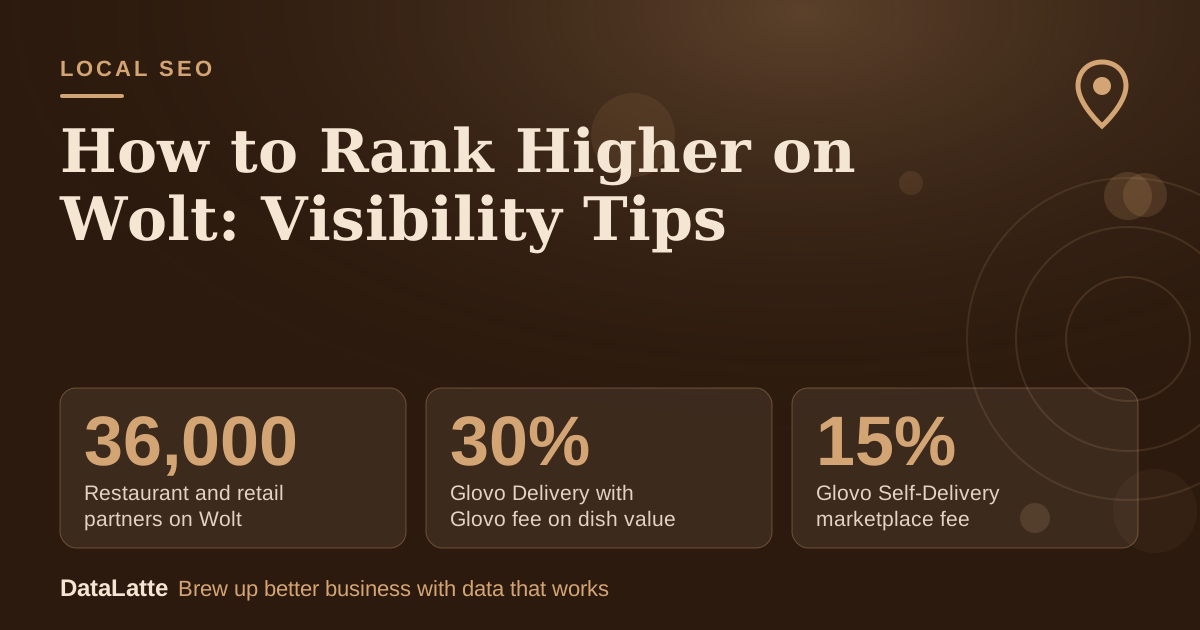
Wolt has not published a ranking formula that this guide can verify, so no one can promise a specific rank change. What is known is the scale: Wolt works with more than 36,000 restaurant and retail partners, which makes visibility competitive. The practical route is to keep the venue reliably open, keep the menu complete, measure each change and compare fee models before spending on promotion. This guide separates confirmed facts from assumptions and shows how to run a four-week test.
→
Restaurant and retail partners on Wolt
Smartly case study (secondary)
→
Glovo Delivery with Glovo fee on dish value
Deliverect Glovo guide (secondary)
→
Glovo Self-Delivery marketplace fee
Deliverect Glovo guide (secondary)
↑
Higher conversion for teams that regularly A/B test
HubSpot 2024 via Universal Mailworks (secondary)
See Sources at the end of the article. Cards marked Assumption are examples, not results.
Does Wolt Publish How It Ranks Venues?
No public document this guide can verify sets out Wolt's ranking criteria. Any article that gives a fixed uplift from one action, such as a single review or a single price cut, is presenting a guess as a rule. Treat those figures with suspicion until the platform itself states them.
Wolt's merchant help pages are the right reference point because platform rules change. Check the live pages before each change and note the date you read them. That way your test log matches the rules you actually followed, and you can tell whether a later drop in orders came from a platform change or from your own edit.
How Large Is the Competition on Wolt?
According to a Smartly case study, Wolt partners with more than 36,000 restaurant and retail partners. A venue listed among that many partners competes with a large pool of similar menus in the same area, so being average on photos, hours and prices rarely stands out.
The figure comes from a vendor's retelling of Wolt's case, so treat it as context rather than a measured market share. Each listing should be checked on its own terms, because each delivery app is a separate marketplace with its own customers. The
comparison of food delivery advertising in Europe sets out how the main platforms differ in audience and paid options, which helps when deciding where effort should go first.
How Do Fees Affect Visibility Decisions?
Fees shape how much a venue can afford to spend on promotions, and that decides how aggressively it can price. Wolt's fee schedule is not covered by the sources behind this guide, so the clearest public comparison is Glovo's published plans, as summarised by Deliverect. The table below shows those plans. Check Wolt's partner terms directly before using these numbers for Wolt decisions.
| Glovo plan (per Deliverect) | Fee | Delivery option |
|---|
| Delivery with Glovo | 30% of dish value | Yes |
| Self-Delivery | 15% marketplace fee, restaurant uses its own couriers | Yes |
| In-Store Pickup | 15% pickup fee | No |
Worked example (all inputs are assumptions): 100 orders a week at an average dish value of EUR 20 gives EUR 2,000 of dish value. At 30% the fee is EUR 600; at 15% it is EUR 300. The EUR 300 weekly gap is the sum a venue could redirect to better photos or a promotion, if its contract and courier model allow. The
Glovo vs Wolt comparison covers how the two platforms differ beyond fees.
Which Operational Steps Are Within Your Control?
Keeping the venue open during listed hours is the most basic step. Update holiday hours in advance, avoid temporary closures, and check that the tablet, printer or point-of-sale link works before service starts. These steps cost nothing and prevent avoidable lost orders.
The menu side is similar. Use clear item names, specific descriptions and photos of the dishes you actually sell. Mark out-of-stock items as unavailable quickly, and keep prices consistent with your in-store menu where your contract allows. These are general good practices, not confirmed Wolt ranking factors. The routine checks in the
guide to growing on Glovo make a useful checklist for the same tasks on a second platform.
How Do You Test Whether a Change Worked?
Google's own case study shows why tracking matters. 412 Food Rescue, a US non-profit, cut its reporting time by 50% after gaining full visibility into the user journey and campaign metrics with Google Analytics. A change is only useful if you can see its effect, so set up measurement before you edit anything.
Worked example (inputs are assumptions): baseline of 10 of 60 items with photos, 50 orders a week and a EUR 22 average basket, so weekly sales are EUR 1,100. After four weeks, 40 of 60 items have photos, orders reach 60 a week and the basket stays at EUR 22, so weekly sales are EUR 1,320. The gain is EUR 220, or 20%. Because photos, hours and promotions changed together, that EUR 220 cannot be credited to any one of them.
- Record a one-week baseline: orders, average basket and offline hours.
- Change one variable where possible, such as photos on your top ten sellers.
- Log each change with its date, then compare the same weekdays after four weeks.
- Keep a change only if sales rise while the other variables stayed flat.
A third-party source citing HubSpot's 2024 marketing report says companies that regularly A/B test marketing materials see 20-30% higher conversion rates. That is a reason to test, not a forecast for delivery orders.
Should You Pay for Visibility on Wolt?
The sources behind this guide do not describe Wolt's sponsored placement pricing or billing. Check the live Ads help page before committing any budget. Paid visibility is a separate decision from organic rank, and nothing here shows that paid placement changes organic order.
Start with an amount you can lose without damaging cash flow for the week, set a hard cap, and compare results with your baseline log after the test period. If the numbers do not beat the baseline, pause and fix the listing before spending more.
Does a Delivery-Only Brand Face Different Rules?
On Google, yes. Google's guidelines state that delivery-only brands operating from virtual kitchens are permitted if they have distinct branded packaging and a distinct website. They must also add their service areas and hide their address on their Business Profile. These rules govern Google listings, not Wolt, but they show that platforms treat delivery-only brands differently from storefronts.
Setting up a Business Profile for a food venue is covered in the
coffee shop Business Profile guide, and the wider approach to Maps visibility is in
Google Maps ranking tips for Europe. Check each rule against the live Google help page before changing a listing.
FAQ
Can I pay Wolt to rank first?
The sources behind this guide do not describe sponsored placement. Check Wolt's live Ads help page for how sponsored positions work and whether organic order is affected.
This guide has no verified photo count from Wolt. Start with your best sellers and check the live merchant guidance for current image specifications.
Do reviews affect Wolt visibility?
This guide cannot verify how reviews affect Wolt rank. Read the platform's live help pages before assuming a link between reviews and visibility.
Is Glovo's fee the same as Wolt's?
No. The Glovo rates of 30% and 15% come from a Deliverect guide and do not describe Wolt. Compare each platform's current partner terms before deciding.
Sources
Want help with delivery-app visibility? See the
Google Ads service or
book a free audit.
Free for local businesses
Want this applied to your business?
I'll review your Google presence, local SEO, and ad accounts — and send you a specific action plan within 48 hours. No pitch, no pressure.