First Programmatic Campaign Under $1,000: Step-by-Step
June 30, 2026·Nataliia Rumiantsewa· 7 min read All posts
A first programmatic campaign can run for under $1,000 in total, but that figure sits at the floor of what vendors recommend, not in the comfortable middle. One agency recommends a minimum of $1,000 for programmatic advertising for small businesses to ensure substantial reach and impact. A sub-$1,000 test is therefore a learning exercise: one channel, one service area, one measurable goal, and a fixed end date. Judge it on brand-lift signals, not bookings alone.
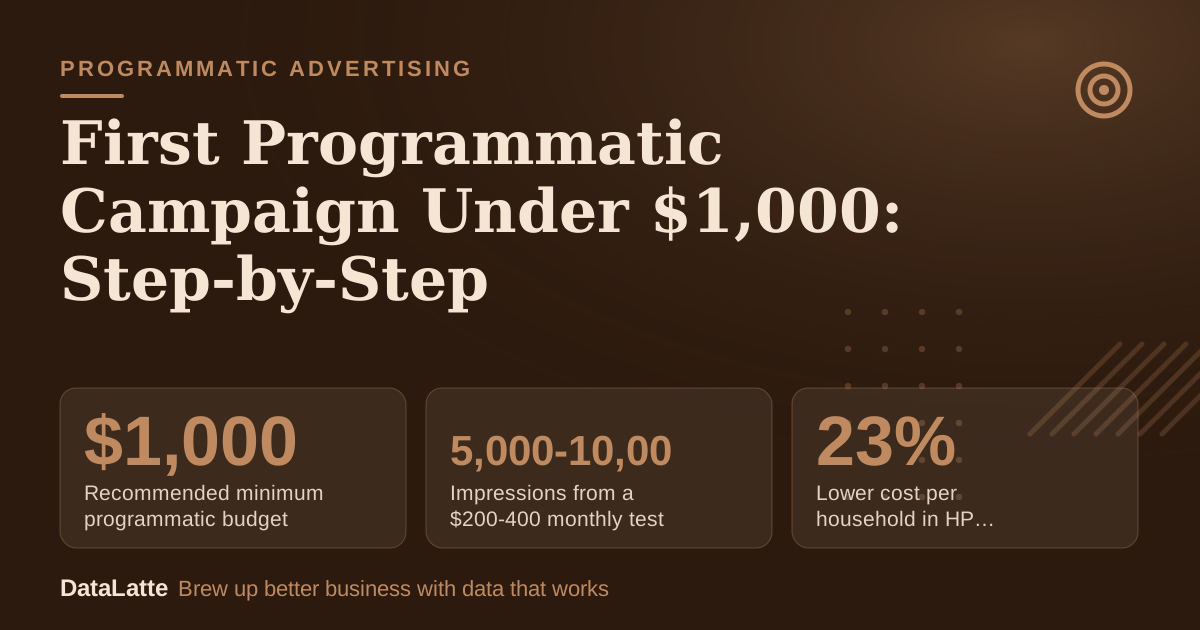
$1,000→
Recommended minimum programmatic budget
Vendor recommendation, as of 2024
Assumption
$40→
Example programmatic CPM
Example rate in a vendor guide
Assumption
5,000-10,000→
Impressions from a $200-400 monthly test
Vendor estimate across streaming platforms
23%↓
Lower cost per household in HP CTV case
Vendor-reported, not a local benchmark
See Sources at the end of the article. Cards marked Assumption are examples, not results.
What does a $1,000 test actually buy?
The arithmetic depends on the CPM, which is the price per 1,000 impressions. A streaming vendor uses a $40 programmatic CPM in its example and estimates that a $200-400 monthly test delivers about 5,000-10,000 impressions across Netflix and other streaming platforms (AdWave). Real CPMs vary by format and audience, so treat these as reference points.
Worked example, with inputs labelled as assumptions:
Assumption: total budget of $1,000, spread evenly over four weeks, so $250 per week.
Assumption: a $40 CPM, matching the vendor example.
Total impressions: $1,000 / $40 x 1,000 = 25,000.
Weekly impressions: $250 / $40 x 1,000 = 6,250.
The $1,000 test equals 2.5 to 5 months at the vendor's $200-400 monthly level. Read the 25,000 figure as a campaign total, not a monthly result, and confirm the real rate in your platform's quote before launch.
Which single channel should a first test use?
Programmatic buying is growing in premium video. Netflix told investors on its first-quarter 2026 earnings call that programmatic buying was on course to become more than 50 percent of its non-live advertising business (PPC Land). That growth does not make CTV the right first step for every local business.
Choose one format based on the goal. Connected TV suits awareness and credibility, while display suits retargeting site visitors. The CTV analysis for small budgets covers when that format earns its place. Splitting the budget across two or three channels leaves too little data to learn from on any of them.
What should you check before you buy a platform?
Minimums and fees change, so check each platform's live help page before committing. Use this checklist:
Check
Why it matters
Self-serve sign-up without a sales call
Lets you start inside your budget
Current minimum spend on the help page
Older guides may show outdated minimums
Whether fees sit inside the budget
Fees reduce the money that buys media
Reporting and frequency controls
Needed to read the test cleanly
Pause or cancel rules
Lets you stop if delivery is poor
Fee structures vary. One marketing tool reviewed by RingCentral says its pricing includes the total advertising budget with no additional fees, with paid plans starting at $120 for the first month (RingCentral). That is a different product, but it shows why asking whether fees come out of the budget matters.
How tight should your targeting be?
Precision is the main advantage programmatic has over broadcast, so use it. Set the geographic area to your real service area rather than a city-wide or national default. A broad radius spends a small budget on people who cannot visit your business.
Keep the audience definition the same for the whole test so results are comparable. Changing targeting in week two makes the data impossible to read. The display advertising guide for small businesses explains the audience options most self-serve platforms offer.
What creative and tracking does a test need?
A simple smartphone video or static banner can be enough to learn whether people respond. One TV advertising guide says AI creative tools let advertisers launch a campaign in under 10 minutes (AdWave). Speed helps, but it does not replace a clear offer and a clear call to action.
Tracking matters more than polish. Give the campaign a unique landing page URL or promo code so its results are separate from your other marketing. The guide to whether programmatic is accessible now covers the setup steps in more detail.
How long should the test run?
A vendor guide on contextual advertising says the first few weeks of a campaign are about gathering data and fine-tuning (ADWservice). Do not judge the test on week one. The four-week plan in the worked example is an assumption, and it is a reasonable starting default.
Before launch, write the end date and the metric you will use to decide. Then check whether your spend matches the price you are paying, using the 2026 CPM benchmarks.
What should you measure before you scale?
Set a cost target before the campaign starts. Smartly's Wolt case study shows how a platform can be configured to scale a campaign's budget automatically when cost per first-time user falls below target (Smartly). The principle transfers to a small test: decide the threshold in writing first, then scale only if the campaign meets it.
Suitable local metrics include direct website visits, branded search volume, and response rates on retargeting that runs at the same time. A rise in any one of these is a signal to test more. A flat result across all of them is a reason to stop, not to add budget.
What results should you realistically expect?
Large brands sometimes report strong programmatic results. In one vendor-reported CTV example, HP's cost per unique household was 23% below its previous campaign, which had used programmatic guaranteed and private marketplace buying (AI Digital). That is one brand, measured on its own terms, and it is not a benchmark for a local test.
For a $1,000 test, the realistic aim is evidence. Look for movement in the brand-lift signals above, and treat an absence of immediate bookings as expected rather than as failure. If the signals are positive, scale the budget in a planned step.
FAQ
Can a first programmatic test really cost under $1,000?
Yes, in total spend. One agency recommends at least $1,000 to ensure substantial reach, so a smaller test trades some reach for learning.
Which format should a first test use?
One format, chosen by goal. Connected TV suits awareness, and display suits retargeting. Splitting the budget across formats leaves too little data on any single channel.
How many impressions will $1,000 buy?
It depends on the CPM. At the $40 example rate used in the worked example, $1,000 buys about 25,000 impressions. Confirm the actual rate in your platform's quote, because it varies.
What if the test shows no immediate bookings?
That is normal for a brand-and-awareness test. Judge it on direct traffic, branded search, and retargeting response. Scale only if those signals improve against the target you set before launch.
For a second opinion on a plan before you spend, DataLatte offers a free audit, and search campaigns can run alongside a test through Google Ads management.
Free for local businesses
Want this applied to your business?
I'll review your Google presence, local SEO, and ad accounts — and send you a specific action plan within 48 hours. No pitch, no pressure.
Local marketing strategist with 10+ years at global agencies — OMD, Dentsu, GroupM, and BBDO. Now helping small businesses get the same data-driven edge. Based in Europe, working with clients in the US, UK, Australia, and beyond.