Influencer marketing for a fitness studio means paying a few local creators to show your classes to people who live nearby. Start with three to five creators, give each one a unique code and booking link, and write an ad label requirement into the agreement. Judge them by cost per new member, not by views.
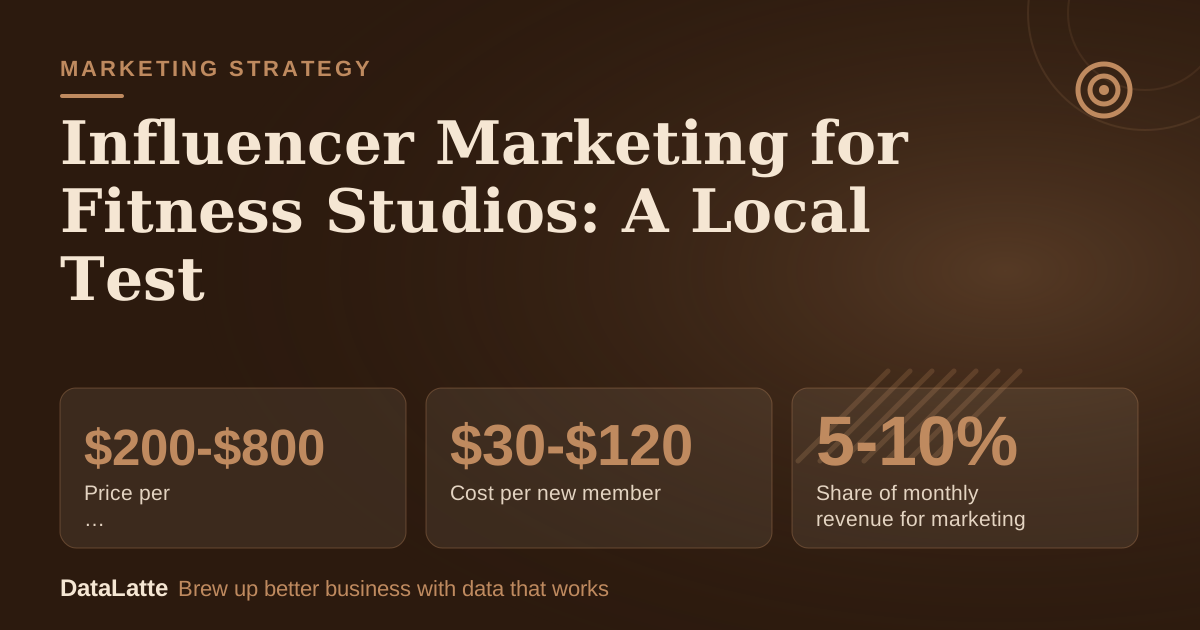
Adwave's gym advertising guide puts local micro-influencers with 5K-50K followers at $200-$800 per partnership, and cost per new member from influencer and trainer marketing at $30-$120. The worked example below shows how quickly a small test can land well outside that band.
→
Price per micro-influencer partnership
Adwave, local creators with 5K-50K followers
↓
Cost per new member
Adwave, influencer and trainer marketing
→
Share of monthly revenue for marketing
Mariana Tek, many boutique studios
→
Short videos per week
Mariana Tek, realistic pace for most studios
See Sources at the end of the article. Cards marked Assumption are examples, not results.
Who should you approach first?
Start with creators whose audience lives close enough to visit your studio on a weekday evening.
Adwave's dental clinic guide recommends local creators with 10,000 to 100,000 followers in niches like beauty, wellness or parenting. A local wellness account near the top of that range is a sensible first target. The gym guide also covers the smaller 5K-50K tier, so you can test both sizes against each other.
Your own members and coaches are a second pool. A member who already tags your studio is easy to approach and believable on camera, but check that their audience is local before you commit.
Before shortlisting anyone, check:
- Audience location and age, taken from a screenshot of their analytics.
- Whether comments show real conversation rather than emojis alone.
- Whether the content is honest and personal enough that you would be comfortable seeing it beside your studio name.
What should you pay a local creator?
Public price data is wide. The gym guide gives $200-$800 per partnership for local micro-influencers and advises planning $300-$2,500 per month across influencer partnerships and trainer-driven marketing. Those are vendor figures, not a rate card. Ask every creator for their rate and a media kit, and expect a small creator to accept less for a membership than for a paid post.
A useful ceiling check comes from
Mariana Tek's guide for group fitness studios, which says many boutique studios budget between 5 and 10 percent of monthly revenue for marketing. Assume your studio takes $20,000 a month (assumption). Then the whole marketing budget sits between $1,000 and $2,000. A $1,200 creator test could consume most or all of one month's budget, so it needs to be sized against your real numbers before you agree to anything.
What belongs in the agreement?
A one-page agreement prevents most disputes. Include:
- Deliverables, for example one Reel, three Stories and one feed post (assumption).
- Dates, and how long the post stays live.
- A unique discount code and booking link.
- An ad label rule: the post must start with a clear ad label, and you approve the draft before it goes live.
- Usage rights: whether you can reuse the content on your channels or in paid ads, and for how long. Paid use is worth a separate fee.
- No claims about weight loss, body change or health outcomes. Keep the focus on the class experience.
Disclosure rules differ by country, and the US, UK, Canada and Australia each have their own advertising regulators with their own guidance. Read your country's current influencer guidance before briefing a creator, because this article does not summarise it. This is general information, not legal advice.
How do you track sign-ups by creator?
Give each creator a unique code and a separate booking page or form. Add a "how did you hear about us?" question to your trial form and your front desk checklist, with creator names as options. Track four numbers per creator: trial sign-ups, attendance, conversion to membership, and retention at 60 and 90 days. Views alone tell you little about whether a class got filled.
Measurement tools help once volume grows.
Gleantap reports that ZenGym, a wellness-focused studio, saw a 60% boost in leads and a 25% rise in conversion within six months of integrating its sales CRM with marketing analytics. That is a vendor's reported result, not a benchmark for a creator test.
Speed matters after the sign-up too. Mariana Tek advises following up within 24 hours with an automated welcome sequence, because interest fades fast. The same logic applies to trial sign-ups from creators. Build the sequence before the first post goes live, using the approach in the
email campaigns guide for fitness studios.
What does the math look like for a four-creator test?
Every input below is an assumption. The $300 fee per creator sits inside Adwave's $200-$800 range, but your quotes may differ.
Inputs (assumption): 4 creators, $300 fee each, total test cost $1,200. Member revenue of $60 per month, staying 10 months, which is $600 of revenue per member.
| Weak | Base | Strong |
|---|
| Trial sign-ups per creator | 2 | 6 | 12 |
| Total trials | 8 | 24 | 48 |
| Trial to member rate | 25% | 35% | 45% |
| New members | 2.0 | 8.4 | 21.6 |
| Cost per new member | $600 | $143 | $56 |
Reading the table against the vendor's $30-$120 band: the base case at $143 is above the top of that range, and the weak case at $600 is five times it. Your numbers will be different, so treat the band as a reference point, not a target.
Payback on revenue is simple. The base case recovers its $143 after about 2.4 months of member fees ($143 divided by $60). The weak case uses up the full $600 of expected revenue, leaving nothing for costs.
The biggest lever is your own conversion rate. In the weak case, moving the trial-to-member rate from 25% to 45% cuts cost per member from $600 to about $333 without changing the creator deal. Work on your trial class and your welcome call before you pay a larger fee.
What should you keep after the test?
Repost creator content with permission, and run the best video as a paid ad where the usage rights allow it. Offer the strongest creators a standing ambassador deal with a membership and a referral reward.
Keep your own feed moving too. Mariana Tek describes three to five short-form videos per week as a realistic, sustainable pace for most studios. A creator can add reach, but a steady channel of your own content keeps people searching for you after the campaign ends. Our
Instagram marketing strategy for fitness studios covers the content side.
What mistakes waste the budget?
- Chasing follower counts instead of local relevance.
- Paying a large fee before running a small test.
- Leaving the ad label to the creator's discretion.
- Sending new leads to a slow or confusing booking flow.
- Filling a class without checking capacity, so new people arrive at a full room and never come back.
- Judging the test by views or likes instead of trials and members.
What should you do this week?
- Write your goal, your offer (for example one free class or a 7-day pass) and the most you will spend on this test.
- Shortlist 10 local creators, members or wellness professionals, then keep four after checking audience location.
- Create one unique code and one booking link per creator, plus a "how did you hear about us?" field on your trial form.
- Send four short, personal messages with a one-page agreement that includes the ad label rule and a draft approval step.
- Set a review 30 days after the last post. Count trials, members and cost per member, then keep, change or drop each creator.
FAQ
How much should a fitness studio pay a local creator?
Prices vary widely. Adwave's gym guide lists $200-$800 per partnership for local micro-influencers with 5K-50K followers. Ask each creator for their rate, start with a small test, and judge the result by cost per new member rather than cost per post.
Does the creator need to label a free membership as an ad?
Treat it as an ad by default and write the label into your agreement. Free or discounted memberships are a material connection in most countries, so check your country's current advertising regulator guidance before you brief anyone. This is general information, not legal advice.
How many creators should I start with?
Three to five. That gives you a range of styles and audience types without a large commitment, and enough data after about one month to decide which creators to keep.
Why measure cost per member instead of cost per post?
A cheap post that brings no trials costs more than it looks. Cost per member combines the fee with conversion, so a $300 creator who brings four members beats a $150 creator who brings none. Track it alongside retention at 60 and 90 days.
Sources
Want a second opinion on your creator shortlist and tracking setup? Start with the
free audit.
Free for local businesses
Want this applied to your business?
I'll review your Google presence, local SEO, and ad accounts — and send you a specific action plan within 48 hours. No pitch, no pressure.