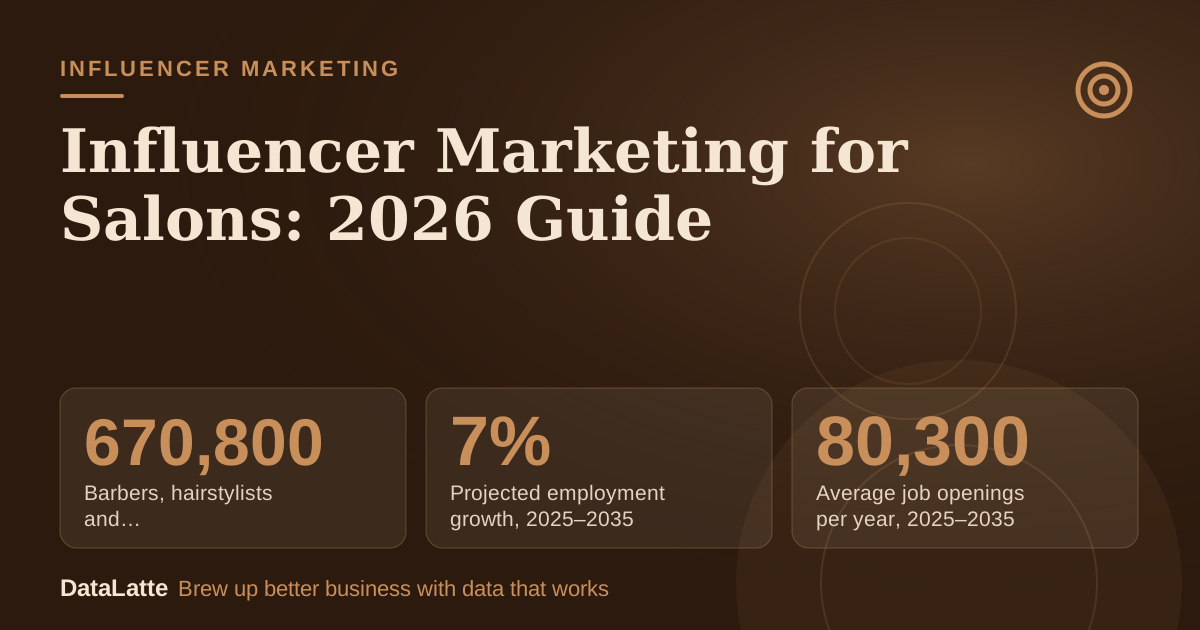
Influencer marketing works for salons when the creator's audience lives near your chair, the collaboration has a clear deliverable, and every booking can be traced back to a link or code. The Bureau of Labor Statistics counts 670,800 barbers, hairstylists and cosmetologists in the US in 2025, so clients have plenty of options. A local creator can put your salon in front of people who already search for the service you sell. This guide covers how to find creators, which collaboration types fit a small budget, how to track results, and what legal points to check before any deal.
→
Barbers, hairstylists and cosmetologists employed, 2025
US workforce size (BLS)
↑
Projected employment growth, 2025–2035
much faster than the average occupation (BLS)
→
Average job openings per year, 2025–2035
many from workers who retire or change jobs (BLS)
→
Median pay, 2025
per year (BLS)
See Sources at the end of the article. Cards marked Assumption are examples, not results.
How Big Is the Competition for Salon Clients?
The BLS projects employment in this occupation to grow 7 percent from 2025 to 2035, which is much faster than the average for all occupations. That growth means more stylists competing for the same local clients. The BLS also expects about 80,300 openings each year, many from workers leaving the field, so the number of salons and chairs keeps shifting. A salon that stands out in search and on social feeds has a better chance of filling its calendar.
Workforce growth does not show which marketing channel to use. It only shows that the local market is crowded. Influencer marketing is one way to borrow trust from a creator who already talks to people in your city. For a broader view of channels, the
best marketing for salons guide compares several options.
How Do You Find the Right Local Creator?
Start with local creators, not the biggest accounts. A creator with a few thousand followers in your city is often more useful than a national account, because the people who see the post can actually walk into the salon. Search TikTok and Instagram for your city plus your service, such as "balayage [your city]," and note which creators tag locations and post hair content regularly.
Check engagement before follower counts. Look at the last ten posts. Real comments ask practical questions such as the price, the location, or whether the salon handles a specific hair type. Generic emoji replies from accounts with no profile picture are a warning sign.
Forbes Agency Council writer Adam Drawas advises matching a creator to the brand's audience, price point and style before any deal. He describes some beauty creators as bold and others as natural and understated, and says the choice should follow the target customer. This is secondary advice from a Forbes contributor, but it applies to salons as much as to beauty brands.
Which Collaboration Types Fit a Small Salon Budget?
Salon collaborations usually fall into four types. The table below is a planning model. The cash costs and client counts are assumptions for illustration, not market rates, so replace them with real quotes.
| Collaboration type | Typical cash cost (assumption) | What the salon receives | Best for |
|---|
| Free service for a post or Reel | $0 cash, one service at menu price | One Reel or Story set, reposting rights | First test with a new creator |
| Paid Reel with booking link | $50–$150 (assumption) | Short video, tagged location, tracked link | Filling open weekday slots |
| Giveaway with a creator | Cost of one service plus ad time (assumption) | Follower growth, entries tied to booking page | Launching a new service or stylist |
| Ongoing ambassador | Commission per referred client (assumption) | Repeat content, referral tracking | Creators who already visit as clients |
The free-service option is the easiest start. Give the creator a service at a real menu price, record its value, and agree on the post in advance. Repeat visits often produce more natural content than a single paid post. For a more detailed walkthrough of this approach, read the guide on
influencer marketing for hair salons and free bookings from local creators.
Forbes notes that some beauty brands pay between $15,000 and $95,000 for one YouTube tutorial with social promotion, and that creators often decide how the content looks. That range reflects large consumer brands, not salons. It does show that creators control their own style, so a salon should set a clear deliverable, leave the creative approach to the creator, and still review the final post.
How Do You Build a Simple Budget for a Test?
A small test needs three inputs: the cash spent, the value of free services given, and the bookings expected. The example below uses assumptions, so it shows the calculation rather than a forecast. For a wider budgeting framework, the
local marketing budget guide explains how to split a monthly amount across channels.
Worked example (all inputs are assumptions):
- Cash spend: two paid Reels at $75 each = $150
- Free service given: one color service valued at $50 at cost to the salon
- Total monthly cost: $150 + $50 = $200
- Bookings tracked to creator codes: 8 new clients
- Average ticket per new client: $60
- Revenue from tracked bookings: 8 × $60 = $480
- Return on the $200 cost: ($480 − $200) ÷ $200 = 140%
If only three clients book, revenue is $180 and the test loses $20. That outcome is why the test should run for a fixed period, such as two months, before deciding whether to keep spending. Repeat posts from the same creator also keep working after the campaign ends, which this simple model does not count.
How Do You Track Bookings From Influencers?
Give each creator a unique link and a unique promo code. Use a link format like this: https://your-salon.com/book?utm_source=tiktok&utm_medium=influencer&utm_campaign=creatorname. Most booking tools and Google Analytics can then show clicks and completed bookings by source.
Promo codes capture bookings that arrive by other routes, such as a client who types the code at checkout. Ask every new client how they heard about the salon and log the answer. This is manual, but it catches referrals that codes miss. For more on local search tracking, read the
hair salon local SEO guide.
What Legal Points Should a Salon Check Before a Deal?
A free haircut is still a payment for a post, so a short written agreement is worth the effort. It should state the service and its value, the deliverables (for example, one Reel and two Stories within 14 days), the timeline, and whether the salon can repost the content. It should also require the creator to disclose the arrangement in the post, such as with a #ad or #sponsored tag.
The US Federal Trade Commission publishes guidance on endorsements, influencers and reviews. Read it before starting, especially if the salon plans to pay creators or offer free services in exchange for posts. Rules outside the US differ, so salons in the UK, Canada or Australia should check their own regulators.
What Should a Salon Do If a Post Goes Wrong?
Plan for mixed reactions before the video goes live. Forbes writer Adam Drawas notes that negative criticism can spread quickly, and that a creator with 500 followers can matter as much as a large account when a comment goes viral. Decide in advance who will reply to comments, how complaints about service will be handled, and when the creator will be asked to edit or remove a post.
Asking to approve a post before it goes live is a reasonable request for a free service. Keep the request polite and focused on accuracy, such as correct pricing or the service shown.
Who Should You Target: Stylists or Clients?
Local creators who are hairstylists can be useful for education and industry visibility, but they do not always bring clients. A stylist in one state posting to other stylists may build industry friendships, yet the post may not move local bookings. A secondary Instagram post from Looks By Laurel makes this point: the goal is clientele, so the content should answer what a woman in the area wants to know before she books.
Before each collaboration, check whether someone who lives within driving distance of the salon would want this service. If the answer is no, the post may be good for reach but weak for bookings.
FAQ
What is a realistic first budget for influencer marketing?
Start with a small test that the salon can afford to lose, such as the assumption-based $200 model above. Test one or two creators for two months, then compare tracked bookings against cost before spending more.
Do I need a contract for a free service?
Yes, a one-page agreement is enough. Include the service value, deliverables, timeline, repost rights, and a disclosure requirement. The FTC guidance on endorsements is a useful reference before drafting it.
How can a salon tell if a creator has fake followers?
Compare comments with follower count and check whether comments ask real questions about price, location or service. Low engagement on a large account is a warning sign, and generic comments from accounts with no profile picture are a red flag.
Should a salon use the same creator more than once?
Often yes. A creator who visits as a client several times produces more natural posts, and their audience starts to link them with the salon. Track each round separately to see which creator brings bookings.
Is influencer marketing better than Google Ads for salons?
They do different jobs. Search ads capture people already looking for a service, while creator posts build familiarity and can keep getting views after paid activity stops. Many salons use both, and the right mix depends on tracked results. For more ideas, see
salon marketing ideas that fill the chair every week.
Sources
Ready to test local creators without guessing where the bookings come from?
Book a free audit. The audit reviews the booking funnel, tracking setup, and local search presence before any campaign spend.