Local SEO for a coffee shop in St. Louis, MO comes down to three things: a Google Business Profile that matches the real-world business, a website that Google can read and understand, and a realistic timeline for judging results. Google's guidance says a profile should be accurate, use the fewest categories that describe the business, and exist once per business. Google also says changes can take a few hours or several months to appear, so owners should wait a few weeks before deciding whether an edit worked. The checklist below follows those rules.
Assumption→
Customers who leave a review after a text link
Assumption: planning rate for a worked example
Assumption→
Customers served per week
Assumption: example shop volume
↑
Reviews per month from that routine
Derived from the assumptions above
→
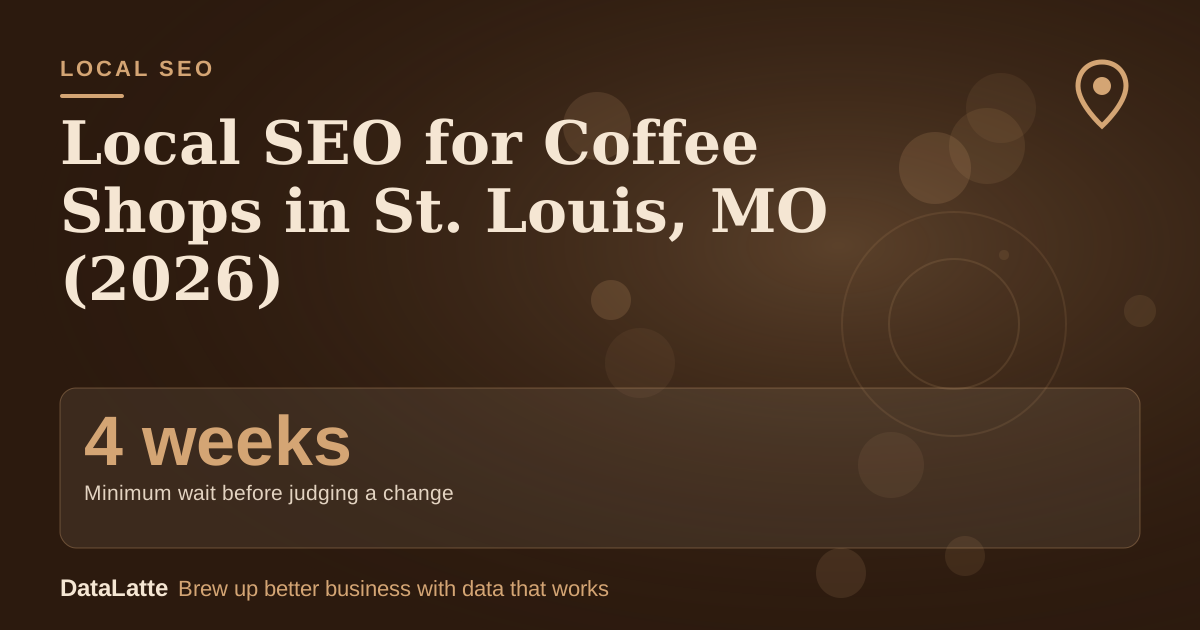
Minimum wait before judging a change
Google advises a few weeks before judging a change
See Sources at the end of the article. Cards marked Assumption are examples, not results.
How does Google find a St. Louis coffee shop's website?
Google uses automated crawlers that explore the web and add pages to its index. Most sites are found without any action beyond publishing, and the SEO Starter Guide notes that sites following Search Essentials are more likely to appear in results (
SEO Starter Guide, Google Search Central). Before changing anything, search for the site with the site: operator to confirm whether Google has already indexed it.
Google also finds pages through links from other pages it has already crawled. A neighbourhood listing, a local blog post, or a mention from a partner business can help Google discover the site. Building links deliberately is not needed before the basic profile is correct.
If pages show different content depending on the visitor's location, check what Google sees. The same guide says Google's crawler generally operates from the US, so the version Google reads may differ from what a St. Louis customer sees. The URL Inspection Tool in Search Console shows how Google renders a specific page.
What should a St. Louis coffee shop put in its Business Profile name and description?
Google's guidelines require the business name to reflect the real-world name used on signage, stationery, and the storefront. Extra words such as a city, a tagline, or a store code are not permitted, and they can lead to suspension (
Guidelines for representing your business on Google). The guidelines use the example of a coffee shop called Shelly's Coffee, which is entered as that name, with the address, hours, and category in separate fields.
A St. Louis shop should therefore keep "St. Louis" and "Best Coffee" out of the name field. The city belongs in the address, and it can appear naturally in the description. The description should cover services, products, mission, and history. It should not contain links, special promotions, prices, or sale offers, and it should avoid misspellings or gimmicky characters.
A workable description names the service, the neighbourhood, and one clear differentiator, such as house-roasted beans or seating for remote workers. Read it aloud. If it sounds like a sentence a customer would say, it is probably right. For more on profile fields, see
Google Business Profile tips for coffee shops.
Which categories and fields should a coffee shop complete?
Google asks businesses to choose the fewest categories needed to describe their core business. For most St. Louis coffee shops, a primary category of coffee shop is enough. Secondary categories should only be added where they describe services the shop actually offers. Loosely related categories can blur how the listing displays in Maps and Search.
The table below sets out each field, what Google's guidelines require, and what to write for a St. Louis coffee shop.
| Profile field | What Google's guidelines require | What to write in St. Louis |
|---|
| Business name | Real-world name, no taglines, no city | The name on the signage |
| Primary category | Fewest categories that fit | Coffee shop |
| Address and service area | Accurate and precise | Storefront address; service area only if delivery is offered |
| Hours | Match real opening times | Holiday changes entered in advance |
| Description | No links, no promotions or prices | Service, neighbourhood, one differentiator |
| Photos | Represent the business honestly | Interior, drinks, exterior, menu board |
How long before profile and website changes show up?
Google says each change takes time to appear. Some changes show within hours, while others take months. It recommends waiting a few weeks before deciding whether a change worked, and it notes that not every edit produces visible results. Testing one change at a time and observing it is the sensible approach.
Consider a worked example with the following inputs. Assumption: a St. Louis coffee shop changes its description and adds ten new photos on 1 March. Assumption: the owner reviews Search Console and Business Profile insights four weeks later, comparing views and actions with the previous four weeks. If the numbers rise, the change stays. If they do not, the owner adjusts one field at a time. Changing everything at once makes the cause of any result impossible to identify.
How should reviews fit into a St. Louis local SEO plan?
Reviews are a customer-facing trust signal, and they are easy to mismanage. Google's guidelines focus on accurate, honest representation of a business, so a review request should never ask for a positive review or offer an incentive. Every customer should receive the same neutral request, and every review should get the same professional reply.
Consider another worked example. Assumption: the shop serves 250 customers a week. Assumption: 2 percent of customers who receive a text with a review link leave a review. That gives about 5 reviews a week, or roughly 20 a month. These are planning figures, not benchmarks, but they show how a simple follow-up routine can be sized before committing to it.
Replies can mention the neighbourhood and drink names where they fit naturally. They should not be stuffed with keywords. Google's documentation consistently asks for content that is relevant and useful to customers.
What does consistent name, address, and phone data look like?
Google's guidance asks that a business be represented the same way it appears in the real world. That means the same name, address, and hours on the storefront, the website, the Business Profile, and any directory listing the owner controls. If the sign says "Street" and the profile says "St.," choose one form and use it everywhere.
Listings the owner did not create need checking too. Google states there should be only one profile per business, and duplicate or inconsistent profiles can cause display problems. If a duplicate exists, claim it and request its removal rather than adding a second listing.
How should the website support the Google listing?
The website should reinforce the same facts as the profile. Descriptive URLs help visitors understand what a page covers, and Google can display parts of the URL as breadcrumbs in search results (
SEO Starter Guide, Google Search Central). A page about espresso drinks should use a path that names espresso and the neighbourhood, not a random code.
Google's LocalBusiness structured data documentation explains how to mark up name, address, and hours so Google can read them directly (
Local Business structured data, Google Search Central). The markup should match the profile exactly. A map on the contact page also helps visitors confirm the location, and the
guide to embedding a Google Maps listing on a website covers the setup.
What is a 7-step checklist for a St. Louis coffee shop?
The following sequence applies the guidance above in order. Each step should be finished before the next one begins, so that any later change can be measured against a known baseline.
- Search for the site with the site: operator and confirm it is indexed.
- Check that the name on the profile matches the signage with no city, tagline, or store code.
- Set the primary category to coffee shop and remove any category that does not describe a real service.
- Confirm the address, hours, and phone number match across the storefront, website, and profile.
- Rewrite the description with no links, prices, or promotions.
- Mark up the business details with LocalBusiness structured data that matches the profile.
- Record a baseline, then wait a few weeks before judging any change.
Keeping the baseline matters. Without a dated record of views and actions before the work starts, a later comparison has nothing to measure against.
FAQ
Can a St. Louis coffee shop add its city to the business name?
No. Google's guidelines say the name must reflect the real-world name used on signage and stationery. Adding a city, a tagline, or a store code is not permitted and can lead to suspension. The city belongs in the address field.
How many categories should a coffee shop choose?
Google recommends choosing the fewest categories that describe the core business. For most coffee shops, that means a primary category of coffee shop, with secondary categories only where they accurately describe services offered.
How long should a change be given before judging it?
Google recommends waiting a few weeks. Some changes appear within hours and others take months, so one or two days of data is not enough to judge an edit.
No. Google's guidelines say the description should not focus on special promotions, prices, or sales, and it should not contain links. Offers belong in posts or on the website.
Next steps for a St. Louis coffee shop
Start by checking that the name, address, hours, and category match what Google's guidelines require. Update the description, confirm the website shows the same facts, and wait a few weeks before reviewing results. For help applying this to a St. Louis location, see
DataLatte's local SEO service, or request a
free audit of the current listing.
Sources