DataLatte☕
Marketing Strategy

Marketing for Axe Throwing Venues
Infographic: Marketing for Axe Throwing Venues

Part of the guide: Local Marketing Strategy

May 21, 2026·Nataliia Rumiantsewa· 10 min read All posts
A group of 10 at $35 a head is a $350 booking, and it takes the same lane as a couple paying $60. That is the whole economics of an axe throwing venue in one line: lanes are your stock, empty weekday lanes are spoiled stock, and groups are the way you sell them.
ZenBusiness's venue guide (updated September 28, 2026) puts lane pricing at $30 to $40 per person and says marketing "centers on group bookings and corporate events, which fill lanes more reliably than walk-ins alone."
This guide is for venue owners in the US, UK, Australia and Canada. It covers who books, how to put weekday lanes in front of them, what Google and Meta ads allow, and a payback calculation.
It also has a section most marketing guides skip: axe throwing sits in an awkward spot in ad policies and with regulators, and your own social posts can be used as evidence of how you run your lanes. Where something is a recommendation rather than a verified rule, it is labelled. This is marketing guidance, not legal or insurance advice.

Who Books, and What They Need to See

Think about the person who clicks "book", not the person who throws. Party organisers (birthdays, stag, hen and bachelor nights) want a package price and proof other groups had fun. Office and team organisers want capacity, session length, food options and one invoice, and they often book weekday evenings, exactly when lanes sit empty.
Couples and small groups book late, from a phone, after checking reviews. Leagues are repeat revenue; ZenBusiness suggests a programme of 100 to 200 participants, which is one venue guide's target, not a norm.
You have competition. WATL's site lists "300+ Affiliated Venues across 20 countries," and Xola's 2023 industry roundup cites about 360 US axe throwing businesses, a figure it attributes to IBISWorld. Counts differ by source, so assume a customer in your city can choose between venues.

Step 1: Win the Search That Fills Weekday Lanes

Most people find a venue with a phone search for the activity plus a city or "team building". Fill in your Google Business Profile with the closest primary category Google offers in your country, real photos of lanes and groups, and a booking link (see our Google Business Profile checklist).
Give each offer its own page (walk-ins, parties, corporate, leagues) stating group size, session length, age rule, safety briefing and price. Ask the organiser for a review the same evening, reply to every review, and keep hours, age limits and cancellation terms identical across Google, your site and Facebook.
If a competitor outranks you for "axe throwing near me", compare their review count and photos with yours first.

Step 2: Make a Group Booking Take Two Minutes

Test your own flow on a phone. Can someone book eight people for 7 pm on a Saturday without emailing you? Does it show live availability and take a deposit? Does every group member get the waiver automatically, with the age rule clear before payment? Is there a visible route for corporate quotes and invoices?
Waivers matter commercially, not only legally. ZenBusiness says insurers often require legally binding digital waivers for every participant, and that the waiver system should link to booking software so that no customer enters the throwing area without signing.
It also notes that collecting email addresses through that digital waiver gives you a channel to promote leagues and events. Whether you can market to that list depends on the consent you collect and the privacy law where you operate, so ask a lawyer to word the waiver.

Step 3: Sell the Weekday Slot

Build offers around the quiet times: a fixed-price 90-minute midweek team session with one invoice, a modest Monday to Wednesday group rate, a recurring league night, and gift vouchers usable off-peak. Prices vary by city; the $30 to $40 range above is one guide's figure, so check two or three local competitors. Our Facebook ads for event promotion article gives a promotion framework for a recurring night.

Step 4: Know What the Ad Platforms Say

This is where axe throwing differs from a salon or a café.

Google's weapons policy mentions throwing axes

Google's Other weapons policy lists "throwing axes" among its examples of knife designs that give a confrontational advantage, under a heading of items that are not allowed. It also bans ads for products designed to injure an opponent in sport, and for instructional content about assembling, enhancing or acquiring them.
The page is written about products and instructional content. It does not say whether a venue selling an axe throwing session falls inside it.
Google's wider Dangerous products or services policy says you cannot promote products or services that cause damage, harm or injury in your ads or destinations, and it also does not address recreational venues.
What does that mean in practice? Nobody can tell you from the policy text alone. Sensible precautions (this is our recommendation, not Google's guidance):
  • Advertise the experience (team event, party, league) and not the axes themselves. Never sell axes or teach buying or making them in the same ad or landing page.
  • Keep ad copy about fun, coaching and supervised sessions rather than combat, weapons or injury.
  • Start with a small test campaign. If an ad is disapproved, ask Google Ads support how the policy applies to a venue rather than guessing at workarounds.
  • Do not make Google Ads your only channel. Your Business Profile, organic social, email and corporate outreach do not depend on this question.

Alcohol rules change your creative

If you hold a licence and sell drinks, the alcohol policies matter.
  • Google. Its alcohol policy covers ads that feature alcoholic beverages available for purchase, including at offline locations, and allows alcohol advertising only in listed countries and in line with local law. Among the content rules, ads must not show drinking before or during activities that require sobriety or skill. Throwing an axe is a skill activity. A photo of someone holding a beer at the lane in your ad is the thing to avoid. The page does not address bars or venues directly, so check it for your country and ad type.
  • Meta. Its alcohol policy says ads that promote or reference alcohol must follow local laws, and at a minimum cannot target anyone under 18. It lists higher minimum ages in some countries, for example 21 in the US and 19 in Canada.
The safest default, again a recommendation rather than a rule: leave alcohol out of paid creative and promote it in venue and on your site.

Step 5: Social Content Without Creating a Problem

Short video suits this business: a first throw landing, a coach tip, a team challenge. The shooting principles are the same ones used in our coffee shop TikTok guide: a hook in the first second, captions on screen and one clear next step.
But think about what the clip says about how you run the place.
  • Show what a regulator would want to see. The World Axe Throwing League's rules describe lanes as separated by fences or walls to keep throwers and axes contained, and allow only the participating throwers and the lane judge inside the lane during a match. They also recommend a 12 ft minimum clear ceiling height. These are league standards, with venue specs described as recommendations, so they are a sensible benchmark, not a law.
  • Learn from a real case. According to WATL's own 2018 statement, the Michigan Liquor Control Commission reviewed an affiliated bar, a hearing found lax enforcement of safety precautions and the bar received a one-day suspension. The statement said the allegations were not proven in court "with exception to the social media trick shot posts only." The point is not what happened at that bar. It is that your own posts can be treated as evidence of how you run the floor.
  • Do not post unsafe stunts. Trick-shot clips are tempting, but if a video shows throwers outside a lane, people downrange or visibly drunk people with axes, delete the idea and re-film it properly.
  • Be careful with minors. Age rules differ by venue and insurer (an assumption here, since no single standard was found). One US venue profiled by NBC26 in 2022 required a signed waiver and an adult with anyone under 18, and the local council had voiced concern about children as young as 10 taking part. Put your age rule on the booking page and in the briefing video, and get consent before posting identifiable people, especially young people. Consent wording belongs in your waiver, drafted by a lawyer familiar with your area.
The same NBC26 piece quotes an owner acknowledging that a waiver does not fully shift responsibility if someone is hurt. Do not market the waiver as protection for customers or as making the venue "risk free". Market the briefing, the coaching and the supervision instead.
For help getting guests to post, with the permission and disclosure rules, see our guide to getting customers to post about your business.

Step 6: Corporate Outreach That Does Not Rely on Ads

Corporate buyers are expensive to find with search ads, as the math below shows. List 50 employers within a 20 to 30 minute drive, find the office manager or HR lead, and send one offer: "a 90-minute team session on a Tuesday, from $X per person, we handle the briefing, you get one invoice." Follow up once a week later, and ask every booked team for a review that mentions team building. Our email marketing guide covers keeping past organisers warm.

The Math

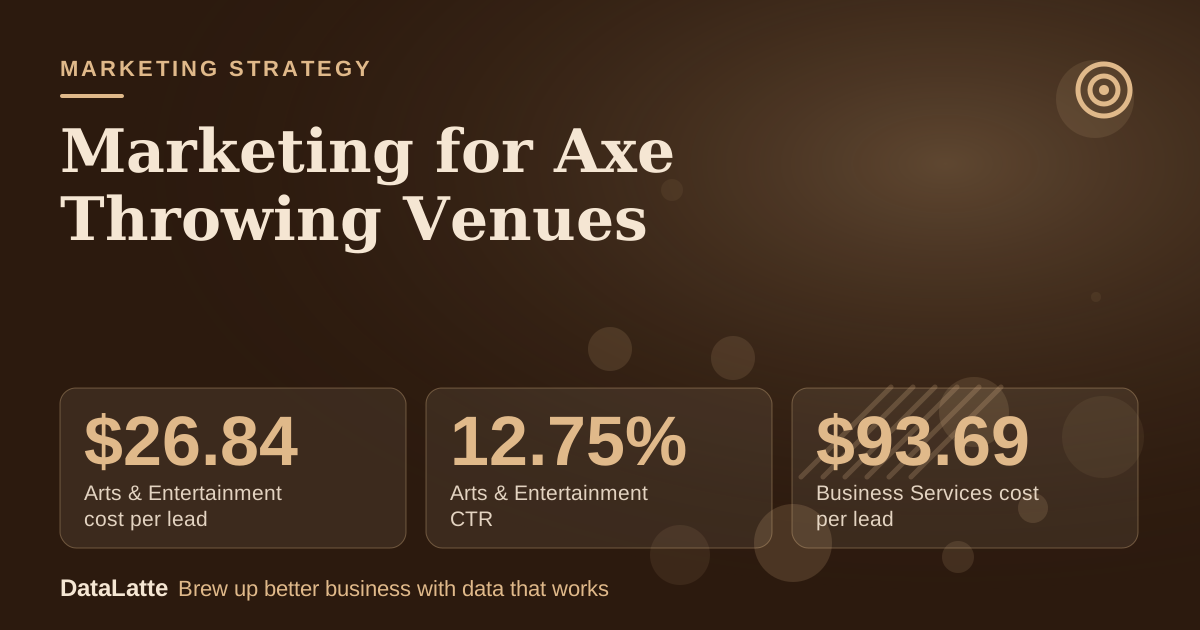
LocaliQ's 2026 search advertising benchmarks (updated June 1, 2026) give all-industry averages of a $5.42 click and $66.69 per lead, and these industry rows:
$26.84→

Arts & Entertainment cost per lead

LocaliQ 2026

12.75%→

Arts & Entertainment CTR

LocaliQ 2026

$93.69→

Business Services cost per lead

LocaliQ 2026

$44.26→

Sports & Recreation cost per lead

LocaliQ 2026

See Sources at the end of the article. Cards marked Assumption are examples, not results.

LocaliQ's category list does not include axe throwing, so treat Arts & Entertainment as a proxy for consumer groups, and Business Services as a proxy for corporate buyers. The rows below use a $600 monthly budget. Everything labelled assumption is a placeholder; replace it with your own booking data.
Consumer groupsCorporate teams
Monthly budget (assumption)$600$600
Cost per lead (LocaliQ proxy)$26.84$93.69
Leads22.46.4
Lead to booking rate (assumption)25%20%
Bookings5.61.3
Cost per booking$107$469
Group size (assumption)812
Price per person (assumption, within the $30 to $40 guide range)$35$35
Revenue per booking$280$420
Revenue from the month's bookings$1,565$538
How to read it:
  • Consumer search ads can pay back. Each booking costs $107 in ads and brings $280 in lane revenue, before staff, rent and insurance. The same revenue-not-profit warning applies.
  • Corporate search ads, at these assumptions, do not. $469 to acquire a $420 booking loses money on the first event. Your maximum lead cost for corporate is group revenue times close rate: $420 x 20% = $84 before any margin, and about $42 if only half the revenue is margin (assumption). That is why direct outreach and repeat events are the better corporate route.
  • Insurance and fixed costs are the real ceiling. ZenBusiness estimates liability premiums of $8,000 to $15,000 as a startup cost (its figure). Whatever yours is, convert it into a number of bookings per month you must sell before you spend anything on ads.
Count Bookings, Not Likes
Ask every group organiser "how did you find us?" and log the answer. A viral clip with 200,000 views that produces no bookings costs more than a quiet one that produces three team events.

Do This Today

  1. Pull your booking calendar for the last four weeks and count empty lanes by weekday. That is your target list for offers.
  2. Write down your price per person, usual group size and the most you would pay to win one booking, using the break-even formula above.
  3. Check the age rule, waiver steps and cancellation terms on your booking page and Google listing, and make them match.
  4. Review your last 20 social posts for anything a regulator or insurer would not want to see, such as unsafe stunts, alcohol with axes, or identifiable minors without consent.
  5. Pick 20 local employers, find the right contact at each, and send a midweek team-session offer this week.

FAQ

Q: Can I run Google Ads for an axe throwing venue? A: Google's Other weapons policy lists throwing axes among examples of items that are not allowed, but the page is about products and instructional content and does not mention venues. Run a small test campaign about the experience, not the axes, and ask Google Ads support if an ad is disapproved.
Q: What should I charge per person? A: There is no official price. ZenBusiness cites $30 to $40 per person for lane pricing in the US. Check two or three local venues and test.
Q: Can I show alcohol in my ads? A: Be careful. Google's policy bars ads that show drinking before or during activities that require sobriety or skill, and both Google and Meta require compliance with local law and age restrictions. Keep drinks out of paid creative unless you have checked the policy for your country.
Q: Can I film customers for social media? A: Only with clear consent, ideally written into your waiver or booking terms, and with extra care for minors. Ask a lawyer to word it for your jurisdiction.
Q: How do I attract corporate bookings? A: Build a corporate page, then contact local office managers and HR leads directly with one weekday offer. At the benchmark lead costs above, search ads rarely pay for a single corporate event.

Sources

If you want a plan that connects local search, group booking and compliant ads, see our Google Ads service, our social media service or contact DataLatte.

Free for local businesses

Want this applied to your business?

I'll review your Google presence, local SEO, and ad accounts — and send you a specific action plan within 48 hours. No pitch, no pressure.

marketing for axe throwing venuessocial media marketinglocal business owners

Want hands-on help?

See how DataLatte handles Analytics & Reporting for local businesses.

Learn more
Nataliia — local marketing expert
Nataliia Rumiantsewa

Local marketing strategist with 10+ years at global agencies — OMD, Dentsu, GroupM, and BBDO. Now helping small businesses get the same data-driven edge. Based in Europe, working with clients in the US, UK, Australia, and beyond.

Want this applied to your business?

Let's review your current marketing setup together — free, no obligations.

Get Your Free Marketing Audit