SMS marketing for retail works when a store texts opted-in customers a small number of real offers: a flash sale with a clear end time, or early access for VIP shoppers. Volume should stay modest, each campaign needs its own promo code so you can see what it drove, and consent has to be documented before anyone joins the list. Local shops that already run in-store promotions can reuse those offers by text. This guide covers cadence, consent, VIP lists, a worked budget example, and holiday planning.
↑
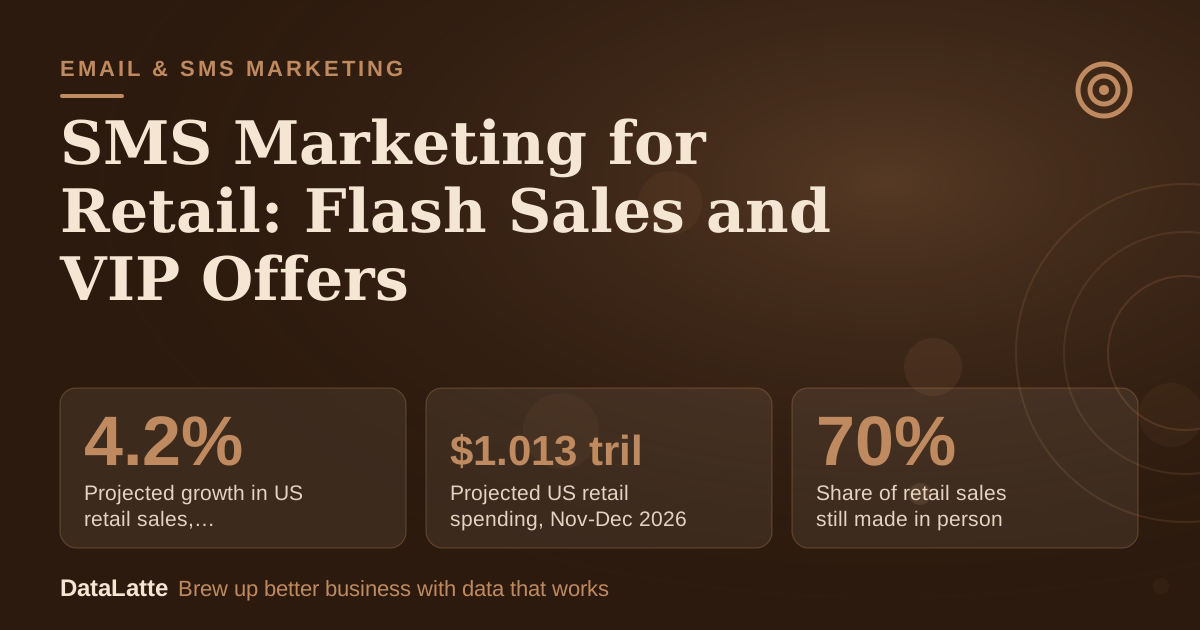
Projected growth in US retail sales, Nov-Dec 2026
NRF forecast, 2026 (primary)
↑
Projected US retail spending, Nov-Dec 2026
NRF forecast, 2026 (primary)
→
Share of retail sales still made in person
NRF figure cited by StackAdapt (secondary)
→
Suggested weekly email volume for e-commerce brands
AdWave guidance for e-commerce brands, not SMS
See Sources at the end of the article. Cards marked Assumption are examples, not results.
AdWave recommends that e-commerce brands send
3-7 emails per week when running flash sales and new drops. That guidance covers email and online stores, so treat it as a ceiling for promotional rhythm, not a target for texts. A shop with a physical storefront usually gets better results from fewer, more useful messages.
A practical starting point is two to four texts per month, reviewed after six weeks. Look at redemptions per text, unsubscribes and feedback from staff at the till. Increase frequency only if redemptions hold steady and opt-outs stay flat. State the expected frequency in the welcome message so subscribers know what they signed up for.
Cadence should also follow the calendar. A text about a weekend sale is useful; a text about nothing is what leads to STOP replies.
Is texting customers legal in the US?
US businesses that send marketing texts must follow the Telephone Consumer Protection Act (TCPA), which generally requires prior consent from the person receiving the message. Record that consent with the date, the phone number, the wording shown at signup and the channel where the customer opted in. A number on a receipt or a business card is not, on its own, a clear record of consent.
Buying or renting a phone list is the highest-risk shortcut. Only text people who joined your list directly.
Rules change, and they differ by country. If you also sell in the UK, Australia or Canada, check the consent rules there separately. Confirm current US requirements with the FCC's consumer guidance or a lawyer before launching, and ask your SMS provider how it captures consent and processes STOP replies.
How do you build a VIP list that actually buys?
A VIP list works best when it is built from customers who have opted in and already bought from you more than once. Ask for the number at checkout as part of a loyalty sign-up, not through a separate form that most shoppers skip. Tag each contact with the categories they buy, such as shoes, skincare or gifts, so a VIP text can refer to something they already shop for.
VIP offers need real value to feel exclusive. Early access to a new collection, first pick of a restock or a members-only discount window all work better than a generic percentage. Keep VIP messages separate from public flash sales so the difference is obvious to subscribers. Automation tools can trigger these messages from purchase history, which is covered in
AI for marketing automation.
What does a flash sale text earn? A worked example
The example below uses assumption inputs for a small boutique. Replace each one with your own numbers before deciding anything.
- Opted-in subscribers: 600 (assumption)
- Flash-sale texts per month: 4 (assumption)
- Cost per text delivered: $0.02 (assumption; check your provider's price list)
- Redemption rate per flash sale: 3% of subscribers (assumption)
- Average discounted sale: $48 (assumption)
- Gross margin on those sales: 40% (assumption)
Texts sent per month: 600 × 4 = 2,400 texts. SMS cost: 2,400 × $0.02 = $48.
Redemptions per sale: 600 × 3% = 18. Across four sales: 18 × 4 = 72 redemptions.
Sales from codes: 72 × $48 = $3,456. Gross profit at 40%: $3,456 × 0.40 = $1,382. Net after SMS cost: $1,382 − $48 = $1,334.
This calculation counts every redemption as new business, which overstates the result. Some shoppers would have bought anyway. Hold back a small random group, for example 10% (assumption), from one promotion and compare redemptions and sales with the group that received it.
How do you measure whether SMS sales are real?
Give each campaign its own promo code. A text that says "Show this message and use SHOE20 by 6pm today" tells you which send produced which sales. Count in-store redemptions in your point-of-sale system and track them against the code. A generic "20% off" message cannot be attributed to a specific text.
For online orders, put a tagged link in each text and check the source in your analytics tool. Keep in-store and online results in separate columns so one channel does not hide the other.
Track unsubscribes alongside redemptions. A spike in STOP replies after a campaign means the offer, the timing or the frequency needs work. For choosing a platform that reports by code, see
AI email marketing tools. Small shops with tight budgets can also review
affordable marketing help for small businesses.
Does SMS matter when most retail still happens in store?
The NRF figure cited by StackAdapt says 70% of retail sales still occur in person. An SMS list therefore mostly drives store visits, so each flash sale should include an in-store cue, such as "show this text at the till." Online-only offers miss most of the people on the list.
The SBA's Small Business Saturday survey includes retail trade with a physical location among its eligible industries. That makes the Saturday after Thanksgiving a natural date for an in-store promotion, announced by text to subscribers who already know the shop.
NRF predicts US retail sales in November and December 2026 will grow 4.2% over 2025, reaching $1.013 trillion in total spending. That is a national figure. Your local result depends on your category and footfall.
When should you plan holiday flash sales?
A retail planning guide cited by AdWave recommends starting seasonal sales planning at least 90 days before the target season. For a November promotion, that means starting in early August. Earlier planning gives you time to set up codes, agree on consent records and test one offer before the busiest weeks.
Use this sequence for each campaign:
- Confirm the consent record for every subscriber you plan to message.
- Write the offer and its exact end time.
- Create a unique promo code in your point-of-sale system.
- Schedule the send and set aside a holdout group.
- Review redemptions and unsubscribes within 48 hours of the sale ending.
FAQ
Should I use SMS or email for flash sales?
Use both for different jobs. SMS suits time-limited offers that need fast attention, such as a same-day sale. Email suits longer content, such as a new-collection story or a loyalty program update.
How many texts can I send without annoying customers?
The sources here do not give a reliable SMS-specific limit. AdWave's 3-7 per week figure is for e-commerce email. Start with a low frequency, measure unsubscribes and redemptions, and adjust from your own data.
You need a platform that records consent, handles STOP replies automatically and reports redemptions by promo code. A built-in tool from your point-of-sale system may cover basic blasts, but check whether it tracks consent and reports results by campaign.
Can I text people who bought in store?
Only if they gave consent to receive marketing texts. A purchase or a receipt is not enough on its own. Confirm the rules for your situation before adding anyone to a list.
If you want a second opinion on whether SMS fits your margins and footfall,
request a free audit.
Sources
Free for local businesses
Want this applied to your business?
I'll review your Google presence, local SEO, and ad accounts — and send you a specific action plan within 48 hours. No pitch, no pressure.