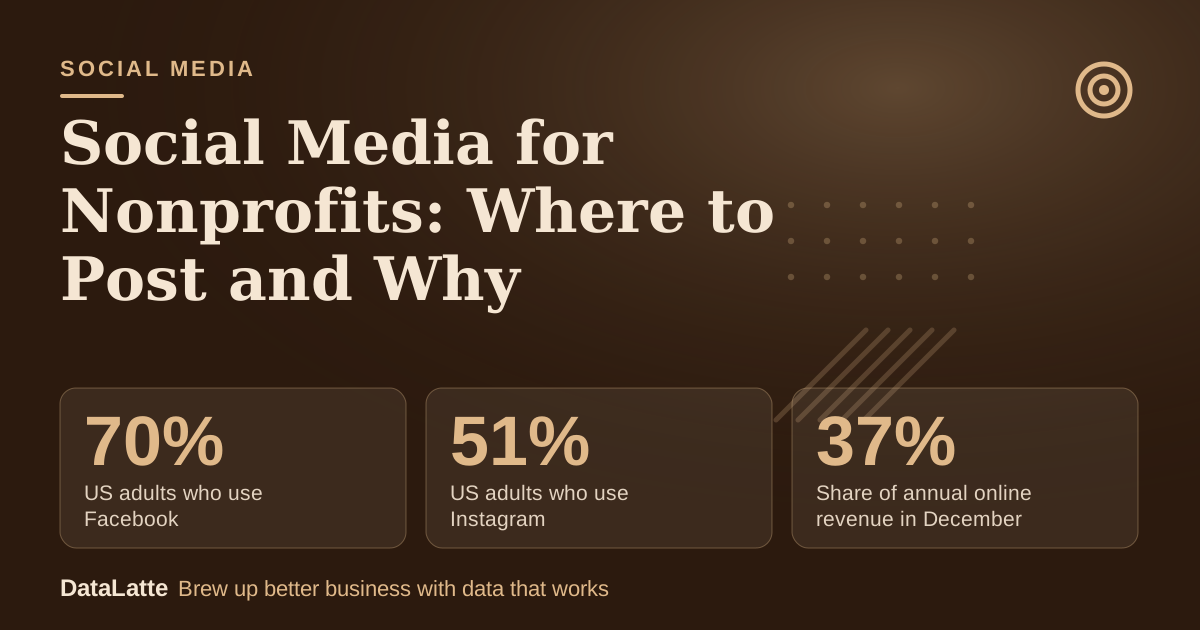
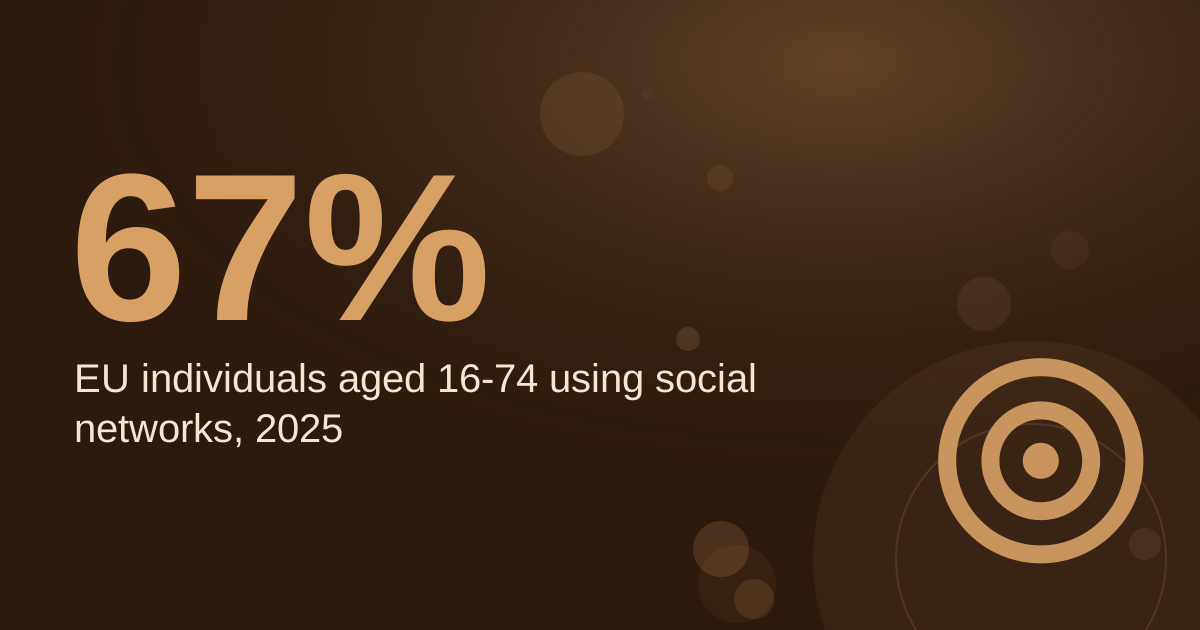
A nonprofit should pick one or two channels where its donors already are, post a steady mix of stories and clear asks, and build the calendar around year-end, when December brought 37% of annual online revenue in the 2026 M+R Benchmarks Study. For most local nonprofits that means Facebook first, then Instagram or YouTube.
This guide covers channel choice, a giving calendar and the cost of taking donations. Every number comes from a source listed at the end. The worked example is labelled as an assumption.
→
US adults who use Facebook
Pew Research Center, 2026
→
US adults who use Instagram
Pew Research Center, 2026
↑
Share of annual online revenue in December
M+R Benchmarks 2026 (2025 data)
↑
Share of online revenue from monthly gifts
M+R Benchmarks 2026 (2025 data)
See Sources at the end of the article. Cards marked Assumption are examples, not results.
Start with reach. Pew Research Center's survey (fieldwork January 30 to June 18, 2026) found that 84% of US adults use YouTube, 70% Facebook, 51% Instagram, 37% Pinterest, 33% LinkedIn, 31% TikTok, 26% WhatsApp and 25% X. Facebook and YouTube reach the widest adult audience.
Nonprofits seem to follow that pattern. In the 2026 M+R Benchmarks Study, nearly all participants were on Facebook and Instagram, 74% on YouTube, 54% on X, 43% on TikTok, 37% on Bluesky and 32% on Threads. Average followers were 53,000 on Facebook and 18,000 on Instagram. The study has 180 participants, so a small local group should expect much lower counts.
How Do Donations Work Through Facebook and Instagram?
Meta moved US nonprofit donation processing to PayPal Giving Fund in October 2023, according to a Funraise guide from September 2023 (secondary source). It reports a US processing fee of 1.99% plus $0.49 per donation and says Meta stopped covering processing fees.
PayPal's own page lists the registered charity rate as 1.99% plus a fixed fee, with no fees for setup, cancellation or withdrawals, and says a charity must be verified first. Meta's current eligibility rules differ by country and change, and Meta's help pages could not be opened for this article. Check them in your Page settings before you plan around donate buttons.
When Do Supporters Give?
Timing matters more than posting volume. M+R found December produced 37% of annual online revenue, the last week of the year 10% and the last day of the year 4%. Monthly gifts made up 27% of online revenue, and 71% of sustainers were still giving after a year.
New donors are harder to keep. M+R reports 24% new-donor retention against 66% for prior donors. A social calendar should therefore do two jobs: bring in first-time givers in the fall and thank existing donors in public.
Can Influencers Help a Small Nonprofit?
Some do. M+R reports that 58% of participating nonprofits had worked with influencers at least once: 24% paid only, 33% unpaid only and 43% both. Every influencer program included Instagram, and 72% included TikTok.
For a local organization, the realistic version is a volunteer, a board member or a local business owner sharing a post with a clear ask. Instagram says posts that are original, use search keywords in captions and bio, and avoid watermarks or reposted content are more likely to be recommended to non-followers.
What Should a Month of Posts Look Like?
Use a repeating rhythm so the page never goes silent. Rotate four post types: a beneficiary story with permission, a number showing what a gift pays for, a volunteer or staff moment, and a direct ask with one link. Put the ask in about one post in four.
Pair the calendar with email, because social reach is not guaranteed. Our email marketing for nonprofits guide covers the list side. For a repeatable calendar format, see the social media content calendar guide. Paid reach is compared in
organic vs paid social media.
What Does One Gift Really Net? A Worked Example
All inputs are an assumption. A donor gives $50 through a Facebook fundraiser processed by PayPal Giving Fund, using the secondary-source fee of 1.99% plus $0.49.
| Item | Amount (assumption) |
|---|
| Gift | $50.00 |
| Percentage fee, 1.99% | $0.995 |
| Fixed fee | $0.49 |
| Total fee | about $1.49 |
| Net to the nonprofit | about $48.51 |
Fees are small against the gift, so the real cost is staff time. If preparing a December campaign takes 10 hours and a volunteer's time is valued at an assumed $20 an hour, the campaign must raise more than $200 to break even on time. Check your own fee in your PayPal Giving Fund account.
Open last year's donation report and mark the weeks that brought the most gifts. Schedule your first three posts for those weeks.
FAQ
Facebook has the widest reach among US adults after YouTube (70% against 84% in Pew's 2026 data), and nearly every nonprofit in the M+R study uses it. Add Instagram or YouTube only when you can post there weekly.
How often should a nonprofit post?
No source in this article gives an exact number. Pick a rhythm you can keep for a year, such as three posts a week, and track results by month.
Not entirely. PayPal Giving Fund lists a registered charity rate of 1.99% plus a fixed fee. There are no setup, cancellation or withdrawal fees.
When should a nonprofit run its biggest campaign?
M+R data shows December produced 37% of annual online revenue, so plan the main ask for the last weeks of the year, and start warming up the list in the autumn.
Should small nonprofits use TikTok?
43% of M+R participants did, but Pew shows 31% of US adults on the platform. Test it only after Facebook and email run smoothly.
Sources
Want a donor-focused social plan? See our
social media service or
book a free audit.
Free for local businesses
Want this applied to your business?
I'll review your Google presence, local SEO, and ad accounts — and send you a specific action plan within 48 hours. No pitch, no pressure.