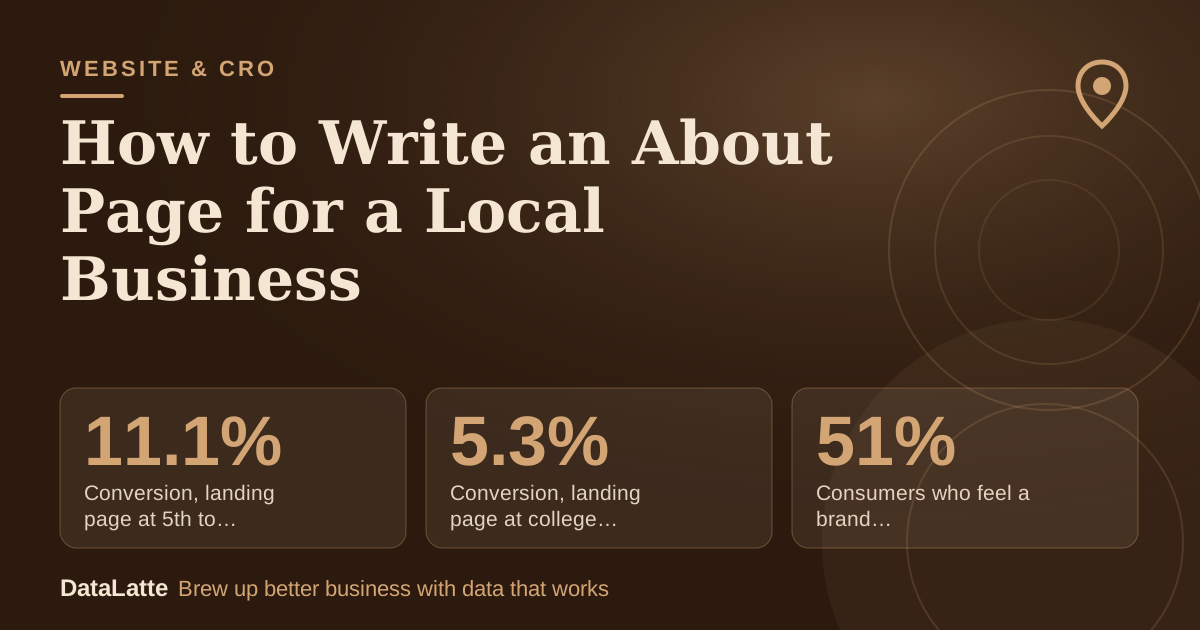
A local business About page should say plainly what you do, who runs the business, where you operate and why a customer should trust you, then point to one next step. Keep the wording plain and specific. In one landing-page benchmark, copy written at a 5th to 7th grade reading level converted at 11.1%, against 5.3% for college-level copy. That figure covers landing pages, not About pages, so treat it as a direction to test rather than a guaranteed result.
The figures in this guide are secondary: they are retellings of benchmarks reported by a vendor blog, not primary research. Use them to shape your own tests.
↑
Conversion, landing page at 5th to 7th grade reading level
Genesys Growth via Adwave (secondary)
↓
Conversion, landing page at college reading level
Genesys Growth via Adwave (secondary)
→
Consumers who feel a brand relationship starts when it understands them
Knapsack Creative via Adwave (secondary)
↑
Low end of first-person CTA uplift
Rob Palmer via Adwave (secondary)
See Sources at the end of the article. Cards marked Assumption are examples, not results.
What should a local About page include?
Use this seven-part outline. Each part answers a question a stranger has before they buy. A short page may combine two parts, but do not drop a question.
| Section | Question it answers | Example content |
|---|
| What you do | Am I in the right place? | One sentence: service, area, who it is for |
| Who runs it | Who am I dealing with? | Names, photos, role, training or years in the trade |
| Origin | Why does this business exist? | Two or three true sentences |
| How you work | What happens if I buy? | Process and any guarantee you actually honour |
| Proof | Can others vouch for you? | Genuine reviews, licence numbers, memberships you hold |
| Place | Where are you? | Address, hours, map, parking |
| Next step | What do I do now? | Book, call or visit button |
Every claim should be true and checkable. If you cannot prove a statement, such as an award or a years-in-business figure, leave it out. Make sure the name, address and hours match your Google Business Profile exactly.
Why does plain wording matter?
The clearest benchmark available is the reading-level test. Genesys Growth's roundup, as reported by Adwave, puts landing pages written at a 5th to 7th grade reading level at 11.1% conversion, compared with 5.3% for copy at a college reading level (
Adwave, secondary).
That is a landing-page result, so it does not prove the same lift for an About page. It does suggest that a stranger reading about your business should not need a dictionary. Write one idea per sentence, name the service in the first line, and cut phrases like "passionate about excellence" that a competitor could also claim.
Should the page focus on your story or your customer?
Little Flame Creative's copywriter, Erica Hartwick, argues that the About page is not really about the writer's life story. Its job is to show how the business is the right person to help its audience (
Little Flame Creative, secondary).
A benchmark that Knapsack Creative cites, reported by Adwave, puts the figure at 51% of consumers who feel a brand relationship starts when the brand understands them and their desires (
Adwave, secondary). Use the What you do and Origin parts to show you understand the customer's problem, then the Who runs it part to show you can solve it.
How should proof and reviews appear?
User-generated content can add weight. WordStream's CRO roundup, as cited by Adwave, reports a 3.2% conversion rate for user-generated content on 1,200 websites, and an additional 3.8% increase in conversions when visitors engaged with it (
Adwave, secondary). Those are website-wide figures, not About-page results.
Put proof in the Proof part: genuine reviews, licence numbers and memberships you actually hold. Link to a fuller reviews page rather than copying every review onto the About page, and keep the details identical to your third-party profiles so no visitor finds a mismatch.
Which next step should the About page point to?
Rob Palmer's copywriting guidance, cited by Adwave, reports tests where first-person CTAs outperformed second-person CTAs by 25% to 90% (
Adwave, secondary). The range is wide and the tests are not described in detail, so run your own split test on the button wording.
Whatever the person, name the action for what it does. "Book a haircut" tells a visitor more than "Learn more", and it should sit in the Next step part with the phone number or booking link beside it.
What is an About page worth?
The worked example below uses assumptions, not benchmarks. Replace each one with your analytics before making decisions.
| Input | Assumption |
|---|
| Monthly About page views | 400 (assumption) |
| Visitors who click the booking button | 8%, so 32 clicks (assumption) |
| Clicks who become customers | 25%, so 8 customers (assumption) |
| Value per customer | $60 (assumption) |
| Monthly revenue linked to the page | 8 x $60 = $480 (assumption) |
If a rewrite lifts the click rate from 8% to 10%, the same traffic gives 40 clicks, 10 customers and $600 a month. Change one thing at a time, so you can tell which edit made the difference.
Do local habits change the outline?
Trust cues and contact habits vary by market. If your customers are in New Zealand, the
New Zealand guide covers local context. Businesses serving Singapore can compare their approach with the
Singapore guide, and those in Malaysia with the
Malaysia guide. The seven parts stay the same; the examples and proof you choose should match the market you serve.
FAQ
How long should an About page be?
The sources here give no ideal length. Cover all seven parts, and cut any sentence that does not answer one of the questions in the outline.
Should I lead with my story or my credentials?
Follow the outline order: what you do first, then who runs the business, then origin and proof. A stranger should know the service and location before reading history.
Do I need photos of my team?
Real photos show the people a customer will deal with. Stock photos of people who do not work for the business undermine the Who runs it part.
Do the reading-level and CTA findings apply to About pages?
They come from landing-page and general website tests, so treat them as direction. Test the wording on your own About page and compare conversions before and after.
Sources
Want a second opinion on your About page?
Book a free audit and we will review the seven parts against what your customers need to see.
Free for local businesses
Want this applied to your business?
I'll review your Google presence, local SEO, and ad accounts — and send you a specific action plan within 48 hours. No pitch, no pressure.