An AI appointment booking agent reads a customer's message, checks your calendar for open times, offers two or three slots and creates the booking once the customer confirms. It can work in Instagram DMs, SMS or a website chat. It does not make people attend. Reminders and clear confirmations do that. Most of the no-show evidence comes from vendor and clinic research, so measure the effect in your own diary before paying for a full build.
This guide covers how the parts fit together, when a plain booking page is enough, what the agent should never do, and a worked budget with labelled assumptions.
↑
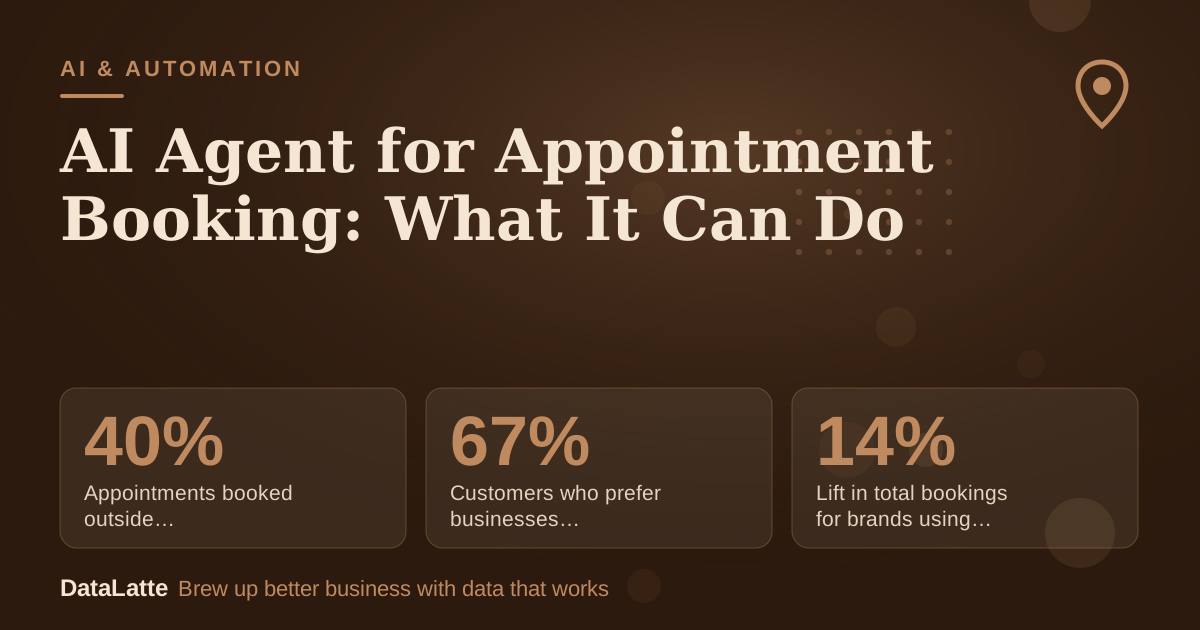
Appointments booked outside standard business hours
Zippia via Adwave (secondary)
↑
Customers who prefer businesses offering online booking
Zippia via Adwave (secondary)
↑
Lift in total bookings for brands using social booking tools
Bookeo vendor guide
↓
Cut in no-shows claimed for automated reminders
Adwave dental guide, vendor claim, not measured for your shop
See Sources at the end of the article. Cards marked Assumption are examples, not results.
How does an AI booking agent work step by step?
Three parts handle a booking. A language model reads the request, such as "can I get a trim Thursday after work?" A calendar connection returns your open and busy times. A booking step writes the appointment and sends a confirmation message.
The agent should offer only slots the calendar returned. A time it invents becomes a broken promise, and the customer blames you, not the software. Keep each offer short: two or three times, with a simple way to reply yes.
Treat the first reply as a lead, not a booking. TailWerks, a pet grooming marketing agency, puts it plainly: a form submission is an inquiry until your booking process confirms the appointment. Count a request as booked only once the calendar entry and the confirmation message both exist. The
LangGraph booking agent guide shows a technical build that keeps context between messages.
Is an AI agent better than plain online booking software?
Often it is not. A booking page already shows free slots, takes deposits and sends reminders. Customers who want to pick a time themselves do not need a conversation. Adwave's mobile wireframe for a booking page shows seven days of tappable slots in one column, with unavailable times labelled in text. A plain page can do that well.
An agent earns its place when people message in free text and expect an answer straight away. Adwave, citing Zippia statistics, says 40% of appointments are booked outside standard business hours. An agent can take those requests in the evening without staff online. For more on the chat side, see
AI chatbots for local business booking and FAQs.
| Situation | Booking page | AI agent |
|---|
| Customer picks a free slot alone | Works well | Not needed |
| Asks "anything Thursday after work?" in a DM | Not handled | Checks calendar and offers times |
| Changes a time by text reply | Manual | Possible if you build that step |
| Complaint or unusual request | Manual | Hands off to a person |
Do reminders actually reduce no-shows?
Reminders are the lever you control most directly, but the size of the effect is uncertain. Adwave's dental guide says automated appointment reminders reduce no-shows by 30% to 50%. Its med spa guide gives 20 to 30%. Both are agency marketing claims, not trials run on your type of business.
A hair salon blog claims automated SMS reminders cut costly no-shows by up to 40%. That claim has no source, so do not plan around it. Bookeo's guide adds that brands adopting social media booking tools see a 14% lift in total bookings. That is a vendor statement, not a controlled result.
The practical step is to log your no-shows for a month, switch on reminders, then log another month and compare. Use the worked example below to check whether the difference is worth paying for.
What should the agent never do?
Set these rules before the agent speaks to a customer:
- Offer only slots the calendar returned.
- Quote prices only from its written instructions.
- Hand complaints, refunds, medical questions and pet-health questions to a person.
- Say it is an automated assistant when a customer asks.
- Send marketing texts only with consent, and check the rules that apply where you operate in the US, UK, Australia or Canada.
Keep sensitive health details out of the agent's notes. The
customer service agent guide covers how to set up those handoffs in more detail.
How much can an AI booking agent save each month?
Every input below is an assumption for illustration, not a benchmark. The 20% reminder effect is the low end of the 20 to 30% range in Adwave's med spa guide.
| Input | Value |
|---|
| Appointments booked per month (assumption) | 200 |
| No-show rate today (assumption) | 12% |
| Average appointment value (assumption) | $60 |
| Relative cut in no-shows from reminders (assumption) | 20% |
| Monthly cost of agent and messaging (assumption) | $50 |
Today: 200 × 12% = 24 no-shows, or about $1,440 of lost sales. After a 20% cut, the no-show rate falls to 9.6%, which is about 19 no-shows and $1,152 lost. The recovered revenue is 4.8 appointments × $60 = $288 a month. Subtract the $50 assumed cost and the net gain is about $238 a month. This assumes the freed slots are not refilled.
If your real no-show rate is only 3%, the math shrinks: 6 no-shows, a 20% cut recovers 1.2 × $60 = $72, and the net after $50 is about $22. A plain reminder on your current software may be enough at that level.
What setup steps should you follow?
- List the services the agent may book, with the duration and staff member for each.
- Connect the calendar and limit bookable hours to what you actually offer.
- Test the booking flow on a phone. Bookeo advises simplifying it if it takes longer than 30 seconds or more than three taps.
- Write the handoff rules from the section above into the agent's instructions.
- Confirm each booking in one message that repeats the service, date and time.
- After seven days, compare confirmed appointments, no-shows and calls the page or agent should have handled, as Adwave's booking page guidance recommends.
If your bookings live in a spreadsheet, the
Google Sheets booking agent guide explains how to connect the two. For a visual workflow tool, see the
Make.com agent workflow guide.
FAQ
Can an AI agent book appointments without staff?
Yes, if it can read your calendar, write events and follow your confirmation and handoff rules. Keep a person available for exceptions, such as complaints or special requests.
Will an AI booking agent cut my no-shows by 40%?
No measured source here supports 40%. Adwave's dental guide claims 30% to 50% and its med spa guide 20 to 30%, both agency statements. A hair salon blog's 40% figure has no source. Test the effect on your own calendar.
How much does it cost?
This guide does not quote platform prices. Costs depend on the tool and message volume, so check current pricing pages, then run the worked example above with your own numbers.
Is it safe for health or pet-medical appointments?
Keep sensitive details out of the agent and hand those cases to a person. Add that rule to the instructions before going live.
Sources
Want help mapping this to your diary?
Book a free audit and we will look at where your no-shows and missed requests are coming from.
Free for local businesses
Want this applied to your business?
I'll review your Google presence, local SEO, and ad accounts — and send you a specific action plan within 48 hours. No pitch, no pressure.