June 30, 2026·Nataliia Rumiantsewa· 7 min read All posts
Connected TV (CTV) advertising lets a small business place video ads in front of households watching streaming content, and a test budget can be set far below the cost of traditional broadcast TV. The clearest way to start is to set a small monthly test, define the audience, and judge results against published benchmarks. This guide uses figures from WordStream's and Google's published material. Local UAE CPMs and regulatory rules are not covered by these sources, so confirm current platform rates and rules directly before committing budget.
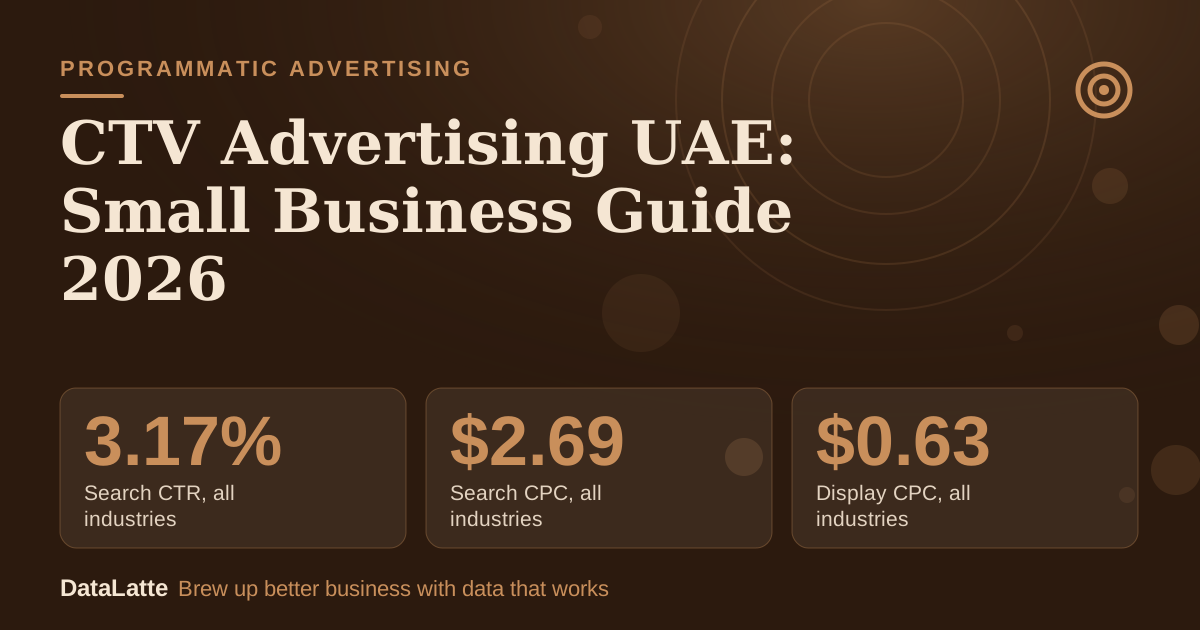
3.17%→
Search CTR, all industries
Average click-through rate across industries (WordStream benchmark)
$2.69→
Search CPC, all industries
Average cost per click for search ads (WordStream benchmark)
$0.63→
Display CPC, all industries
Average cost per click on the Display Network (WordStream benchmark)
35 million↑
Websites and apps in Display Network
Reach of Google Display campaigns across websites, apps, and Google properties
See Sources at the end of the article. Cards marked Assumption are examples, not results.
What do digital ad benchmarks tell a small business?
Benchmarks give a starting point for judging whether an ad is performing. WordStream reports that the average click-through rate across all industries is 3.17% for search and 0.46% for display, and that the average cost per click is $2.69 for search and $0.63 for display. Those figures come from search and display ads, not CTV, so they are a reference for digital efficiency rather than a CTV price list.
Industry numbers vary widely. WordStream's table shows Dating & Personals with a 6.05% search CTR and Technology with 2.09%, while legal services carry a $6.75 average search CPC. A local business should compare its own results against the row for its industry, not the all-industry average. The benchmark page is updated periodically, so check the current version before using any figure in a plan.
How do CTV, search, and display compare on cost and role?
The table below separates what the sources measure from what a CTV buy still needs. Only the search and display rows have published benchmarks. The CTV row is left open on purpose, because CPM quotes depend on the platform and targeting.
Channel
Main job for a small business
Sourced benchmark
What to get before buying
CTV (streaming TV)
Awareness in a living-room context
None in these sources
CPM quote and minimum spend from each platform
Google Search
Capture people already looking
3.17% average CTR, $2.69 average CPC (WordStream)
Industry row from WordStream's table
Google Display
Broader reach across sites, apps, YouTube, Gmail
0.46% average CTR, $0.63 average CPC (WordStream); 35 million sites and apps (Google)
Campaign reach estimate inside Google Ads
Google's Display campaign documentation describes ads reaching people across 35 million websites and apps, plus Google-owned properties such as YouTube and Gmail. Google also states that Display campaigns can use AI-powered bidding and targeting, and that Smart Bidding strategies can optimise for conversions. For a small business, CTV builds awareness with full-screen video, while search and display report clicks and conversions more precisely. Most small budgets should keep a direct-response channel running alongside any awareness buy, so the TV spend can be measured. For a similar budget logic in another market, see the CTV advertising guide for Canadian small businesses.
How should a small business build a CTV test budget?
Start with a fixed monthly test and one clear goal, such as calls, table bookings, or store visits. Set the CPM assumption and the frequency before buying, so the reach numbers are not guesses after the fact. Keep the test running long enough to see a pattern, usually several weeks, and avoid changing targeting every few days.
Here is a worked example for a restaurant. Every input is an assumption and should be replaced with real quotes:
Monthly test budget: $1,500 (assumption).
Cost per thousand impressions (CPM): $25 (assumption).
Cost per household reached: $1,500 ÷ 20,000 = $0.075 (calculated).
If the restaurant gains 40 extra bookings in the test month, which is an assumed count, the cost per booking is $1,500 ÷ 40 = $37.50 (calculated). Compare that figure against the average booking value to decide whether to scale.
How do you check that a CTV campaign is working?
Track the same measures used for any paid channel: visits, calls, bookings, and clicks to your site or map listing. Add a unique phone number, URL, or promo code to the ad so results can be tied back to the spend. Compare the test period against the same weeks before the campaign to see whether the lift is real.
Benchmarks are useful as sanity checks. If your search CTR falls far below the row for your industry in WordStream's table, the problem is more likely the ad copy or the landing page than the TV buy. Fix those before spending more on awareness.
What should you check before you launch in the UAE?
The sources used here do not set out UAE-specific advertising regulations or CTV pricing. Before launching, read the current content rules from the relevant regulator and the platform's ad policy, and have the creative reviewed against them. Check pricing claims for tax treatment as well, because a price that looks correct on screen can be rejected if it does not match local requirements.
Language targeting also matters. Many UAE residents speak Arabic, English, or other languages, so creative in more than one language may widen reach. Test one language first, then add a second only if the first version shows a clear result. If you are weighing content-style placements against video, the native advertising guide for small businesses explains how the two can work together.
How do you set up a first campaign step by step?
Write one goal and one measure, such as bookings per month.
Set a test budget you can afford to run for one full cycle.
Request CPM quotes from two or three platforms and record the minimum spend for each.
Choose a single audience and a single creative version.
Assign a unique tracking number or URL to the ad.
Review results after four to six weeks and decide whether to scale, change, or stop.
Geographic targeting is a useful test in its own right. The Phoenix small business CTV guide shows how city-level targeting changes reach and budget in a US market, which can serve as a template for comparing targeting options in any city.
FAQ
How much should a small business spend on a first CTV test?
Set a budget you can afford to run for a full test cycle, typically several weeks. In the worked example above, a $1,500 monthly test at an assumed $25 CPM buys about 60,000 impressions. Replace the assumed CPM with real quotes before deciding.
Are Google's benchmarks a reliable guide to CTV costs?
No. The benchmarks cover search and display advertising, not CTV. Use them to judge digital efficiency, such as click-through rate and cost per click, and get CTV CPM quotes directly from the platforms you plan to use.
Should CTV replace search or display ads?
Usually not. CTV is best used for awareness, while search and display campaigns capture people who are already looking and report clicks and conversions more precisely. Most small budgets keep a direct-response channel running alongside any TV buy.
How do you know whether CTV is working for your business?
Use a unique phone number, URL, or promo code for the campaign, and compare bookings or calls during the test period against the same weeks before it. If the lift is small relative to spend, adjust the audience or creative before scaling.
Local marketing strategist with 10+ years at global agencies — OMD, Dentsu, GroupM, and BBDO. Now helping small businesses get the same data-driven edge. Based in Europe, working with clients in the US, UK, Australia, and beyond.