CTV Advertising in Phoenix, AZ: Local Guide (2026)
Part of the guide: Connected TV (CTV) Advertising
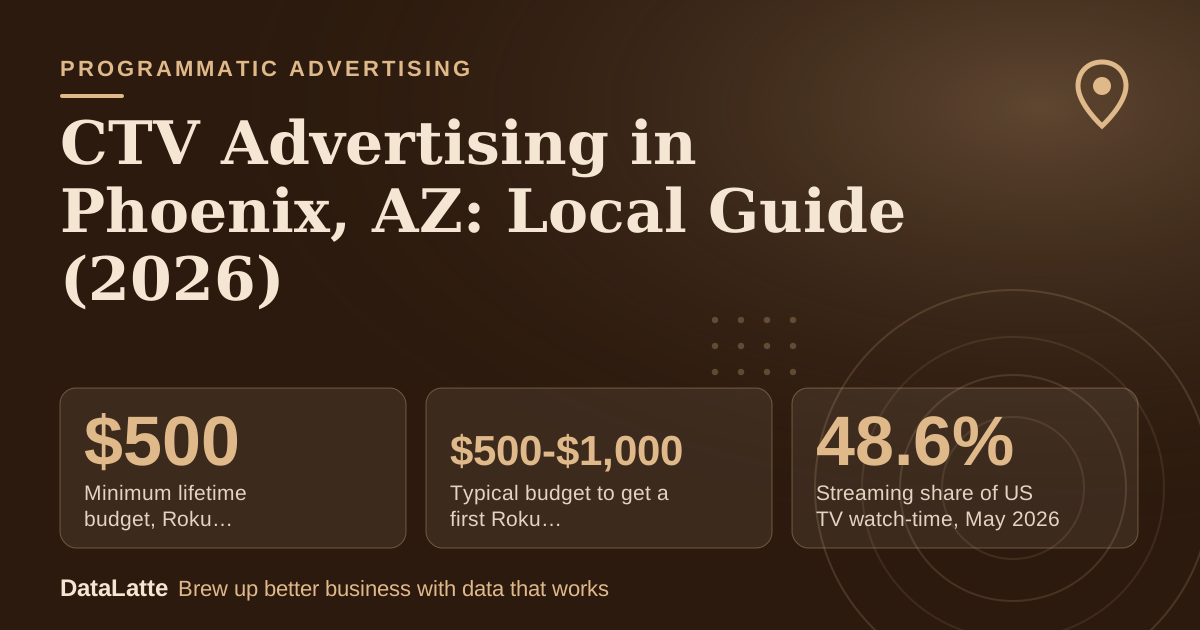
Minimum lifetime budget, Roku Ads Manager
Roku Ads help center
Typical budget to get a first Roku campaign live
Roku Advertising
Streaming share of US TV watch-time, May 2026
Nielsen Gauge, via Advanced Television (secondary)
Blended US CTV CPM, 2026
eMarketer, via AdWave (secondary)
See Sources at the end of the article. Cards marked Assumption are examples, not results.
What Does the Phoenix CTV Market Look Like?
Why Can CTV Work for Local Businesses?
- ZIP-code or radius precision: target the neighbourhoods where your customers live.
- Household-level reach: the ad appears on the living-room screen, not a single phone.
- TV-style brand building: a short, well-made video can build familiarity faster than a small display ad.
Which Platforms Can Phoenix Advertisers Use?
- Self-serve ad managers from streaming services: Roku Ads Manager requires a lifetime budget of $500 or more per campaign (Roku help center). Disney Campaign Manager starts at $500 per campaign for Hulu and Disney+, with ZIP code, age, gender and interest targeting (Disney Campaign Manager FAQ). Tubi announced a self-serve platform for small and medium-sized businesses in May 2025, but its page gives no minimum (Fox Corporation).
- Programmatic DSPs: Platforms like StackAdapt and The Trade Desk can buy across many streaming apps from one dashboard. They offer more control, and often higher minimums.
- Managed services: A partner handles buying, creative direction and reporting for you, usually for a fee.
How Do You Set Up Targeting in Phoenix?
When Should You Run CTV in Phoenix?
What Creative Specifications Do You Need?
- Format: MP4 or MOV
- Aspect ratio: 16:9 landscape, for full-screen TV viewing
- Duration: 15 seconds is a common starting point, with 30 seconds for more complex offers
- Audio: Sound is usually on in CTV, so plan good audio, and add on-screen text for your offer
- Resolution: Full HD or better
How Much Should a Phoenix Business Budget for CTV?
| Stage | Goal | Approach |
|---|---|---|
| Trial run | Test audience response and creative | A modest budget for four to six weeks in a tight area |
| Core campaign | Build recognition | A steady monthly budget for about three months, with frequency capping |
| Seasonal burst | Support a peak period | Concentrate spend for six to eight weeks before the season |
Worked Example
How Do You Measure CTV Results?
- Branded searches: use Google Search Console and your Google Business Profile to see if searches for your name rise
- Direct website traffic: a lift during the campaign can indicate recall
- A campaign-specific phone number, URL or promo code
- "How did you hear about us?" on bookings and intake forms
- Provider attribution reports: some platforms model store visits, which are helpful but estimates
How Do You Get Started?
- Fix your foundation. A complete Google Business Profile, good reviews and a fast landing page make every channel work harder.
- Choose a platform. Compare a self-serve option with a DSP or managed partner, based on your budget and how much control you want.
- Prepare creative. Shoot a short, clear video that fits a TV screen.
- Launch a tight test. Use a small local area, a frequency cap and a clear offer.
- Review and adjust. Check results after several weeks before scaling.
FAQ
Sources
- Roku help center: Campaign budget and schedule ($500 minimum lifetime budget)
- Roku Advertising: How much does it cost to advertise on Roku ($500-$1,000 to get live; video specs; no CPM listed)
- Disney Campaign Manager: Getting started FAQ ($500 minimum; targeting options)
- Fox Corporation: Tubi self-serve ads platform (announced May 2025; no minimum listed)
- Advanced Television: Nielsen, YouTube takes 13.8% of US TV watch-time in May (secondary report of Nielsen's Gauge, May 2026)
- AdWave: Average CTV CPM, Q2 2026 (secondary: a reseller citing eMarketer for the $26 blended CPM; the $15-$35 local range is AdWave's own)
Related Articles
- How Much Does CTV Advertising Cost? Real CPM Data
- CTV Ads for Fitness Studios
- Is CTV Advertising Worth It on a Small Budget?
- Google Ads for Hair Salons in Phoenix, AZ
- CTV advertising guide
Ready to Try Streaming TV in Phoenix?
Related guides
- CTV Advertising in San Antonio: ZIP Data and Costs
- CTV Advertising in the UK for Small Business (2026)
- CTV Advertising Tampa: Local Business Guide
- OTT Advertising for Local Business: Costs and Setup
- CTV Advertising Charlotte NC: Local Business Guide 2026
- Holiday CTV Ads for Local Business: Q4 Playbook
- CTV Advertising in Los Angeles: Local Business Guide
- CTV Advertising Honolulu HI: Local Business Guide 2026
- CTV Advertising in Fresno, CA: Local Business Guide
- CTV Advertising in Europe for Small Business (2026)
- Mobile Advertising Networks for Local Business
Free for local businesses
Want this applied to your business?
I'll review your Google presence, local SEO, and ad accounts — and send you a specific action plan within 48 hours. No pitch, no pressure.
Want hands-on help?
See how DataLatte handles CTV Advertising for local businesses.

Local marketing strategist with 10+ years at global agencies — OMD, Dentsu, GroupM, and BBDO. Now helping small businesses get the same data-driven edge. Based in Europe, working with clients in the US, UK, Australia, and beyond.
Related articles
CTV Advertising Virginia Beach: Local Business Guide
7 min read
CTV Advertising Tampa: Local Business Guide
7 min read
CTV Advertising in St. Louis, MO: Local Guide 2026
7 min read
CTV Advertising Seattle WA: Local Business Guide 2026
7 min readWant this applied to your business?
Let's review your current marketing setup together — free, no obligations.
Get Your Free Marketing Audit