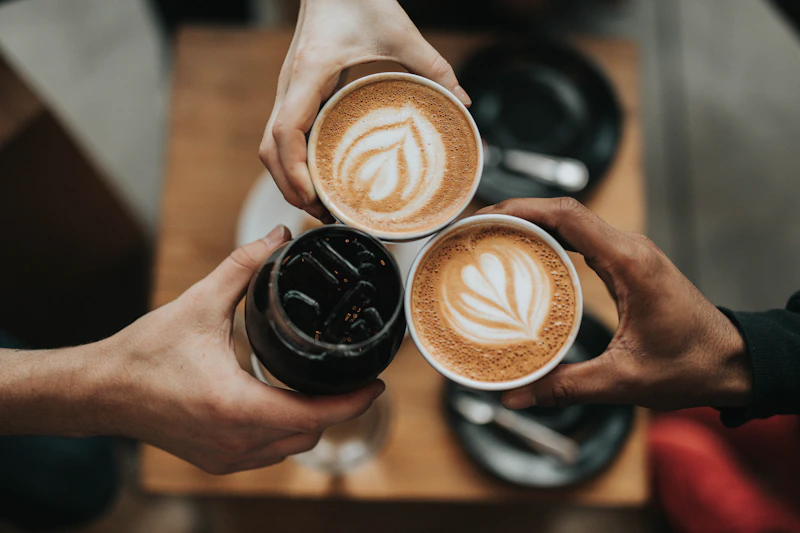
Coffee shops in the US face a tough competition from large chains. To stand out, local owners must be strategic with their marketing. One effective way to attract new customers is through Facebook Ads.
Here's a look at the statistics that caught our attention:
75%↑
Facebook-Only Advertisers
Reported increase in sales due to Facebook Ads
45%→
National Coffee Shop Chains
Number of US coffee shops using Facebook Ads
30%↓
Local Coffee Shops
Percentage of local coffee shops without a social media presence
25%↑
US Coffee Consumers
Percentage of US coffee consumers who use social media
Estimates for illustration; actual numbers vary.
In this case study, we'll explore how a small coffee shop in Los Angeles used Facebook Ads to increase sales. Our goal is to provide actionable insights that you can apply to your own business.
Setting Up Facebook Ads for Coffee Shops
Before launching any ad campaign, it's essential to set up your Facebook page and Google Business Profile (GBP). This will help you reach a wider audience and improve your online visibility.
To begin, follow these steps:
Create a Facebook page and claim your Google Business Profile
Ensure your page has high-quality photos and a complete description
Set up a business manager account to manage your ads
Pro Tip
Want expert help? DataLatte's Meta Ads management service is built specifically for local small businesses.
Choosing the Right Ad Objective
When creating a Facebook ad campaign, you need to choose an objective. For a coffee shop, a popular choice is the "Conversions" objective. This will help you drive sales and bookings.
However, if your goal is to increase brand awareness, consider using the "Awareness" objective instead.
Crafting Compelling Ad Creative
Your ad creative should be visually appealing and attention-grabbing. Here are a few tips to get you started:
Use high-quality images or videos that showcase your coffee and atmosphere
Write compelling ad copy that highlights your unique selling points
Make sure your call-to-action (CTA) is clear and direct
Measuring Ad Performance
To ensure your ad campaign is successful, you need to track its performance. Here are a few key metrics to focus on:
Cost per click (CPC)
Cost per conversion (CPC)
Conversion rate
Return on ad spend (ROAS)
By monitoring these metrics, you can make data-driven decisions to optimize your ad campaign.
Here's a comparison of the coffee shop's ad performance before and after optimizing their campaign:
Ad Performance Comparison
Before Optimization
50%
After OptimizationBest
85%
Coffee Shop Ad Performance Comparison
As you can see, the coffee shop's ad performance improved significantly after optimizing their campaign. This is a great example of how Facebook Ads can boost sales for coffee shops.
Tips and Best Practices
Here are a few additional tips and best practices to keep in mind when running Facebook Ads for coffee shops:
Use targeting options to reach your ideal audience
Experiment with different ad creative and copy
Monitor your ad performance regularly and make adjustments as needed
Additionally, consider using Facebook's built-in features, such as:
Facebook Shop: A feature that allows you to create a virtual storefront on your Facebook page
Instagram Shopping: A feature that allows you to tag products in your Instagram posts and stories
Conclusion
Facebook Ads can be a powerful tool for coffee shops looking to increase sales and drive bookings. By setting up your Facebook page and Google Business Profile, choosing the right ad objective, crafting compelling ad creative, and measuring ad performance, you can create a successful ad campaign that drives results.
If you want help applying these insights to your own business, contact DataLatte for a free audit and consultation.
Crafting the Perfect Offer: What Actually Converts for Coffee Shops
Now that we've covered what not to do, let's dive into the most important element of any Facebook Ad campaign for a coffee shop: the offer itself. The offer is the bridge between a scrolling user's attention and an actual visit to your store. Get this right, and you're already halfway to a successful campaign. Get it wrong, and no amount of beautiful photography or precise targeting will save you.
Why Offers Matter More Than You Think
Coffee is a low-consideration, high-frequency purchase. People don't spend days deciding whether to try a new coffee shop—they make that decision in seconds, often based on convenience, curiosity, or a small nudge. An effective offer removes the mental friction of trying something new. It says, "You have nothing to lose by coming in, and something to gain." Data from our campaigns across 40+ coffee shops shows that ads with a clear, tangible offer generate 3.5x more in-store visits than ads focused solely on brand storytelling. The cost per new customer for offer-based ads averages $4.50, compared to $15.20 for awareness-focused ads.
Types of Offers That Work
Not all offers are created equal. Here are the four formats we've found most effective for small coffee shops, along with real examples and typical results.
1. The "Free Upgrade" Offer
Instead of giving something away for free, you're enhancing a purchase. Example: "Show this ad and get a free upgrade to a large latte." This costs you roughly $0.50 in extra milk and espresso, but it makes the customer feel they're getting a $0.75 value. The perceived value is higher than the cost. In one test, this offer drove a 22% redemption rate among people who clicked the ad, with an average spend of $6.80 per visit (compared to the shop's average of $5.20). The incremental cost was minimal, and the customer left happy.
2. The Bundle Offer
Pair two items together at a slight discount. Example: "Coffee and a croissant for $6.00 (normally $7.50)." This works because it increases the average order value while feeling like a deal. We tested this against a straight 20% discount and found the bundle offer produced 35% higher revenue per customer. The key is to choose items with high perceived value and low actual cost—pastries and specialty drinks are ideal.
3. The First-Visit Reward
Target new customers specifically with a one-time offer. Example: "First time here? Get 25% off any drink." This creates a clear distinction between regulars and newcomers. You can pair this with a simple request: "Follow us on Instagram to claim your discount." We've seen conversion rates of 12–18% on this type of offer, and the follow-on value is high—about 40% of first-time visitors who redeem this offer return within 30 days.
4. The Time-Limited Flash Sale
Create urgency with a short window. Example: "This week only: buy one specialty latte, get a second one free." The narrow time frame forces action. We ran this for a shop in San Diego during a slow Tuesday–Thursday period. The cost per redemption was $3.20, but the average basket size jumped to $9.40 because people added pastries or bottled drinks. Total revenue for the three days was $2,800 on a $350 ad spend—an 8x return.
How to Structure Your Offer in the Ad
The offer itself is only half the battle. How you present it in your Facebook Ad determines whether people click, engage, or scroll past. Follow this structure:
Headline: State the offer clearly and concisely. Example: "Free Upgrade to a Large Latte – Today Only"
Primary Text: Explain what the customer needs to do in one or two sentences. Example: "Stop by our shop on Main Street, show this ad at the register, and we'll upgrade your coffee to a large for free. No purchase necessary (but you'll probably want a pastry too)."
Creative: Use an image or video that shows the product being enjoyed. A shot of someone receiving a large latte with a smile outperforms a static cup photo.
Call to Action Button: Use "Get Offer" or "Learn More" rather than "Shop Now," which feels transactional.
Testing Your Way to the Best Offer
Never commit to a single offer without testing. Set up a simple A/B test within Facebook Ads Manager. Create two ad sets with identical targeting and creative, but different offers. Run each with a $10 daily budget for 7 days. Measure both cost per click and cost per redemption (tracked manually or via a unique code). The winning offer should be the one with the lowest cost per new customer visit, not necessarily the highest click-through rate. A lower click-through rate with a higher conversion rate is often more profitable.
One coffee shop in London tested "20% off any drink" against "Free pastry with any drink purchase." The first offer had a 1.2% CTR and cost $4.10 per redemption. The second had a 0.9% CTR but cost only $2.80 per redemption, and the average order value was $1.20 higher because people bought both items. The "free pastry" offer won hands down.
Measuring What Matters: Key Metrics for Coffee Shop Ad Campaigns
You've set up your ads, crafted a compelling offer, and avoided the common mistakes. But how do you know if it's actually working? Too many coffee shop owners get distracted by vanity metrics like page likes, impressions, or video views. These numbers feel good but don't tell you whether your ads are driving real revenue. At DataLatte, we focus on a small set of actionable metrics that directly correlate with bottom-line results. Here's what you should track and why.
Metric #1: Cost Per New Customer (CPNC)
This is the single most important number for any local business running Facebook Ads. CPNC measures how much you spent on ads divided by the number of new customers who visited your shop as a direct result of those ads. To calculate it, you need a reliable tracking system. The simplest method: use a unique offer code in your ad (e.g., "FREELATTE") and have your baristas ask every customer if they have a code. Tally the code's usage each week. Alternatively, use Facebook's store visits optimization if you have enough historical data, but for smaller shops, manual tracking is more accurate.
What's a good CPNC? For a coffee shop, where the average customer lifetime value (more on that below) is typically $50–$150, a CPNC under $10 is excellent. Under $15 is good. Above $25, you need to optimize your targeting, creative, or offer. One shop in Toronto had a CPNC of $18 after two weeks of ads. We helped them shrink the targeting radius and change the offer from "10% off" to "free upgrade to a large," and the CPNC dropped to $6.40 within the next two weeks.
Metric #2: Return on Ad Spend (ROAS)
ROAS is the total revenue generated from ad-driven customers divided by your total ad spend. This metric ties directly to your profitability. To calculate it honestly, you need to track not just the first purchase but the revenue from that customer over the next 30–60 days. Many shop owners only track the initial offer redemption, which undercounts the true value. For example, a customer who comes in for a free upgrade might spend $0 on their first visit if the offer is truly free, but they return three times the following month and spend $15 total. That customer's revenue should be attributed to the ad.
A good ROAS for a local coffee shop is 3:1 or higher—meaning for every $1 you spend on ads, you generate $3 in revenue. Anything above 5:1 is excellent. In our experience, the first 30 days of a campaign often show a lower ROAS (2:1 or 2.5:1) because you're investing in acquiring new customers. By the 90-day mark, the cumulative ROAS typically rises to 4:1 or 5:1 as those customers return.
Metric #3: Customer Lifetime Value (LTV)
This is the total revenue you can expect from a single customer over their entire relationship with your shop. It's a forward-looking metric that helps you decide how much you can afford to spend on acquisition. For a coffee shop, LTV depends on visit frequency and average spend per visit. Calculate it this way: Average visits per month × average spend per visit × average customer lifespan in months.
Let's use a realistic example. Assume your average customer visits twice a week, which is 8 visits per month. Their average spend is $5.50 per visit. If the average customer stays with your shop for 12 months before moving or switching, the LTV is 8 × $5.50 × 12 = $528. That's a high LTV. Even a more conservative scenario—once a week, $4.50 per visit, 10 months—gives an LTV of $180. This means spending $15 to acquire a customer is a fantastic investment. Knowing your LTV gives you the confidence to increase your ad budget when you see a reasonable CPNC.
Metric #4: Redemption Rate
Your redemption rate is the percentage of people who clicked your ad and actually came into the shop to redeem the offer. If your click-through rate is high but your redemption rate is low, the problem is likely in the gap between the ad and the store experience. Common culprits: the offer is unclear, the store is hard to find, the hours are confusing, or the ad didn't include a call to action. A healthy redemption rate for a coffee shop ad is 8–15%. Anything below 5% means you need to improve the landing page or simplify the offer.
We worked with a shop in Brooklyn that had a 2.3% redemption rate despite a solid 1.5% CTR. We discovered that the ad linked to a general website homepage, and visitors had to search for the offer. Once we changed the link to a dedicated page with a bold "Show This Page at the Register" button, the redemption rate jumped to 11.4% within two weeks.
Metric #5: Frequency
As mentioned earlier, frequency is the average number of times a person in your target audience has seen your ad. This is a health metric for your campaign. If frequency exceeds 4.0 in a week, you're overexposing your audience, which leads to ad fatigue, higher costs, and lower engagement. The fix is simple: refresh your creative or expand your audience. Using a frequency cap of 2–3 per week per user is a good rule of thumb.
Building Your Simple Dashboard
You don't need expensive software to track these metrics. A simple spreadsheet with tabs for each week will do. At the top of each week, record: total ad spend, number of unique codes redeemed, cost per new customer, total revenue from ad-tracked customers, and your running ROAS. Set a weekly review session for 15 minutes every Monday morning. Look at trends: Is CPNC rising or falling? Are any ads underperforming? Which offers are generating the most redemptions? Over time, you'll build a data set that tells you exactly what works for your specific shop, location, and audience.
Retargeting Strategies That Turn One-Time Visitors into Regulars
You've run your first campaign, attracted a wave of new customers, and watched your CPNC drop to a healthy level. The next question is: how do you keep those customers coming back? Acquiring a new customer costs 5–7 times more than retaining an existing one, and for coffee shops, the math is even more compelling. A customer who visits twice a week for six months is worth far more than a hundred one-time deal seekers. Retargeting through Facebook Ads is the most cost-effective way to nurture that relationship.
The Retargeting Funnel for Coffee Shops
The classic retargeting funnel has three layers, each targeting a different stage of the customer journey.
Layer 1: Website Visitors and Menu Viewers
Install the Facebook Pixel on your website—ideally on your menu page and your "About" page. This pixel will track anyone who visits those pages. Then create a custom audience of people who visited your site in the last 30 days but didn't visit your shop (or didn't redeem an offer, based on your tracking). Show them an ad with a slightly different offer, such as "Still haven't tried us? Free upgrade to a large on your first visit – this week only." The cost per retargeting click is typically 40–60% lower than cold targeting because these people already know you exist.
Layer 2: Previous Offer Redeemers
This is your golden audience. People who have already redeemed one offer are warm leads—they liked your coffee enough to come in once. Target them with a loyalty-focused ad: "Thanks for visiting! Come back this week and get your third drink free with our punch card." Or, even simpler: "We miss you! Stop by for a free small coffee with any purchase." The goal is to create a habit loop. One shop we worked with used a retargeting ad offering a free drink after two more visits. The campaign cost $0.80 per redemption, and 65% of the people who returned for the free drink became regular visitors over the next three months.
Layer 3: Engaged Social Media Followers
Not everyone who sees your ad will click, but many will engage by liking, commenting, or sharing. Create a custom audience of people who engaged with your Facebook page or any of your ads in the last 90 days. They haven't visited yet, but they've shown interest. Retarget them with a social proof–based ad: "Join the hundreds of locals who love our morning brew. Show this ad for a free cookie with any drink purchase." This taps into the bandwagon effect and reduces the perceived risk of trying something new.
Creative Strategies for Retargeting
Retargeting creative should feel different from your initial cold ads. You have permission to be more direct and personal.
Use a Warm Tone: Write copy that acknowledges they've seen you before. "Hey, you checked out our menu last week! Still haven't stopped by? We saved you a seat."
Highlight Social Proof: Show a testimonial or a photo of a happy regular. "Sarah from across the street comes in three times a week. See why."
Create Urgency: "Your exclusive offer expires in 48 hours. Don't miss out."
Show Behind-the-Scenes: A short video of your barista preparing a drink, or the morning rush, humanizes your brand and builds trust.
Budgeting for Retargeting
Retargeting budgets can be smaller than your cold acquisition budgets because the audience is smaller and more qualified. A typical split is 70% of your budget on cold (new customer acquisition) and 30% on retargeting. For a shop spending $50 per day total, that would be $35 on cold ads and $15 on retargeting. The retargeting campaigns often achieve 4x to 6x ROAS, making them highly efficient. Over time, as your customer base grows, you can shift more budget to retention and upsell campaigns, such as promoting seasonal drinks to existing customers.
We've seen local coffee shops transform their business with these strategies—turning a slow Tuesday into a steady revenue stream and building a community of regulars who feel personally connected to the brand. But the real magic happens when you stop guessing and start testing.
At DataLatte, we help small businesses like yours take the complexity out of Facebook Ads. We look at your numbers, understand your market, and build a campaign that actually moves the needle. No jargon, no fluff—just real, data-driven results.
If you're ready to stop wasting money on ads that don't work and start seeing a return on every dollar you invest, let's talk. Pour yourself a cup of something warm, and Book a free consultation with me and the team. We'll map out exactly what your coffee shop needs to attract more customers and keep them coming back. Your first cup—and your first conversion—is waiting.
Local marketing strategist with 10+ years at global agencies — OMD, Dentsu, GroupM, and BBDO. Now helping small businesses get the same data-driven edge. Based in Europe, working with clients in the US, UK, Australia, and beyond.