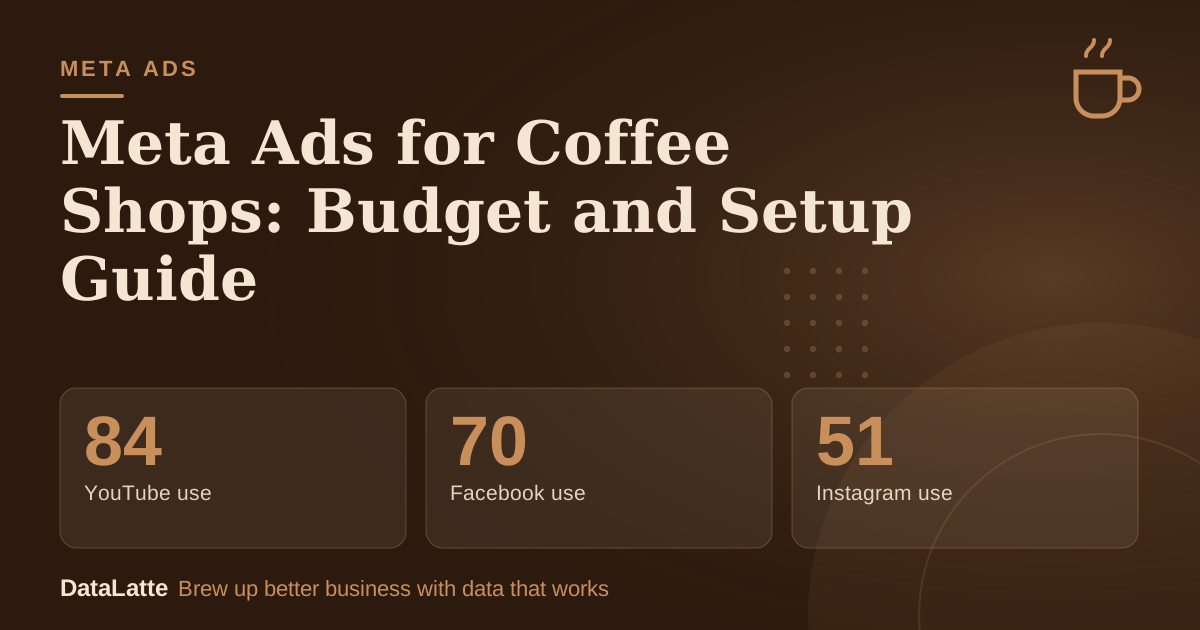
Meta ads let a coffee shop show paid posts on Facebook and Instagram to people who live or spend time nearby. Facebook is used by 70% of US adults and Instagram by 51%, according to
Pew Research Center's 2026 social media fact sheet. Start with a modest daily budget, one local audience, and one clear offer. Then test a single change at a time and judge the ads by orders or visits, not by impressions.
→
YouTube use
Share of US adults, Pew 2026
↓
Facebook use
Share of US adults, Pew 2026
↑
Instagram use
Share of US adults, Pew 2026
→
TikTok use
Share of US adults, Pew 2026
See Sources at the end of the article. Cards marked Assumption are examples, not results.
Facebook and Instagram both run through the same Meta Ads Manager, so one campaign can serve both. Pew's 2026 figures show Facebook at 70% and Instagram at 51% of US adults, and Instagram's share rose from 50% in 2025 to 51% in 2026, while Facebook's slipped from 71%. Instagram suits food and drink photos, while Facebook can reach an older local audience and promote events.
Meta's own guidance is to let the delivery system spread budget across placements rather than split it by hand. For a shop with a small budget, one campaign with both placements is simpler to read than two campaigns competing for the same nearby customers. Check the placement breakdown after two weeks to see where orders actually came from.
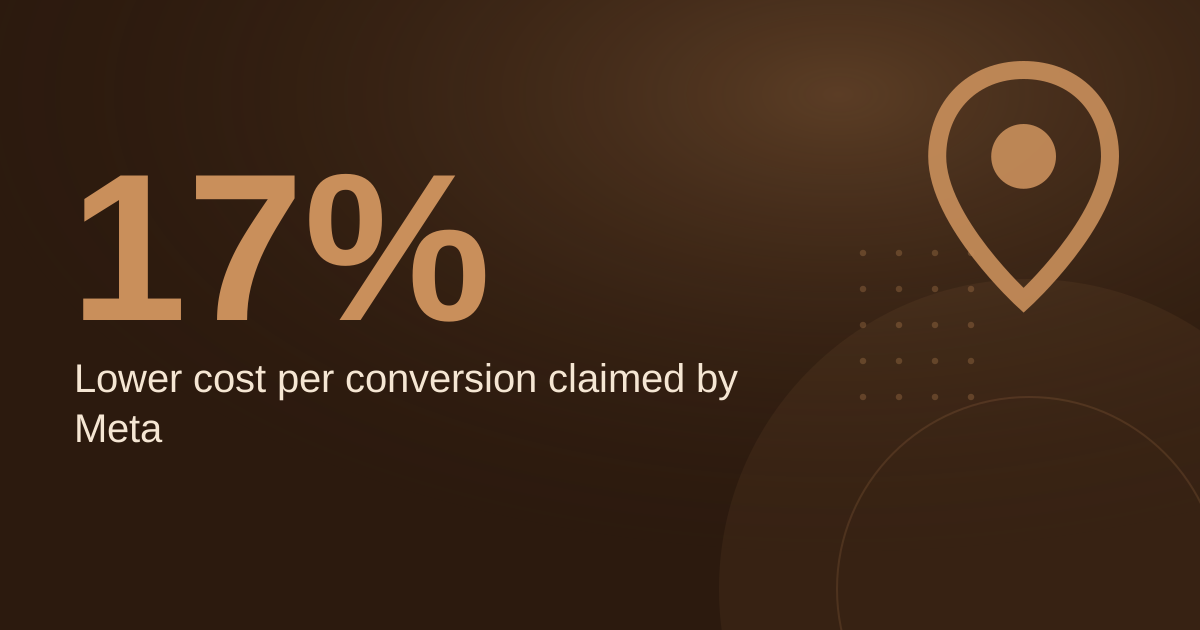
Meta also lists "Promote Your Local Business" as a goal, which fits a shop that depends on foot traffic. Choosing the goal that matches your outcome keeps the campaign optimised for visits or orders rather than generic clicks.
No source gives a universal budget for coffee shops, so the figures below are assumptions you should replace with your own numbers. The example uses a $15 daily budget over 30 days, which is $450 for the month. At an assumed average cost per click of $2.69, that buys about 167 clicks.
The break-even check matters more than the click count. Assume an average order of $6 and a gross margin of 60 percent, so each order yields $3.60 in gross profit. Covering $450 in ad spend would need 125 orders attributed to the ads in that month, roughly four a day.
| Input | Value | Source or label |
|---|
| Daily budget | $15 | Assumption |
| Days in month | 30 | Assumption |
| Monthly spend | $450 | Calculated |
| Average cost per click | $2.69 | All-industry average, WordStream, secondary, older data |
| Clicks bought | about 167 | Calculated |
| Average order | $6 | Assumption |
| Gross profit per order | $3.60 | Assumption: 60% margin |
| Orders needed to cover spend | 125 | Calculated |
At these inputs, clicks alone cannot pay for the campaign, because you would need about three-quarters of clicks to become orders. That is why the campaign must be tracked to real visits, redemptions, or online orders. If your attributed orders fall well short of the break-even number after a month, the offer or the audience needs changing before the budget rises.
A simple setup takes less time than most owners expect. Work through these steps in order and do not skip the tracking step, because later decisions depend on it.
- Create or confirm a Facebook Page and link an Instagram account for your shop.
- Open Meta Ads Manager and choose a goal that matches the result you want, such as promoting your local business or generating visits.
- Build one audience around people who live within a short radius of the shop, and keep the radius tight in a small town.
- Set a daily budget that you can sustain for the full test month, using the calculation above.
- Write two creatives with one clear offer each, such as a morning drink deal or a loyalty sign-up.
- Install the Meta pixel on your website and confirm that events fire before you launch.
- Review results after 7 to 14 days and keep, pause, or change one element.
Meta's Experiments tool and Ads Manager both support A/B tests, and the company advises against switching ad sets on and off by hand. For a coffee shop, that means set up a proper comparison rather than pausing a campaign whenever a week looks slow.
How do you test ads without wasting money?
Meta's guidance on A/B testing says each version is shown to a separate segment of the audience so nobody sees both, and the same budget should be used for both versions to keep the comparison fair. Informal testing, such as turning ad sets on and off manually, can overlap audiences and produce unreliable results.
Choose one variable per test. Test the offer first, then the photo, then the audience radius. Write down a hypothesis before launching, for example that a morning offer will bring more first-time customers than an afternoon offer. Keep the test running long enough to produce a meaningful number of orders, not just a few clicks.
Once a test ends, move the winning version into the main campaign and start the next test. Repeating this cycle monthly gives a shop a record of what works, which is more useful than any single benchmark. For more on platform choices, see
Meta ads for coffee shops in 2026 and the
Virginia Beach Meta ads guide.
Which numbers show whether the ads are working?
Click-through rate, cost per click, and conversion rate are the standard measures. The WordStream benchmark, which is older and covers all industries rather than cafés, put the average search click-through rate at 3.17% and the average search cost per click at $2.69. Treat these as rough reference points only, because they predate current Meta placements and do not isolate coffee shops.
Your own baseline matters more. Record your click-through rate, cost per click, and attributed orders in the first month, then compare each new test against that baseline. A version that lifts orders at the same spend is a win even if its click-through rate looks lower.
Track the tools you already have. A simple redemption code for an ad-only offer, or a separate online order link, lets you connect sales to specific creatives without complex setup. For text-based reminders to existing customers, see
SMS marketing for coffee shops, and for organic Instagram content, see
Instagram marketing for coffee shops in the UK.
FAQ
No source sets a universal figure. Use the break-even method in the worked example: estimate your gross profit per order and work out how many attributed orders your budget needs. Start with an amount you can sustain for a full month of testing.
Should I run ads on Facebook or Instagram?
Pew's 2026 data shows Facebook is used by 70% of US adults and Instagram by 51%. Running one campaign across both placements lets delivery allocate budget, and you can check the placement breakdown to see where orders came from.
How long should I wait before judging a test?
Give each test 7 to 14 days and enough orders to compare versions fairly. Meta advises running a proper A/B test with equal budgets rather than switching ads on and off manually.
If you want to tie ads to website visits or online orders, yes. Without the pixel, you cannot see which ad led to a sale. Install it and confirm events fire before you launch.
Sources
Book a free review of your current ad setup, budget, and tracking, and get a concrete next step for your shop.
Book a free audit. If you also want search visibility for your shop, see
local SEO.
Free for local businesses
Want this applied to your business?
I'll review your Google presence, local SEO, and ad accounts — and send you a specific action plan within 48 hours. No pitch, no pressure.