A local business can use Meta Advantage+ when the goal is sales or leads and it accepts that Meta chooses who sees the ads inside the area you set. It is a poor fit when tight control over audience or placement matters. The sources opened for this guide describe the automation but do not include a verified local-business result. A side-by-side test with a fixed budget is the safest way to decide before moving everything across.
Worked numbers are assumptions.
→
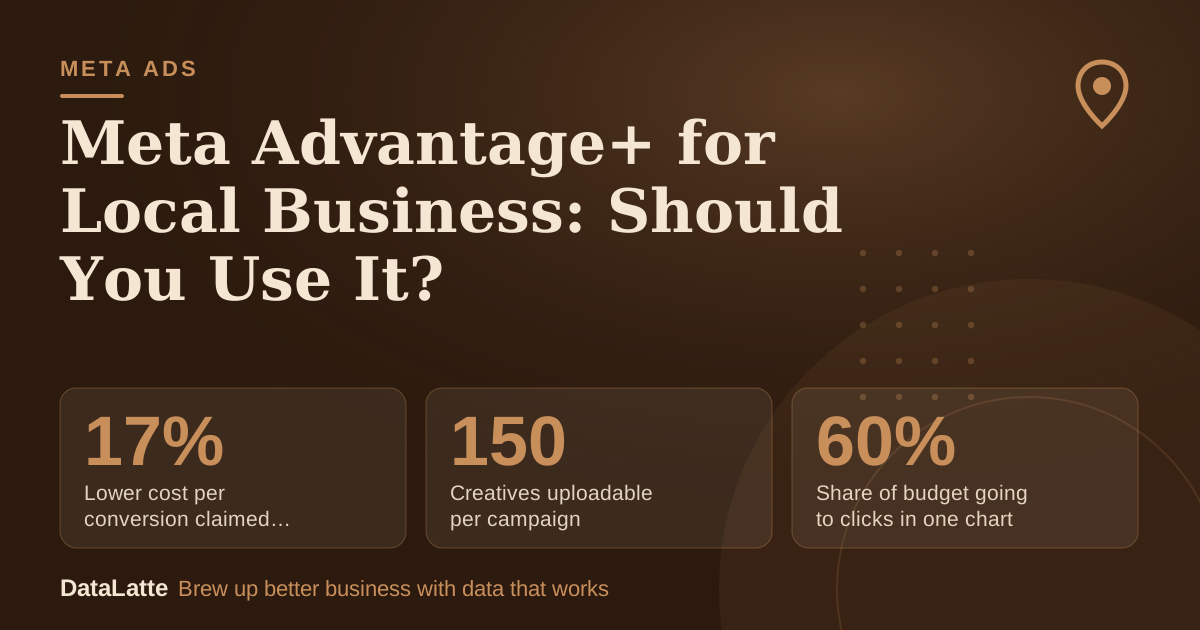
Lower cost per conversion claimed by Meta
Secondary: Needle quoting Meta
→
Creatives uploadable per campaign
Secondary: LeadEnforce
→
Share of budget going to clicks in one chart
Secondary: LeadEnforce chart description
→
Share of budget going to add-to-carts in one chart
Secondary: LeadEnforce chart description
See Sources at the end of the article. Cards marked Assumption are examples, not results.
Needle, a vendor, describes Advantage+ shopping campaigns as handing Meta three jobs: audience targeting, budget allocation and creative optimisation (
Needle, secondary). Audience targeting merges prospecting and retargeting into one campaign. Budget allocation shifts spend toward the best-performing creative and placements. Creative optimisation tests the ads and pushes spend toward the winners.
LeadEnforce adds that Advantage+ mixes the creative you upload, so input quality matters. The same article says up to 150 creative pieces can be uploaded (
LeadEnforce, secondary). That ceiling is useful for a small shop, but three strong ads gain little from a larger pile of weak ones.
Both sources describe e-commerce campaigns. Neither shows that the same mechanics apply to a salon, café or trades business that wants bookings.
Where Does a Local Business Lose Control?
The main trade-off is visibility. LeadEnforce says Meta does not show detailed breakdowns, so the advertiser may not see which audience or placement drove a sale. It also warns that Advantage+ can spend budget without showing what went wrong (
LeadEnforce, secondary).
Needle makes a related point: the algorithm runs the best ad until it tires, and performance falls unless fresh creative is supplied (
Needle, secondary). For a local shop, that means a steady supply of new offers, photos and short videos, not one set of creative launched once.
A weekly log of ads run and bookings or calls received makes a black-box campaign easier to judge. Without that log, results are hard to attribute.
Is Advantage+ a Fit for Your Shop?
LeadEnforce lists cases where Advantage+ may hurt more than it helps: expensive items with long buying cycles, too little pixel data such as purchases or add-to-cart events, a small niche audience that needs specific targeting, and creative that is not ready for testing (
LeadEnforce, secondary). Several of these match local services. A niche trade with a small catchment often fits the "small niche audience" case.
Check these points before switching:
- Does the booking, call or lead form send a conversion event to Meta?
- Are there enough past conversions for Meta to learn from? No threshold appeared in the sources opened, so check Ads Manager.
- Is the audience broad enough to suit automated targeting?
- Are there three or more ads ready to run?
If the answer is no to two or more, start with a manual campaign and move winning elements into Advantage+ later.
How Would You Test Advantage+ Against Manual?
A fair test keeps the budget, area, creative and goal the same, and changes only the campaign type. The table below uses assumed inputs to show the calculation. Replace them with real figures before deciding.
| Input | Manual campaign | Advantage+ campaign |
|---|
| Monthly budget (assumption) | $300 | $300 |
| Run time (assumption) | 4 weeks | 4 weeks |
| Area (assumption) | 5-mile radius | 5-mile radius |
| Ads (assumption) | 3 same ads | 3 same ads |
| Goal | Booking form submits | Booking form submits |
| Bookings received (assumption) | 12 | 15 |
| Cost per booking (calculated) | $25 | $20 |
At these assumed figures, Advantage+ costs $5 less per booking, or 20% less (assumption-based). The gap only means something if it holds over a full month. Four weeks gives the campaign time to learn, while judging after a few days risks reading noise as a result.
Compare cost per booking, not cost per click. Clicks can be cheap and still fail to produce bookings. If the gap is small, keep the cheaper campaign type to manage.
What Do the Sources Not Prove?
The 17% figure appears in Needle and LeadEnforce, but the two versions describe it differently. Needle says Meta reported a 17% lower cost per conversion, then quotes Meta saying advertisers saw 17% more purchases per dollar (
Needle, secondary). These are different measures, and both are retold from a Meta claim that could not be opened. Neither should be quoted as a result for a specific business.
The 60% and 25% budget splits come from a chart description in LeadEnforce, not from a published dataset (
LeadEnforce, secondary). They show one vendor's illustration of budget bias toward early signals, not a measured outcome.
No local-business benchmark was found. A future revision should replace secondary figures with Meta's own help text once it is readable.
How Do You Keep Spend Near Your Shop?
Set the area first and check it after launch. Neither source explains exactly how Advantage+ handles location radius, so confirm delivery in the reports. If most results come from places that cannot be served, tighten the area.
LeadEnforce notes that suggested audiences can still guide the system without being built from scratch (
LeadEnforce, secondary). Use them as hints, not hard limits.
If ads also run on other platforms, compare results across them. The guides on
Bing Ads for local business and
Amazon ads for local business explain how to set up a like-for-like comparison. To pull campaign data into a spreadsheet, the
best MCP servers for local business setup guide lists tools that can help.
FAQ
Maybe. It may save set-up time if bookings are already tracked and three or more ads are ready. Test it against a manual campaign with the same budget and area before deciding.
What are the three parts Advantage+ automates?
Needle describes audience targeting, budget allocation and creative optimisation (
Needle, secondary).
Can Advantage+ be limited to one city?
Set the location in the campaign and check the delivery reports. The sources opened do not describe the exact limits, so verify it in your own account.
Does Advantage+ lower cost per lead?
No verified local-business figure was found. Measure cost per booking against a manual campaign run on the same budget.
One source describes lower cost per conversion and the other describes more purchases per dollar. Both are secondary retellings of a Meta claim, so treat them as unverified.
Sources
Want Meta and search campaigns tested against a fixed budget?
Book a free audit to review conversion tracking first.
Free for local businesses
Want this applied to your business?
I'll review your Google presence, local SEO, and ad accounts — and send you a specific action plan within 48 hours. No pitch, no pressure.