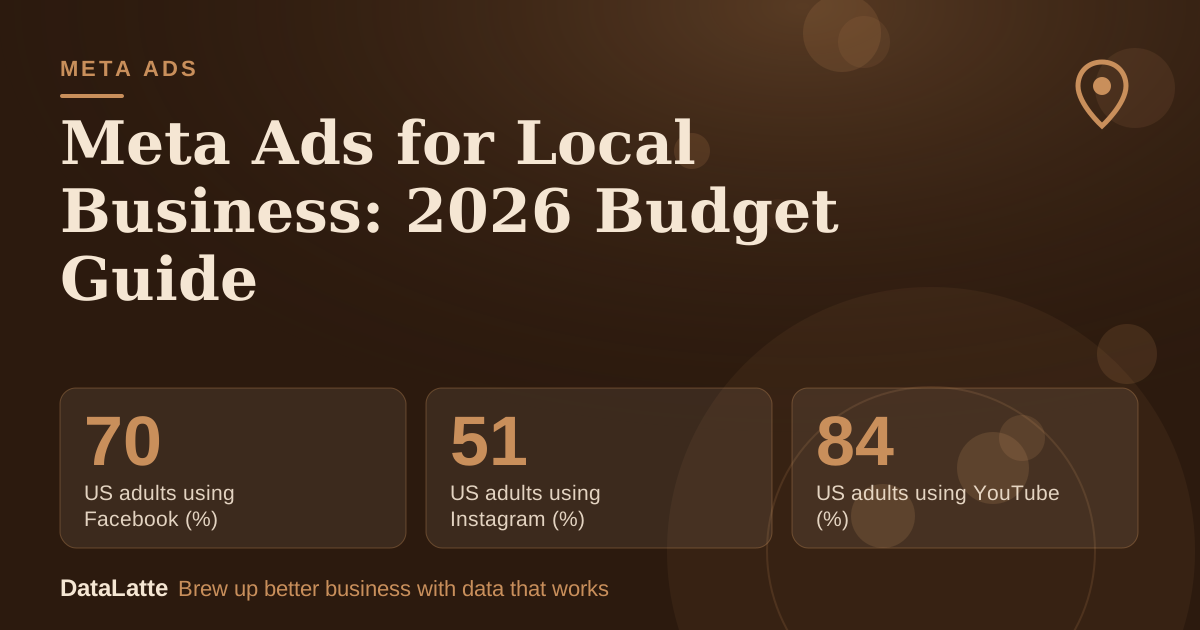
Meta Ads can work for a local business in 2026 if you choose one offer, one service radius and one tracked action, then judge results against what each customer is worth to you. According to Pew Research Center's 2026 survey, 70% of US adults use Facebook and 51% use Instagram. A $300 monthly budget is enough to test one campaign, but only if the cost per booking stays below the value of that booking. The sections below cover the audience data, how to structure a fair test, and a worked salon example with every assumption labelled.
↓
US adults using Facebook (%)
Pew, June 2026
↑
US adults using Instagram (%)
Pew, June 2026
→
US adults using YouTube (%)
Pew, June 2026
→
US adults using TikTok (%)
Pew, June 2026
See Sources at the end of the article. Cards marked Assumption are examples, not results.
Who Still Uses Facebook and Instagram in 2026?
Pew's 2026 fact sheet is based on a survey of 5,511 US adults conducted between January 30 and June 18, 2026, with an overall margin of error of plus or minus 1.8 percentage points (
Pew Research Center). Facebook use fell from 71% in 2025 to 70% in 2026, while Instagram rose from 50% to 51%. Those movements sit within a range close to the margin of error, so they point to a stable picture rather than a clear trend.
The practical reading is that Facebook and Instagram still have very large audiences, spread across ages and areas. Targeting is what narrows that audience to people who can realistically visit a shop, salon or studio.
Pew only covers the United States. The survey does not provide equivalent figures for the UK, Australia or Canada, so check local usage before assuming the same pattern holds there. For Canadian context, the
Canada local marketing guide covers regional platform details.
Meta's own guidance is to test one variable at a time. Its A/B testing help page explains that each version is shown to a separate segment of the audience so nobody sees both, and that the same budget should be used for both versions so the comparison is fair (
Meta for Business).
Meta also advises against informal testing, such as switching ad sets on and off by hand, because that can overlap audiences and produce results that cannot be trusted. Set a hypothesis before you start, for example that a radius-based audience will outperform an interest-based one.
The table below shows a step plan for a single test. The budget and radius values are assumptions to replace with your own.
| Test element | Ad set A (control) | Ad set B (test) |
|---|
| Variable changed | Current offer | New offer (only change) |
| Audience | 3-mile radius (assumption) | 3-mile radius (same) |
| Daily budget | $5 (assumption) | $5 (same) |
| Tracked action | Booking page click | Booking page click |
| Decision point | Equal bookings per version, reviewed weekly | Same |
Do not change the image, audience and offer at the same time. If you do, you will not know which change produced the result.
What Does a $300 Budget Actually Buy?
The example below uses a hypothetical hair salon. Only the Pew figures and Meta's testing guidance come from sources. Every number in the calculation is an assumption to replace with your own data.
Assumptions: monthly budget $300 (assumption), average cost per click $2.00 (assumption), click-to-booking conversion rate 3% (assumption), average booking value $60 (assumption).
Clicks: $300 ÷ $2.00 = 150 clicks per month.
Bookings: 150 × 3% = 4.5 bookings per month.
Revenue: 4.5 × $60 = $270, which is $30 less than the $300 spent, before staff time or product costs.
Cost per booking: $300 ÷ 4.5 = $66.67, above the $60 value of each booking.
Break-even: $300 ÷ $60 = 5 bookings needed. 5 ÷ 150 clicks = 3.33% conversion rate.
This salon needs a conversion rate of about 3.33% just to cover ad spend, before any margin. If the click-to-booking rate is below that, the fix is the offer, the booking page or the audience, not a bigger budget. For a broader cost view, see the
Facebook ads budget guide for local businesses.
Which Audience and Objective Should You Pick?
Choose an objective that matches the action you can measure. If bookings happen through a calendar link, optimise for that link click or booking event rather than reach or post engagement. A campaign built for reach will deliver reach, which does not pay the rent.
Keep the radius tight enough that a customer could visit within the time they would take to decide. For a salon, that usually means one town or district rather than a whole region. Narrow audiences often cost more per click, so rerun the worked example with your real cost per click before committing.
Exclude people who already book with you where your tools allow it. Otherwise the budget pays to remind existing clients, which is a different job from finding new ones.
How Do You Write Offers and Ad Copy That Convert?
A specific, time-limited offer usually gives a clearer test result than a general message such as "book with us". Name the service, the price or discount, and the booking window. Keep that offer constant for the whole test so any change in results can be traced to the variable you chose.
AI writing tools can draft several headline and caption variants quickly. Treat them as a starting point and check every claim against your real prices and availability. The
ChatGPT prompts for local business marketing post includes prompt structures that can be adapted for ad copy.
Check that your Google Business Profile details match what the ad promises, including address, hours and services. Mismatches send people away after they click, and the click still costs money.
Meta and Google reach people in different ways. Meta ads appear in feeds where people are browsing, while Google search ads respond to someone actively looking for a service. Google's Display Network extends reach across millions of websites and apps, including YouTube and Gmail (
Google Ads Help).
Costs also differ between platforms. An older WordStream benchmark put the all-industry average Google search cost per click at $2.69 (
WordStream). That is a dated Google figure, not a Meta benchmark, so use it only as a rough reference point. If search demand for your service is strong locally, search may be the better first test. For a side-by-side view, read
Google Ads vs Facebook Ads for local businesses.
FAQ
Yes, if there is time each week to review results and keep a record of bookings. Setup is manageable for one campaign. The harder part is comparing outcomes fairly and changing one variable at a time, which Meta's testing guidance describes.
How long should a test run before deciding?
Run the test until both versions have collected a meaningful number of bookings, with equal budgets. Meta's help page cited here does not publish a fixed duration, so set a threshold based on how many conversions you expect per month.
Is $300 a month enough?
It can be enough for one focused campaign, as the worked example shows. Whether it is depends on cost per click, conversion rate and booking value. If the break-even conversion rate is out of reach, a larger budget will simply spend faster.
It depends on whether customers search for a service or discover one while browsing. Strong local search demand points to search first. If you rely on discovery and visual offers, Meta may fit better. Testing both on small budgets is a reasonable way to find out.
If you want a second opinion on your current setup,
request a free audit and bring your last three months of spend and booking figures.
Sources
Free for local businesses
Want this applied to your business?
I'll review your Google presence, local SEO, and ad accounts — and send you a specific action plan within 48 hours. No pitch, no pressure.