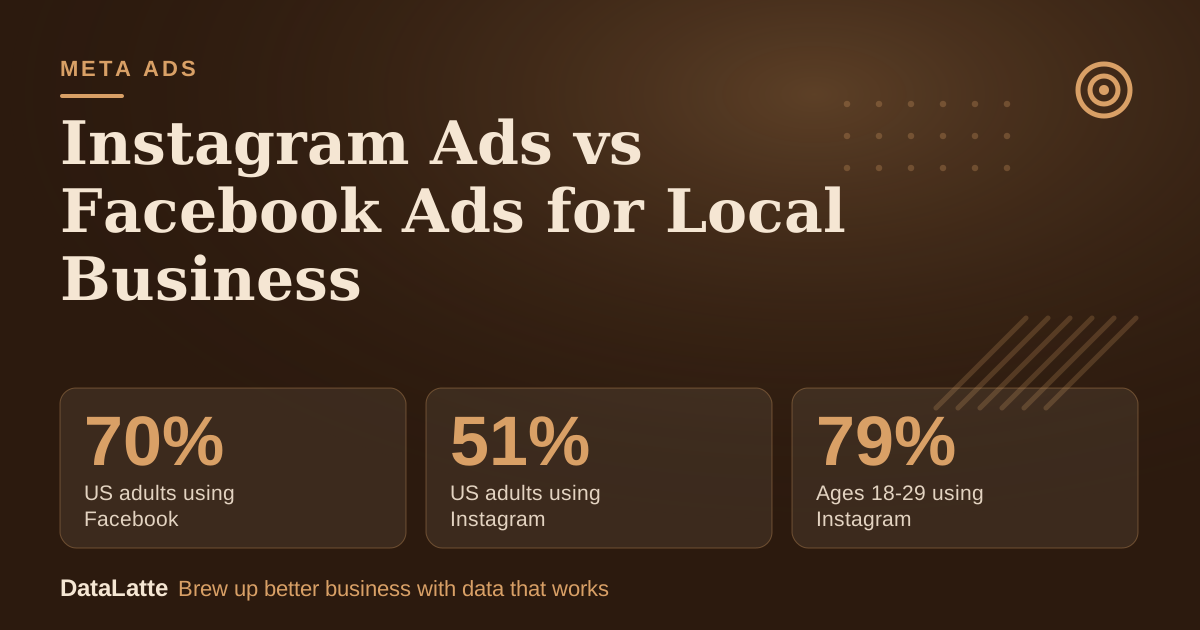
For most local businesses the choice is not Instagram or Facebook. Both are bought in the same Meta Ads Manager account, and you decide where the ad shows through placement settings. Audience age is the best tie-breaker: Pew's 2026 survey finds 70% of US adults use Facebook and 51% use Instagram, but Instagram skews young and Facebook is strong from 30 to 64.
This guide compares the two for salons, cafes, studios and other local shops. Costs come from LocaliQ's 2026 Facebook benchmarks, which do not report Instagram separately. Examples are labelled as assumptions.
→
US adults using Facebook
Pew Research Center 2026
→
US adults using Instagram
Pew Research Center 2026
↑
Ages 18-29 using Instagram
Pew Research Center 2026
↑
Ages 30-49 using Facebook
Pew Research Center 2026
See Sources at the end of the article. Cards marked Assumption are examples, not results.
Are Instagram Ads and Facebook Ads Really Different Products?
Mostly no. Both run from Meta Ads Manager, share the same targeting, budget and reporting, and a single campaign can show the same creative in both apps. What changes is the audience that sees it and the format that suits the screen: tall video and Stories on Instagram, feed posts and longer text on Facebook.
So the practical question is where your customers spend time and which placements you leave switched on.
Pew Research Center's survey of US adults, fielded January 30 to June 18, 2026, gives the clearest split by age. Instagram reaches 79% of 18 to 29-year-olds but only 41% of 50 to 64-year-olds and 21% of those 65 and older. Facebook is used by 69% of 18 to 29, 78% of 30 to 49, 71% of 50 to 64 and 59% of 65 and older.
| Age group | Facebook | Instagram |
|---|
| 18-29 | 69% | 79% |
| 30-49 | 78% | 64% |
| 50-64 | 71% | 41% |
| 65+ | 59% | 21% |
A nail bar or barbershop aimed at under-30s leans Instagram. A pet groomer, dentist or home-services business whose buyers are 30 to 64 should not drop Facebook. Pew measures use in the US only. Check your own audience in the Ads Manager breakdown by placement after the first two weeks.
What Do Facebook Ads Cost for a Local Business?
LocaliQ's 2026 Facebook benchmarks (updated September 23, 2026) split results by campaign objective. Across all industries, traffic campaigns average a $0.60 click and a 1.93% click-through rate. Lead campaigns average a $1.80 click, a 2.70% click-through rate, an 8.54% conversion rate and $27.39 per lead.
| Industry | Traffic CPC | Lead CPC | Lead conversion rate | Cost per lead |
|---|
| Beauty and Personal Care | $0.50 | $2.97 | 5.63% | $50.91 |
| Health and Fitness | $0.64 | $1.84 | 7.98% | $27.11 |
| Home and Home Improvement | $0.63 | $2.18 | 5.32% | $42.95 |
| Restaurants and Food | $0.45 | not listed | not listed | not listed |
| Animals and Pets | $0.51 | not listed | not listed | not listed |
LocaliQ publishes no Instagram-only figures. Treat these as a starting range for both apps and replace them with your own numbers.
When Should You Choose Instagram?
Choose Instagram first when the product is visual and the buyer is under about 40: haircuts and colour, nails, brows, food, fitness classes. Short video and Stories give a salon or cafe room to show the result. Use clear text on the first frame, because many people watch with sound off.
Instagram also suits businesses with a profile that already looks good. People who tap through to your profile will judge it in seconds, so fix the bio, a booking link and recent posts before paying for traffic. Our
Instagram ads guide for local business covers formats and setup.
When Should You Choose Facebook?
Choose Facebook first when buyers are 35 and older, the decision is a considered one, or the customer wants details, reviews and events: home services, vets, dentists, family fitness, local classes. Facebook Pages also let customers read reviews, see hours and send messages.
For lead-style goals such as quote requests, the LocaliQ lead-campaign cost in Health and Fitness ($27.11 per lead) is lower than Beauty ($50.91). That difference reflects the industry and the offer, not which app delivered the click. See our
Facebook ads for local business beginner playbook.
What Does $600 a Month Buy? A Worked Example
All inputs below are assumptions built from the LocaliQ lead-campaign benchmarks above. A "lead" is a booking request or message, not a paid visit.
| Beauty salon | Fitness studio |
|---|
| Monthly budget (assumption) | $600 | $600 |
| Cost per click (LocaliQ lead campaigns) | $2.97 | $1.84 |
| Clicks | about 202 | about 326 |
| Conversion rate (LocaliQ) | 5.63% | 7.98% |
| Leads | about 11 | about 26 |
| Cost per lead | about $53 | about $23 |
| Leads who book (assumption) | 40% | 40% |
| Cost per booking | about $132 | about $58 |
Our arithmetic gives $53 per lead for the salon, close to LocaliQ's published $50.91. At a first-visit value of $90 (assumption), the salon only breaks even if clients rebook, so repeat visits decide whether the ad pays. Use your own average client value before you scale.
How Should You Set Up Placements?
Start with automatic placements so Meta can find where results are cheapest, then read the placement report after about two weeks. Remove a placement only if it spends money and produces no leads. Cutting too early starves the system of data.
Keep the budget in one campaign while it is small. Splitting $600 across separate Instagram and Facebook campaigns leaves each too small to learn. For budgeting basics, read
how much to spend on Facebook ads for a local business. If you are comparing Google instead, see
Google Ads vs Facebook Ads for local business.
Should You Run Both at the Same Time?
Run both through one campaign using automatic placements. That is the default way to cover both apps. Run separate campaigns only when the audiences, offers or creative differ: for example a Reels offer for under-30s and a Facebook event ad for parents.
Whatever you run, set a conversion goal you can count, such as calls, booking-link clicks or form submissions. Our
data-backed answer on whether Facebook ads work for local businesses shows how to judge results after a month.
Open Ads Manager, pick your last campaign and break results down by placement. Write down cost per lead for Instagram feed, Stories, Reels and Facebook feed. That one table answers this article for your business.
FAQ
Are Instagram ads cheaper than Facebook ads?
There is no published Instagram-only benchmark from LocaliQ, so no one can honestly say. Both draw from the same Meta auction. Your cost depends on audience, creative and offer. Compare cost per lead by placement in your own account.
Instagram fits the visual product and a younger audience, with 79% of 18 to 29-year-olds on it according to Pew. Keep Facebook on for clients aged 30 to 64, where Facebook use is higher (78% for ages 30 to 49).
Do I need both an Instagram account and a Facebook Page?
Check the account requirements in Meta Business Help before you start, because Meta changes them. A linked Facebook Page and Instagram account lets customers see the same business in both apps.
What is a good starting budget?
LocaliQ shows lead clicks of $1.84 to $2.97 in the closest industries, so $600 a month buys roughly 200 to 330 clicks. Start where you can afford to wait four weeks.
How long before I know if it works?
Judge on bookings, not clicks, after about four weeks of steady spend. Short tests of a few days rarely produce enough data to compare placements.
Sources
Want ads set up and measured properly? See our
Meta Ads service or
book a free audit.
Free for local businesses
Want this applied to your business?
I'll review your Google presence, local SEO, and ad accounts — and send you a specific action plan within 48 hours. No pitch, no pressure.