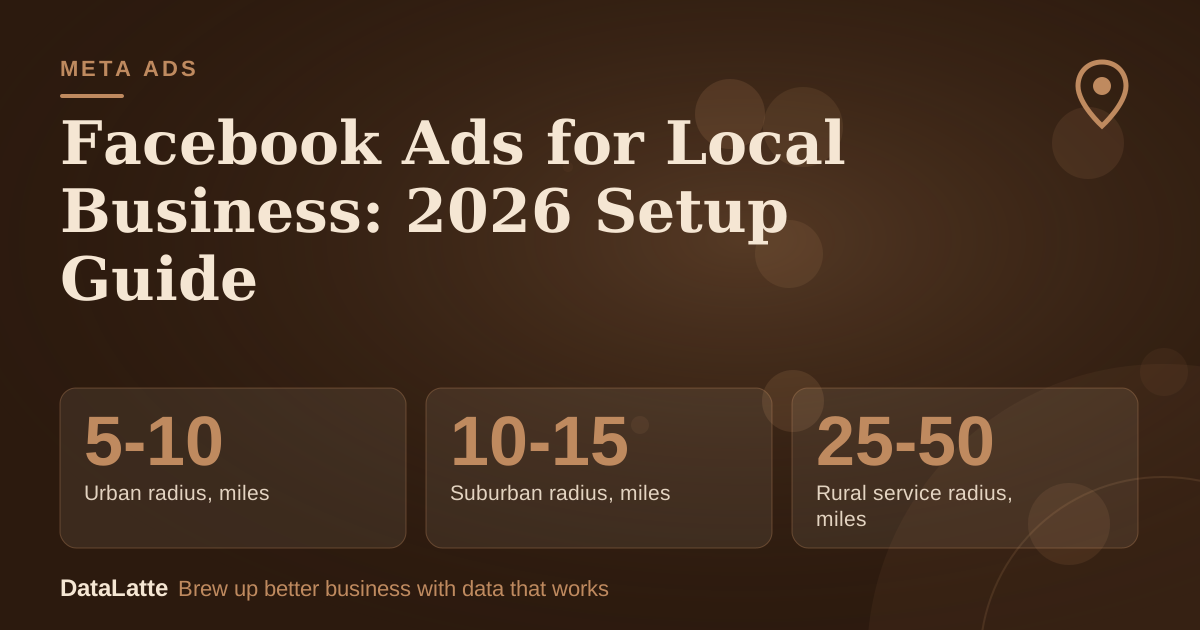
To run Facebook ads for a local business, pick one goal, target a radius the business can actually serve, set up tracking before spending, and test a fixed budget for about a month. Adstellar suggests 5 to 10 miles for urban businesses, 10 to 15 miles for suburban ones and 25 to 50 miles for rural service businesses. WordStream describes the "store traffic" objective as the starting point for local businesses. Both sources are secondary, so confirm the current options in Ads Manager before building a campaign.
This guide covers shops, salons, studios and service businesses in the US, UK, Australia and Canada. The budget example is labelled as an assumption.
→
Urban radius, miles
Adstellar, secondary
→
Suburban radius, miles
Adstellar, secondary
→
Rural service radius, miles
Adstellar, secondary
→
Minutes to read the source guide
Adstellar guide, secondary
See Sources at the end of the article. Cards marked Assumption are examples, not results.
Is Facebook Worth It for a Local Business?
Facebook can reach people near a business location, but it works differently from search. Someone searching Google has already decided they need a service. A Facebook ad reaches someone who is scrolling and may not be thinking about the category at all. That gap is why the offer and the tracking matter more than the reach figures.
WordStream's guide notes that the store traffic objective gives local advertisers more targeting and call-to-action options than print advertising would. The page was last updated in November 2023, so confirm the current objective names in Ads Manager. Businesses deciding between platforms can compare when each one fits in
Google Ads and Facebook Ads for local business. Businesses that sell services customers search for directly may also review
Google Local Service Ads before committing budget to social.
How Big Should the Local Radius Be?
Adstellar's guide suggests a radius based on how far customers will realistically travel. Urban businesses are placed at 5 to 10 miles, suburban businesses at 10 to 15 miles, and rural service businesses at 25 to 50 miles. These are starting points from a secondary source, not rules from Meta.
A lunch counter needs a tight radius. A specialty furniture store can reach further. A plumber or electrician should cover the full service territory. Starting with the smaller radius and checking where actual customers come from is a sensible order. Widen only when results justify it. Targeting a whole city when customers come from three neighborhoods wastes spend on people who will never walk in.
Adstellar also suggests layering age and interest filters, then saving each audience with a clear name such as "Downtown Professionals 5mi," so the setup can be reused.
How Do You Set Up Tracking Before Spending?
Tracking is the step beginners most often skip. Adstellar's guide recommends installing the Meta Pixel on the website, which can capture phone number clicks, direction requests, contact form submissions and online bookings. Without those events, a campaign shows clicks but not whether anyone called.
Connect the Facebook Page and Instagram profile to the same Meta Business Suite so both can be managed from one place. Confirm the address and service area in the Page settings, and set up a payment method in Ads Manager so the campaign does not stop mid-month. Adstellar also notes that business verification unlocks some features and adds a verification badge to ads, which can help trust. If a booking tool is used, record the source of each booking so it can be matched against the ad.
How Do You Set Up the First Campaign?
The steps below are this guide's recommended order, not a platform requirement.
- Prepare the Page and one clear offer, such as a first-visit price. Check hours, address and photos first.
- Choose one goal: leads for a form, traffic for a booking page, or messages if chats get answered quickly. One goal per campaign keeps results readable.
- Draw a tight radius around the shop or service area that can be served.
- Pick one image or short video, plus one sentence of copy with the offer and the action. The list of ChatGPT prompts for local business marketing can help draft variations, but every claim should be checked against what is actually offered.
- Confirm tracking works by testing a phone call, a form fill and a booking before the campaign goes live.
WordStream recommends setting the budget at campaign level for simplicity, and notes that a lifetime budget is available if run dates are specified.
What Could a $450 Test Month Buy?
The example below uses assumptions only. The sources for this article do not include a benchmark cost per lead, so every input should be replaced with real figures after the first month.
| Input or result | Scenario A | Scenario B |
|---|
| Monthly budget (assumption) | $450 | $450 |
| Cost per lead (assumption) | $30 | $45 |
| Leads | 15 | 10 |
| Share of leads who book (assumption) | 25% | 25% |
| Bookings | 3.75 | 2.5 |
| Cost per booking | $120 | $180 |
Whether $120 or $180 per booking is worth paying depends on what a customer is worth over their lifetime with the business. That figure should be worked out before scaling. If one booking is worth $300 in profit (assumption), Scenario A is clearly viable and Scenario B is closer to break-even. Adjust the numbers with actual margins before deciding anything.
What Mistakes Waste a Beginner Budget?
- Running ads without any way to tell which lead became a paying customer.
- Targeting a whole city when customers come from a few neighborhoods.
- Changing the audience, creative and budget in the same week, which makes it impossible to tell what worked.
- Sending clicks to a home page instead of a booking page or form.
- Ignoring replies. A lead who waits two days may have booked elsewhere.
Adstellar's guide also warns that local businesses often copy national-brand approaches, which wastes budget. Targeting, offers and tracking need to be set up for the business's own area.
FAQ
How do I target a local audience on Facebook?
Use radius targeting around the business location, set the radius to the area that can be served, and layer age or interest filters that match actual customers. Save the audience with a clear name so it can be reused.
What is the store traffic objective?
WordStream describes it as the objective previously called local awareness. It is designed to show a business to people within a set distance of its location. Check the current objective list in Ads Manager, since names can change.
Adstellar's guide recommends it because the pixel tracks actions such as phone clicks, direction requests, form submissions and bookings. Without it, clicks can be seen but are hard to connect to results.
How long should a test run before deciding?
Plan for a full month of data before judging results, and change one variable at a time. This timing is a recommendation from this guide, not a platform rule.
Sources
Meta's own help pages did not return usable content during this review, so figures from primary Meta documentation are not included. Check Meta Business Help Center articles directly before relying on any platform rule.
To set up a local Facebook campaign with tracking from day one, start with a
free audit of the current setup.
Free for local businesses
Want this applied to your business?
I'll review your Google presence, local SEO, and ad accounts — and send you a specific action plan within 48 hours. No pitch, no pressure.