Make Money Running Facebook Ads for Local Businesses
May 14, 2026·Nataliia Rumiantsewa· 11 min read All posts
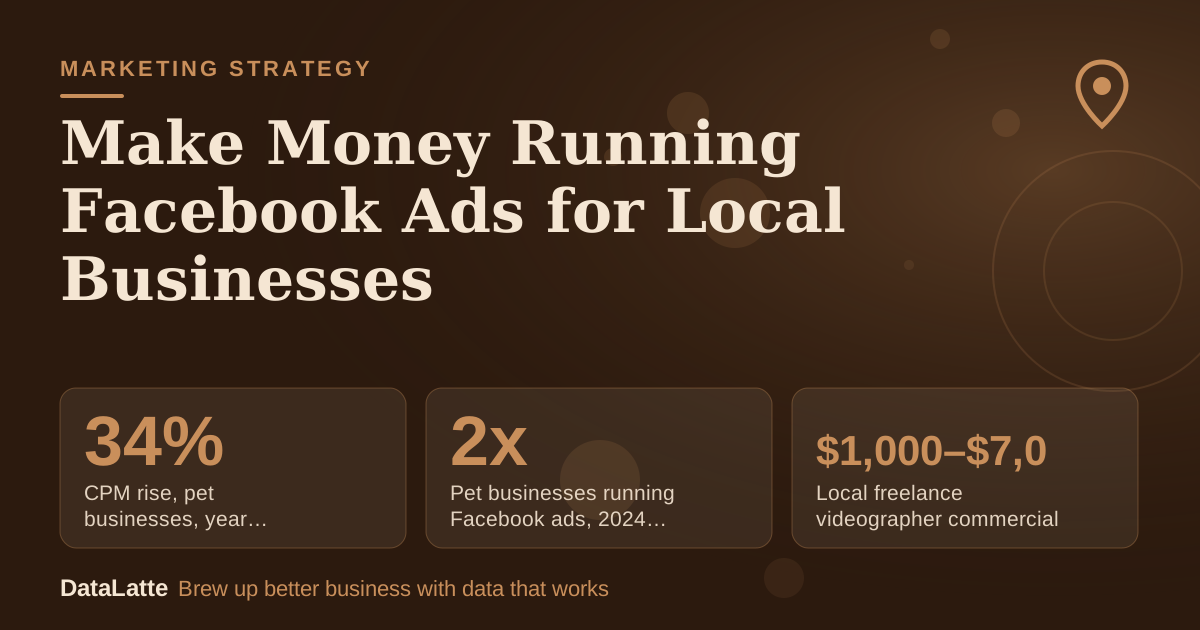
You can make money running Facebook ads for local businesses by selling managed campaigns. The work covers audience targeting, ad creative, lead tracking, and regular reporting, and it is usually paid as a monthly retainer. Demand is growing in some verticals. A Ryze AI guide reports that the number of pet businesses running Facebook ads doubled between 2024 and 2025, while CPM costs rose 34% year over year. Rising costs mean small clients need tighter targeting and clear proof of results. This guide covers setup, creative costs, retainer pricing, a worked monthly example, and the objections you will hear most.
34%↑
CPM rise, pet businesses, year over year
reported by Ryze AI
2x↑
Pet businesses running Facebook ads, 2024 to 2025
the number of businesses doubled
Assumption
$1,000–$7,000→
Local freelance videographer commercial
estimated range, AdWave
$30→
Streaming TV ad, starting price per day
via AdWave, a different channel
See Sources at the end of the article. Cards marked Assumption are examples, not results.
How do you set up a Facebook ad campaign for a local client?
Start with one goal and one offer. A local client needs a clear action, such as a booking, a phone call, or a store visit, and a single offer that matches it. Build the audience from the client's real service area first. Add interests or behaviours only where they clearly match the customer. Keep the first campaign to one ad set so the results stay readable enough to act on.
Next, choose the objective that matches the action. Lead or conversion objectives suit bookings and calls, while traffic objectives suit early content testing. Set up tracking before launch using a call tracking number, a booking link, or a unique landing page, so every lead can be traced back to its ad. Without that link, you cannot tell a good campaign from a lucky week. For ideas on automating parts of this setup, see AI-driven Facebook ads for local businesses.
What does ad creative cost a local business?
Creative is often the hidden cost. AdWave estimates that a local freelance videographer commercial usually falls between $1,000 and $7,000 (AdWave). That range is far above the monthly budget of many small clients, so plan on cheaper formats first: photos, short phone videos, and before-and-after images. The best Facebook ad formats for local businesses in 2026 can help you match formats to a budget.
Video length matters too. AdWave says that anything past two minutes is no longer an explainer but a demo or tutorial (AdWave). For a local service ad, a short clip that shows the service or the result is usually the right length. Draft copy faster with ChatGPT prompts for local business marketing, but check every claim and price against the client's real offer before it goes live.
How should you price a Facebook ads retainer?
Price the retainer on the hours and the responsibility you carry, not on the ad spend alone. A retainer covers setup, weekly optimisation, lead tracking, and reporting. A flat monthly fee works well because regular payments are easier to forecast than one-off project fees. A Raklet guide on membership marketing makes a similar point: fees paid on a regular basis are a common way to earn steadily, rather than in occasional bursts.
Keep the ad budget separate from your fee and state both numbers in writing. Whether you bill the spend directly to the client's card or handle it another way, the client should know what is going to the platform and what is going to you. Test your fee against the time it takes and the value the client gets, not against an agency benchmark you cannot verify. The worked example below shows the arithmetic with assumed inputs.
What does a $500 client actually earn you?
Use these inputs to test a retainer before you quote it. Every input is an assumption you should replace with your own numbers.
Client ad budget: $500 per month (assumption)
Management fee: $600 per month (assumption)
Hours of work: 8 per month (assumption)
One outsourced video: $1,000, the low end of the AdWave range, spread over 12 months (assumption)
The effective fee is $600 divided by 8 hours, or $75 per hour (assumption-based). Spreading the $1,000 video over 12 months costs $83 per month, which leaves $517 of net fee per client per month. Across three such clients, that is $1,551 net per month. Across 24 total hours, that works out to about $64.63 per hour.
A reach check helps too. At an assumed CPM of $12, a $500 budget buys about 41,667 impressions (500 ÷ 12 × 1,000). That figure is an assumption, not a benchmark. Replace it with the client's own CPM from Ads Manager before you promise any reach.
How do you answer the "I can't afford it" objection?
Winback Engine estimates that in about 60% of cases, the "I can't afford it right now" objection is a proxy for doubting the service is worth the money (Winback Engine). Treat the objection as a value question rather than a price question. Answer it with lead data: how many enquiries the last campaign produced, what each one cost, and what a single customer is worth to the business.
Avoid discounting first. A lower fee signals a lower-value service and does not answer the underlying doubt. If the client still hesitates, offer a short, fixed test period with defined success criteria written down in advance. Clear terms make the decision easier for both sides and protect your time.
How do you know your ads are working?
Track two numbers: cost per lead and cost per sale. A campaign with spend and zero enquiries usually has a targeting or creative problem. A campaign with enquiries but no sales usually has an offer or follow-up problem. Those are different fixes, so the two numbers point you to different actions.
Set a review date before launch and pause what fails it. Weekly reporting keeps the client looking at the same numbers you are looking at. For a broader view of whether paid social pays off for small firms, read do Facebook ads actually work for local businesses. Human judgement still matters here, and the trade-offs are covered in AI vs human marketing for local businesses.
FAQ
Can I just boost a post instead of running ads?
Boosting is simpler, but it gives you less control over who sees the post. Campaign ads let you set location, exclusions, and a lead objective. For a local client, that control is usually what makes the budget defensible. Test both on a small budget and compare cost per lead before you decide which one to sell.
Do I need a website for local Facebook ads?
No, but the ad needs a destination that can take a booking or a call. Ads can point to a Facebook page, a map listing, or a booking page. A simple website with a clear booking form usually gives better tracking, so recommend one when the client does not have a site.
How long before a local campaign shows results?
Data arrives quickly, but paying customers take longer. Most local offers need a validation window of about two weeks. After that, decide whether to scale, change the offer, or stop. Services with longer decision cycles may need more time before you judge the campaign.
Should I use Facebook or Google Ads?
Use Facebook for visual offers and for building an audience, and Google Ads for people already searching for a service. Many local clients benefit from both. Start with the channel that matches the client's offer and budget, then add the second once the first has produced reliable leads.
DataLatte runs data-driven local marketing campaigns for coffee shops, salons, pet groomers, and fitness studios. Explore Google Ads management or request a free audit to see where your budget is going.
Local marketing strategist with 10+ years at global agencies — OMD, Dentsu, GroupM, and BBDO. Now helping small businesses get the same data-driven edge. Based in Europe, working with clients in the US, UK, Australia, and beyond.