Facebook ads for a small business cost whatever you choose to spend, and the auction decides how far that money goes. The sources behind this guide do not publish a fixed Facebook price per click, so no single "average cost" is quoted here. What they do show is how many US adults use Facebook, how Meta recommends testing, and how Google's search costs compare as a reference point. Budget a monthly amount you can hold for 60 days, track cost per lead, and adjust from there. The worked example below shows the arithmetic with every input labelled as an assumption.
→
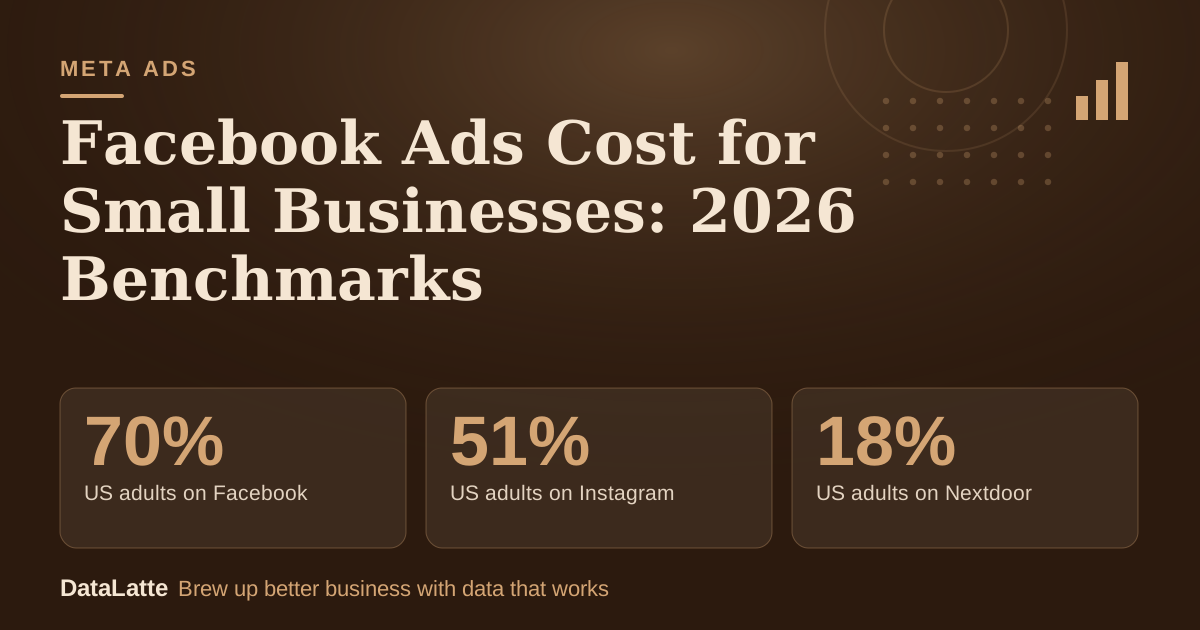
US adults on Facebook
Pew, 2026 survey
↑
US adults on Instagram
Pew, 2026 survey, same Meta ad system
→
US adults on Nextdoor
Pew, 2026 survey
→
Google search CPC, all industries
WordStream, 2016 data (dated)
See Sources at the end of the article. Cards marked Assumption are examples, not results.
How much does a Facebook ad cost a small business?
The cost of a Facebook ad is set by an auction, not by a published rate card. Your audience, ad creative, bidding approach and budget all influence what you pay per result. This means two businesses in the same town can pay very different amounts for the same click.
Because the price moves, the useful planning number is your monthly budget and the cost per lead it produces. Start with an amount you can sustain for two months, since Meta's testing guidance depends on running a fair comparison over time.
How many people in the US use Facebook?
Pew Research Center's 2026 survey of 5,511 US adults found that 70% use Facebook, against 84% for YouTube and 51% for Instagram. Pew notes the survey represents all US adults and carries a margin of error of plus or minus 1.8 percentage points.
Pew's social media fact sheet is the primary reference for these figures.
Reach matters for local businesses because the audience is broad, but local targeting does the narrowing. Nextdoor, which is hyperlocal, is used by 18% of US adults in the same survey, so it may suit some neighbourhood services while Facebook suits most others.
What does a worked monthly budget look like?
The table below uses assumed inputs for a single-location service business. Replace each assumption with your own numbers from Ads Manager after your first 30 days.
| Line | Input or result | Status |
|---|
| Monthly budget | $300 | Assumption |
| Average cost per click | $1.50 | Assumption |
| Clicks per month | 200 (300 ÷ 1.50) | Calculated |
| Landing page conversion rate | 4% | Assumption |
| Leads per month | 8 (200 × 4%) | Calculated |
| Cost per lead | $37.50 (300 ÷ 8) | Calculated |
| Total across a 60-day test | $600 | Calculated |
If your real cost per lead is higher than what your customers are worth, the fix is usually the offer or the landing page, not a bigger budget. A $600 test over 60 days gives you enough leads to compare two ad versions, which is far more useful than a single week of data.
How should you test ads without wasting budget?
Meta recommends A/B testing when you want to measure a change or compare two strategies. A/B testing splits the audience so that nobody sees both versions, and it can be set up by duplicating an existing campaign or ad set. Meta advises using the same budget for both versions so the comparison is fair.
Meta also advises against informal testing, such as switching ad sets on and off by hand. According to its help page, informal testing can cause overlapping audiences and unreliable results. Pick one variable to test first, such as the image or the offer, and leave everything else fixed. For the full setup steps, read
Meta's guidance on A/B testing.
How do Facebook costs compare with Google Ads?
Google's own help pages describe Display campaigns as reaching people across 35 million websites and apps, plus Google-owned properties such as YouTube and Gmail. That is a separate channel from search, so it should be compared with Facebook on purpose, not assumed to be the same.
Google's Display network guidance explains how those campaigns are set up.
The $2.69 figure in the stat row is an all-industry Google search cost per click from a 2016 WordStream benchmark. It is dated and comes from a vendor blog, so treat it only as a rough reference. For current search pricing, see
how much Google Ads costs for small businesses.
If you want a broader view of what paid display costs,
programmatic advertising CPM benchmarks cover a different pricing model. For a deeper look at daily budgets and campaign length, see the
Facebook ads budget guide for local businesses.
What should you measure in the first 60 days?
Track three things: cost per click, conversion rate on the page the ad sends people to, and cost per lead. Cost per click tells you whether people are interested enough to tap. Conversion rate tells you whether the page does its job. Cost per lead tells you what you pay for each person who asks for a quote, books, or calls.
Send ads to your website or booking page rather than your Facebook page, because a page with one clear action converts better than a feed full of other posts. Give every ad a unique offer so that customers who mention it at the counter can be counted. Do not judge the campaign on relevance score alone, since engagement is not the same as a booking.
Frequently asked questions
How much should a small business spend on Facebook ads per month?
There is no single correct figure, because cost depends on the auction. A practical method is to choose an amount you can sustain for 60 days, then measure cost per lead against what one customer is worth to you. The worked example above uses $300 as an assumed starting point.
Why did my cost per click rise without a change on my side?
Costs can move with competition and with how often the same people see your ad. Check whether a small audience is seeing the ad repeatedly, and whether your tracking is firing correctly. Seasonal demand can also push prices up, so compare results across comparable periods.
Is it worth running Facebook ads with few followers?
Ads are shown according to targeting, not according to your page follower count. A new business can reach people who have never heard of it. What matters more is whether the offer and the landing page give someone a reason to act.
Should I run Facebook ads or Google Ads first?
It depends on how people look for your service. Google search suits people who already know what they need, while Facebook suits reaching people who may not be searching yet. Run one channel with a fixed budget for 60 days before adding the other, so you can compare results fairly.
Sources
[S1] Pew Research Center, "Americans' Use of Social Media in 2026" (primary):
https://www.pewresearch.org/internet/fact-sheet/social-media/[S2] Meta, "About A/B testing for Meta Ads" (primary):
https://www.facebook.com/business/help/1738164643098669[S3] WordStream, "Google Ads Benchmarks for YOUR Industry [Updated!]", 2016 data (secondary):
https://www.wordstream.com/blog/ws/2016/02/29/google-adwords-industry-benchmarks[S4] Google Ads Help, "About Display ads and the Google Display Network" (primary):
https://support.google.com/google-ads/answer/2404190If your Facebook spending is not producing leads and you want a second opinion,
request a free audit. Bring your Ads Manager access and the last three months of results, and the review will show which numbers to change first.
Free for local businesses
Want this applied to your business?
I'll review your Google presence, local SEO, and ad accounts — and send you a specific action plan within 48 hours. No pitch, no pressure.