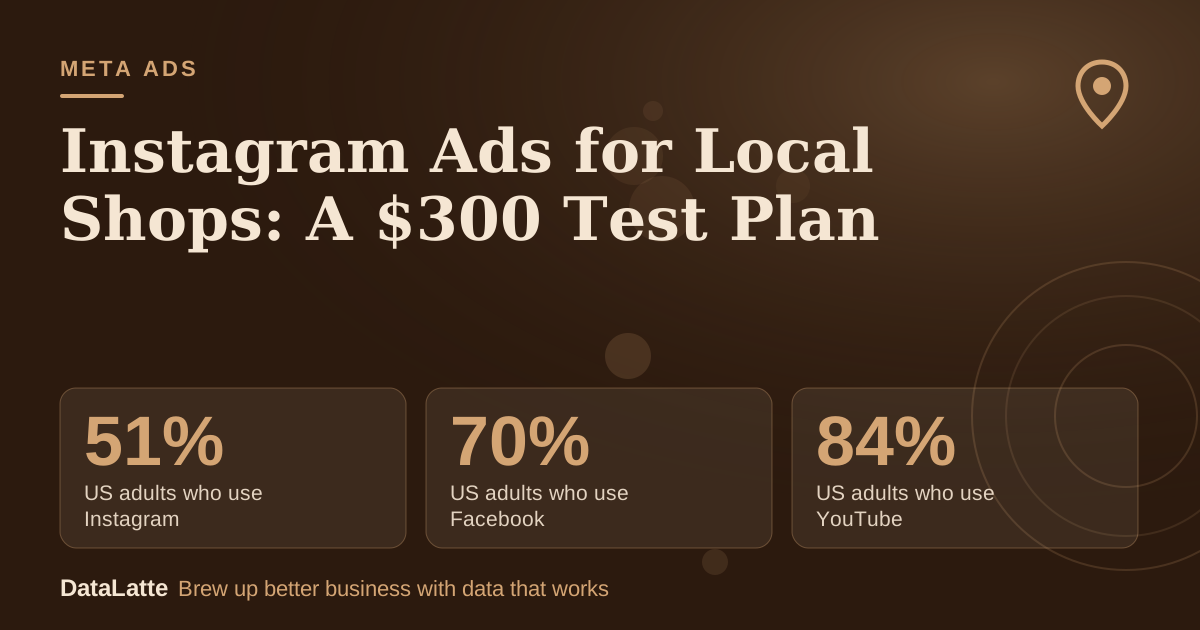
A local shop should use Instagram ads to show one specific product or one reason to visit to people who live or work near the shop, then judge the result by visits and sales, not likes. Pew Research Center's 2026 survey found that about half of US adults use Instagram, so the audience is large. No public source reviewed here gives a cost or foot-traffic result for shops. The worked example below therefore uses labelled assumptions for a $300 test, and the tracking steps show whether it paid.
This guide is for independent shops that sell products to people in their own area in the US, UK, Australia and Canada.
↑
US adults who use Instagram
Pew 2026, primary
↓
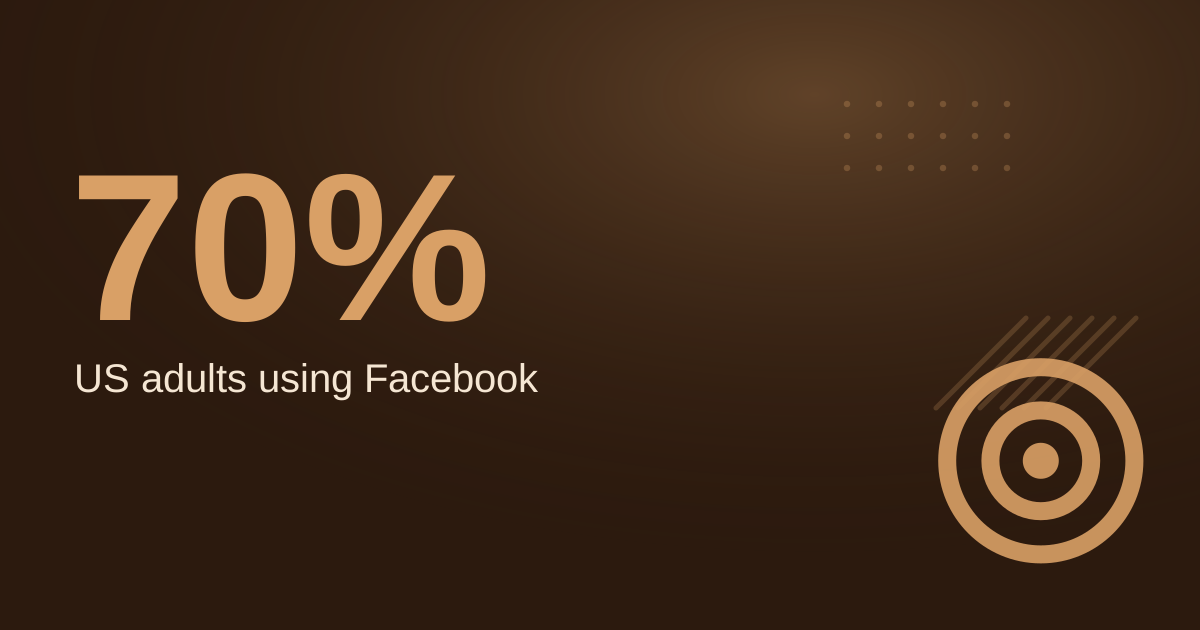
US adults who use Facebook
Pew 2026, primary
→
US adults who use YouTube
Pew 2026, primary
→
US adults who use TikTok
Pew 2026, primary
See Sources at the end of the article. Cards marked Assumption are examples, not results.
Promote something a nearby person can act on this week. Good candidates are a new arrival, a seasonal range, an in-shop event or a clear introductory offer. Avoid ads for the whole catalogue, because they give no reason to come in now. A single product with a date or a reason attached is easier to judge, since the owner can see which ad produced which visit.
Show the real product in a real setting. A phone video of the shelf or a staff member holding the item is usually enough. Put the street or neighbourhood in the first line of the caption so locals recognise the ad is for them. Scheduling posts in advance keeps the ad creative and the organic feed consistent. The
Later versus Planoly scheduling comparison covers the tools that do this.
Which Campaign Goal Fits a Shop?
Meta asks advertisers to choose a campaign objective before setting up an ad, and its help pages describe the goal options in Ads Manager. For a shop that wants visits, a traffic-style goal sending people to a page with opening hours, a map and the featured product is the simplest start. A lead goal suits a shop with a list-building offer, such as a launch-day reminder.
Meta's
A/B testing guidance recommends comparing one variable at a time. Each version is shown to a separate segment so nobody sees both, and the same budget should be used for both versions to keep the comparison fair. Objective names change over time, so match the goal to what the account shows rather than to an older guide.
How Do You Target People Who Can Visit?
Use a radius around the shop. Customers rarely travel far for a single purchase, so start with the area a person could reach in 10 to 15 minutes on foot or by car. This figure is an assumption; check it against the postcodes or suburbs existing customers come from. Keep age and interest settings broad at first, so the platform can find people who respond.
Ask a second question: what happens after the click? If people land on a slow page with no hours and no map, the cheap click is wasted. Put the opening hours, the address and the featured product at the top. A short caption that names the shop and the street also helps people who scroll past the ad remember it.
Local ads can also be paired with search. Search ads reach people already looking, which is a different job. The
guide to whether Google Local Service Ads are worth it explains that channel for service businesses.
What Does a $300 Test Look Like?
Every input in the table is an assumption. Replace each line with real figures after the first run. The cost per click is set at $1.00 for a local test, which is an assumption. WordStream's 2016 all-industry search average of $2.69 is a secondary, dated figure for a different channel, so it is only a rough ceiling and not a forecast for Instagram.
| Input (assumption unless stated) | Value |
|---|
| Test budget for 30 days | $300 |
| Cost per click | $1.00 |
| Clicks | 300 |
| Click to store visit | 3% |
| Store visits | 9 |
| Visitors who buy | 40% |
| Buyers | 3.6 |
| Average sale | $45 |
| Revenue from ad visits | $162 |
| Gross margin | 50% |
| Gross profit | $81 |
On these inputs, the $81 of gross profit leaves a shortfall of $219 against the $300 spend, so the first run does not pay back on first purchases. Break-even needs about 13.3 buyers at $22.50 gross profit each, roughly 3.7 times the example. The test is worth repeating only if repeat visits, bigger baskets or a higher-margin product change the numbers. That is the honest reading: the test shows which inputs need improving before more money is spent.
How Do You Know the Ad Worked?
Clicks are not sales. Track three things from the first day, using a method that separates ad-driven visits from the rest of the trade.
- Give the ad its own landing page or discount code, so online activity can be linked to the campaign.
- Ask at the till, "How did you hear about us?", and log the answers for the whole 30 days.
- Record repeat purchases from the same customers, since a shop often earns the second visit rather than the first.
Compare cost per sale with gross profit per sale, not with revenue. Write down the test goal and the stopping rule before launch, and avoid switching ads on and off by hand, because overlapping audiences make the results unreliable. Ad copy drafts can be adapted from the
ChatGPT prompts for local business marketing article.
Coffee shops and cafes in the UK can apply the same tracking approach using the
Instagram marketing guide for coffee shops. Shops in Canada can compare local context in the
Canada local business marketing guide.
FAQ
Possibly. Ads can put a specific product in front of nearby people, but none of the sources checked for this article measures foot traffic for shops. Run a small test, track visits at the till and let the numbers decide.
What budget should a local shop start with?
The example uses $300 over 30 days as an assumption. Choose an amount that can be afforded if the test fails, and keep it running long enough to collect a few hundred clicks before judging it.
Should a shop use a traffic goal or a lead goal?
Use a traffic goal if the aim is visits to the shop or its page. Use a lead goal if the aim is a list of people to contact later, such as a launch-day reminder.
Is Instagram or Google better for a local shop?
It depends on the job. Search suits people looking for something now, while Instagram suits visual products and new arrivals. Test each one with a fixed budget and compare cost per sale rather than choosing a channel by reputation.
If the test results are unclear, a
free audit can review the account setup, targeting and tracking before more budget is committed.
Sources
Page checked 10 November 2026. The cost, click and conversion figures in the worked example are assumptions, not sourced benchmarks.
Free for local businesses
Want this applied to your business?
I'll review your Google presence, local SEO, and ad accounts — and send you a specific action plan within 48 hours. No pitch, no pressure.