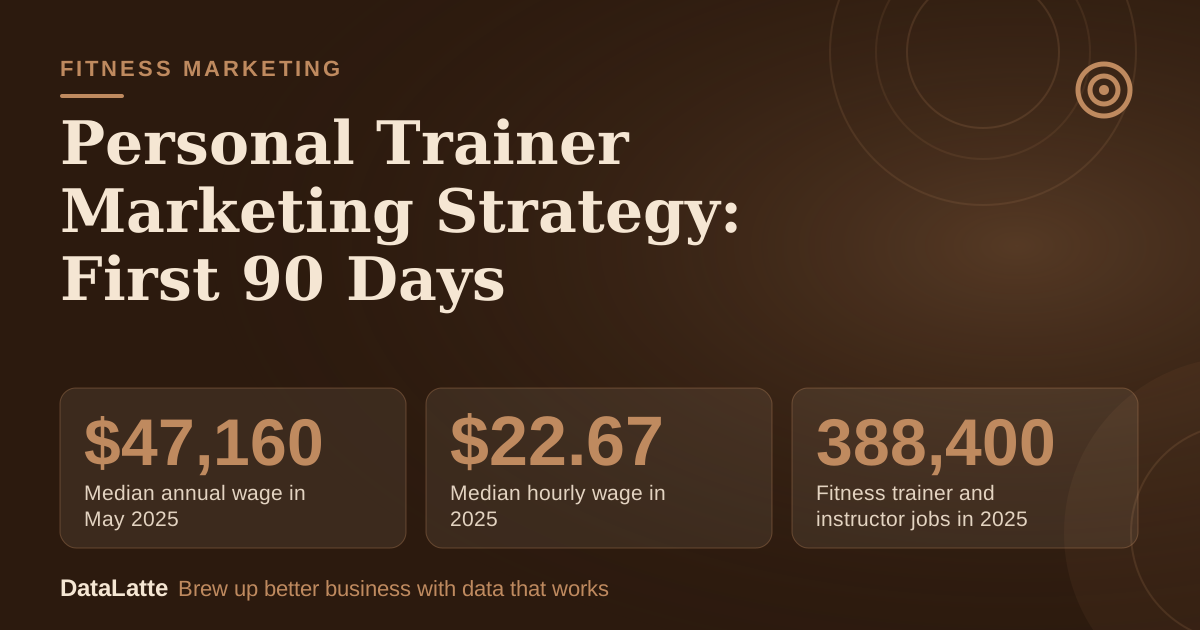
Personal trainer marketing works best in a fixed order: a complete Google Business Profile and booking page first, one clear starter offer, a steady review routine, and only then paid search. Fitness trainers earned a median $47,160 in May 2025, according to the
US Bureau of Labor Statistics, so each marketing dollar needs to bring back a visible client. Organic channels take months to pay off, so a 90-day plan builds the base rather than a full pipeline. Most figures are US benchmarks, and examples marked assumption are illustrations, not results.
→
Median annual wage in May 2025
Bureau of Labor Statistics
→
Median hourly wage in 2025
Bureau of Labor Statistics
→
Fitness trainer and instructor jobs in 2025
Bureau of Labor Statistics
↑
Projected employment growth 2025 to 2035
Bureau of Labor Statistics, much faster than average
See Sources at the end of the article. Cards marked Assumption are examples, not results.
Who Are You Competing With?
The BLS projects employment of fitness trainers and instructors to grow 7 percent from 2025 to 2035, much faster than the average for all occupations, from about 388,400 jobs held in 2025. More trainers means more competition, and many rivals are gym employees who already have a member base to draw on.
Independent trainers win by being easier to find, easier to trust and specific about who they serve. A focus such as postpartum strength or training for people over 50 gives your profile and website something concrete to rank for. Before writing anything, search "personal training studios near me" and note which local businesses appear in the map results, since Google lists those businesses in its Map Pack (
The Association of Fitness Studios).
What Should the Offer Be?
Sell one specific first step rather than a general service. A starter offer, such as a paid assessment session or a short starter block, lets a new enquiry try you before buying a package. Write it on one page with the price, session length, who it suits and a single booking button.
Trust matters as much as the offer. The BLS notes that personal trainers usually must be certified before they begin working with clients or gym members, and most also need CPR, first aid and automated external defibrillator certification. Show current certificates on your site with expiry dates kept up to date. Only publish real client reviews, and ask permission before sharing a client's story.
Which Free Channels Come First?
Start with Google Maps, where people already search for a trainer nearby. The Business Profile shows hours, phone numbers, addresses, reviews and photos directly in search results (
The Association of Fitness Studios). Claim and verify the profile, pick the right category, and add services and a booking link. Verification reviews can take up to 5 business days, so start that early (
Adwave). Gym-specific steps are covered in the
fitness studio profile guide.
Photos matter too. One guide recommends at least 15 authentic photos of your facility, classes and staff (
Vertical Impression). For exterior shots, Adwave suggests the golden hour: the first hour after sunrise or the last hour before sunset (
Adwave). Ask for reviews after a client's first 30 days, as one vendor recommends (
Adwave).
Keepers Digital notes that for businesses outside food and personal services, Google is usually where customers start, so check Yelp too (
Keepers Digital). Referrals from clients and local physiotherapists cost time rather than media budget. Community channels are slow; the
Reddit marketing guide explains how to approach them.
Is a Business Profile Enough on Its Own?
A profile is not the whole picture. Cheers' Market Baseline, covering 49,677 local-intent runs and 356,019 citations across 100 metros and four engines in the 28 days ending September 2, 2026, found business websites supplied 68.1% of pooled AI citations, against 3.3% from Google surfaces (
Cheers). Keep your website's services, location and booking path accurate.
Expect a slow build. Adwave states that organic channels, including the Business Profile, referrals and community, take 6 to 12 months to gain real traction (
Adwave). The 90-day plan sets up those channels; it does not finish them. For AI tools that can help with profile upkeep, see
AI for Google Business Profile optimization.
When Do Paid Ads Make Sense?
Use paid search once a booking page exists and calls or form fills can be tracked. Search works best when you have open slots to fill. A new campaign or bid strategy can show a temporary "Learning" status for up to 7 days, so judge early results after that window (
Google Ads Help).
In the first month, review the Search Terms report weekly, as one pest control guide recommends, and exclude searches you cannot serve (
INSIDEA). Solo trainers weighing outside help can compare options in
AI tools versus a marketing assistant.
What Does a 90-Day Plan Look Like?
Spread the work so each stage builds on the last.
| Days | Focus | Output |
|---|
| 1 to 30 | Foundation | Verified profile, 15+ photos, booking page, one starter offer, review request routine |
| 31 to 60 | Local presence | Two referral partners, one post or short video a week, review count growing |
| 61 to 90 | Test paid search | Small search campaign with call and booking tracking |
Plan seasonal posts early. Adwave advises starting holiday and event planning at least 60 days out (
Adwave); the
holiday marketing strategy covers the calendar. Record profile metrics for 30 days before ads launch, then keep tracking them for 30 to 60 days, as Adwave suggests for campaigns (
Adwave).
At day 90, count enquiries, assessment bookings, paying clients and where each came from. Audit the profile and website quarterly, a practice one landscaping guide recommends alongside monthly strategy reviews (
Accountability Now).
What Does a New Client Cost?
Every input below is an assumption, not a sourced benchmark. Replace them with your own click and booking data after the first month.
| Input | Value |
|---|
| Monthly search budget (assumption) | $300 |
| Average cost per click (assumption) | $5.00 |
| Clicks per month | 60 |
| Clicks that book a free assessment (assumption) | 5% |
| Assessments booked | 3 |
| Booked prospects who buy a starter block (assumption) | 33% |
| New clients | 1 |
| Ad cost per new client | $300 |
| Starter block revenue (assumption) | $400 |
| Revenue left after ad cost | $100 |
At these inputs, one client covers the ads and leaves $100 before your time, equipment and other costs. If the booking rate drops to 2% (assumption), bookings fall to about 1.2 and the ad cost per client rises to about $750, above the $400 block price. Test the booking rate before raising the budget. Outside profile help is priced at $200 to $700 a month by one vendor (
Adwave), which can take a large share of the same budget.
FAQ
How much should a personal trainer spend on marketing?
No single figure fits every trainer. One vendor suggests $200 to $700 a month if you hire help with posts, photos, reviews and citations. Ad spend is a separate line, so test with an amount you can afford to lose and check the numbers with the worked example above.
Is Google or Yelp better for a personal trainer?
For most businesses outside food and personal services, customers start with Google, according to Keepers Digital. Build the Google profile first, then check whether Yelp brings enquiries before spending time there.
Can I use client before and after photos?
Only with written permission, and only if the results are real. Do not imply guaranteed outcomes, and never edit or invent client stories.
How many reviews do I need?
No sourced threshold exists. Ask each satisfied client after their first 30 days, reply to every review, and review the last 60 to 90 days of feedback when auditing your profile (
Cheers).
Sources
Free for local businesses
Want this applied to your business?
I'll review your Google presence, local SEO, and ad accounts — and send you a specific action plan within 48 hours. No pitch, no pressure.