AI can draft the wording of a Google Business Profile quickly, but it cannot verify the facts behind that wording. Use it for the description, service list, post ideas and review replies, then check each claim against what the business actually does. Google asks businesses to represent themselves accurately, keep descriptions free of links and promotional prices, and maintain one profile per business. AI-written text is only useful once the underlying facts are true.
↑
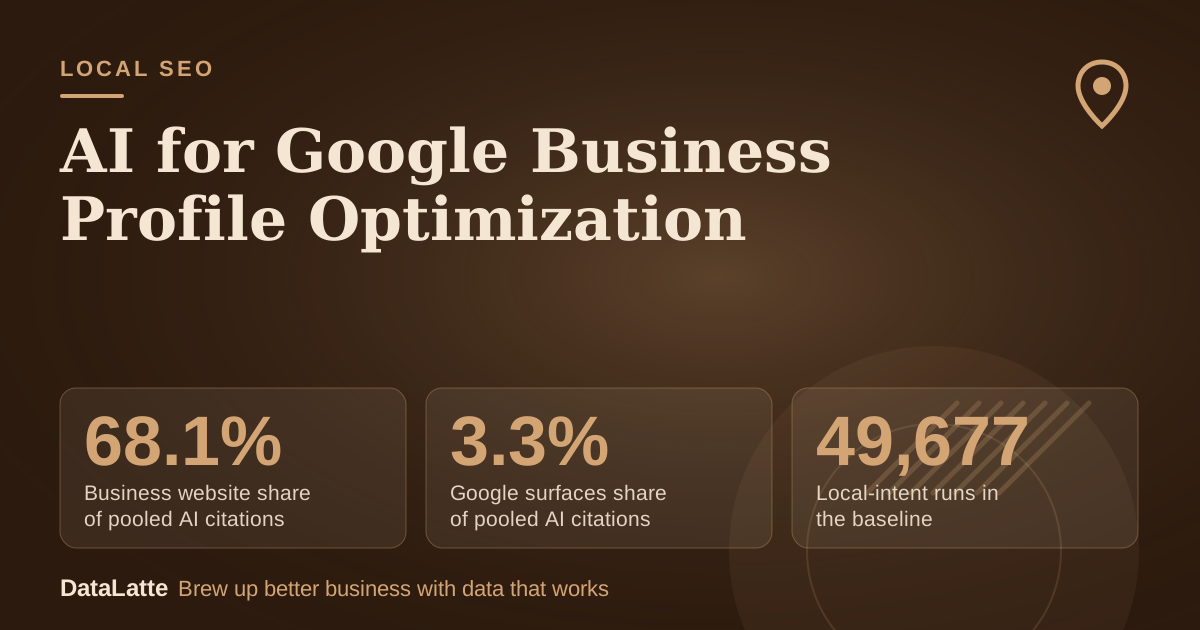
Business website share of pooled AI citations
Cheers Market Baseline, vendor research
↓
Google surfaces share of pooled AI citations
Cheers Market Baseline, vendor research
→
Local-intent runs in the baseline
28 days to Sept 2, 2026, 100 metros
→
Citations in the baseline
Same baseline, aggregate only
See Sources at the end of the article. Cards marked Assumption are examples, not results.
What Can AI Do for a Business Profile, and What Should It Not Do?
AI works well for turning real service details into clear, complete sentences. It is not a source of facts. Hours, service areas, phone numbers, categories and years in business must come from the business owner, because Google expects the profile to reflect the business as customers know it. If a tool invents a detail, the mismatch can spread to the website, listings and reviews.
Google's guidance says local businesses should keep Business Profile information current for AI search, and that AI features rely on the same Search foundations as ordinary results. AI therefore cannot replace the profile itself. It can help write a cleaner version of what is already true. Google also warns against content that could be easily produced by a generative AI model, so generic wording adds little. Treat every sentence the tool produces as a draft that needs sign-off.
Before drafting, review each field against the
Google Business Profile optimization checklist.
Which Profile Rules Must an AI Draft Follow?
Google's guidelines set limits that every draft must respect. The business description should focus on the services and products offered, the mission and the history of the business. It should not focus on special promotions, prices or sales, and it must not display links of any type. The business name should match the real-world name on signage and the website. It should not include taglines, store codes, hours, phone numbers or website addresses.
Categories follow the same logic. Google advises choosing the fewest categories that describe the core business. It also asks for only one profile per business, because duplicates can cause problems with how information displays on Google Maps and Search. If an AI tool suggests extra categories to cover every service, remove any that do not describe the main business.
Write these rules into the prompt so the first draft is closer to usable. The tool will still miss things, so check the output against the list each time.
How Do You Write the Description With AI?
Give the tool facts rather than adjectives. A useful brief lists what the business offers, when it opened, what sets it apart and which parts of the area it serves. Ask for plain English with no prices, offers, links or emojis. The result should describe the business, not sell a discount.
Write a Google Business Profile description for [business type] in [town]. Use only these facts: [services], [year opened], [what is different]. No prices, no offers, no links, no emojis. Plain English.
Read the draft aloud and delete any claim that cannot be proven, such as "the best in town." If the description repeats website copy word for word, shorten it. The profile should summarise the business in its own words. Detail belongs on the service or location page, where conditions can be stated properly.
How Do You Draft the Service List and Categories?
List every service customers ask about, and give each one a single plain sentence. Use the words customers use when they call, not the marketing language on a competitor's site. A pet groomer, for example, should match the names on the booking form, such as "nail trims" or "puppy first groom," rather than broad terms the staff never use.
Service list: [paste]. Write one factual sentence per service, under 25 words each, using the words customers use. Do not add services that are not on the list.
Check that the service list and categories agree. If the profile lists a service that the website never mentions, Google and customers both receive a mixed signal. Where availability varies by branch, put the conditions on the relevant service page and keep the profile consistent with it. The
pet groomer profile guide shows how this works for a niche with many small service variations.
How Should You Plan Posts and Updates?
Posts change more often than most profile fields, so AI can save time here. Ask the tool for a month of ideas in one session: a new service, a staff introduction, a seasonal need and an answer to a common question. Keep each draft short and free of phone numbers, regulated product claims and exaggerated results.
Review every post against Google's content guidelines before publishing. A post that promotes prices or includes links breaks the same rules as the description. Keep a simple log of which posts prompt calls, direction requests or website visits. These actions are signals, not confirmed sales. Google's SEO guidance notes that changes can take anywhere from hours to several months to show, so judge a post after a few weeks rather than the day it goes live.
How Do You Reply to Reviews With AI?
Replies should be brief, polite and specific. AI tends to produce the same thank-you message for every review, so supply one detail from each review and ask for a reply that mentions it. Avoid promotional language, and never repeat a reviewer's private information.
Write a reply under 60 words to this review: [paste]. Thank the customer by first name, mention one specific detail from the review, and sign as [name]. For a negative review, acknowledge the issue and invite them to contact [phone]. No discounts or offers.
Read each reply before posting. A wrong detail, such as the wrong dog's name or the wrong service, does more damage than a slow reply. For a serious complaint, a person should write the response and invite the customer to continue the conversation privately.
What Does the Time Saving Look Like for a Pet Groomer?
The example below uses assumptions, not measured results. It describes a groomer who publishes four posts a month and answers ten reviews. Every input is labelled as an assumption so the owner can replace it with actual figures.
| Input | Value | Source |
|---|
| Posts per month | 4 | assumption |
| Minutes per post, written by hand | 30 | assumption |
| Minutes per post, AI draft plus fact check | 12 | assumption |
| Review replies per month | 10 | assumption |
| Minutes per reply, written by hand | 6 | assumption |
| Minutes per reply, AI draft plus read-through | 3 | assumption |
Manual work comes to (4 × 30) + (10 × 6) = 180 minutes per month. AI-assisted work comes to (4 × 12) + (10 × 3) = 78 minutes per month. The difference is 102 minutes, or about 1.7 hours. The calculation does not show whether the posts earn more bookings. To test that, track calls and booking requests before and after the change, and compare over several months.
The table below shows which steps AI can draft and which the owner must control.
| Step | Who owns it | AI can draft it? |
|---|
| Business name and categories | Owner, checked against signage | No, verify only |
| Description | Owner approves | Yes, then edit |
| Service sentences | Owner confirms each service | Yes, then edit |
| Monthly posts | Owner approves | Yes, then edit |
| Review replies | Owner reads and signs | Yes, then edit |
Businesses in other niches face the same pattern. A coffee shop has more menu-level detail to verify, which is covered in the
coffee shop profile guide. For the wider question of how AI systems choose sources, see the
generative engine optimization guide for local businesses.
FAQ
Yes, for drafting. Check every fact, remove any prices, promotions or links from the description, and confirm that the categories match the main business.
Will AI-written profile text hurt visibility?
Google's guidance says profile information should be accurate and current, and that AI features rely on normal Search foundations. Accuracy matters more than who wrote the sentence, so verify everything before publishing.
How long does a profile change take to show?
Google's SEO guidance says some changes take effect within hours and others can take several months. Wait a few weeks before judging whether a change worked.
Can AI reply to every review automatically?
It can draft replies, but a person should read each one before it is posted. Negative reviews need a human to decide the response.
Should the profile description include links or offers?
No. Google's guidelines say descriptions must not display links of any type, and must not focus on special promotions, prices or sales. Put offer terms and conditions on a page on the website instead.
For a full review of the profile, reviews and location pages together,
book a free audit or read about the
local SEO service.
Sources