Marketing for Local Service Businesses: Where to Start
November 14, 2026·Nataliia Rumiantsewa· 9 min read All posts
Where should a local service business start marketing?
Start with the channels that cost time rather than media spend: the Google Business Profile, reviews, service descriptions and a portfolio. One salon-focused guide gives exactly that advice for a budget close to $0 (RŌZ, secondary). After those are in place, add a small paid search test, then email or SMS for existing clients, then social.
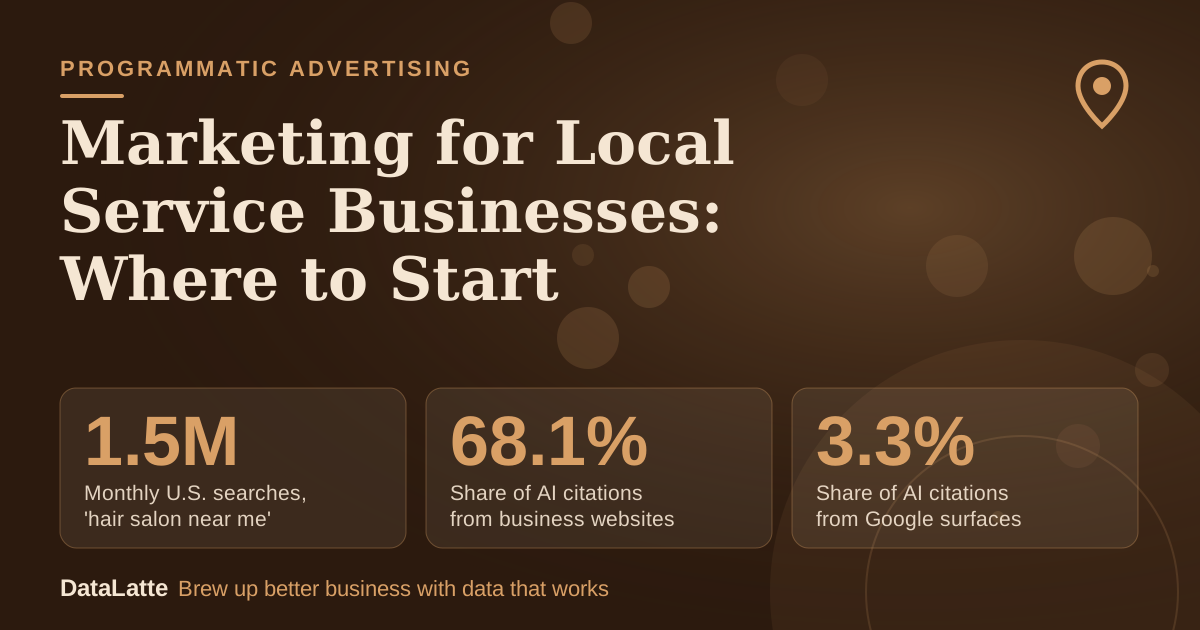
The same logic applies to cafés, studios, groomers, clinics and trades. Demand is already searching. The same guide cites Google Ads keyword data from April 2026 estimating about 1.5 million U.S. searches per month for "hair salon near me" (secondary). The job is to be findable, trusted and easy to book.
1.5M→
Monthly U.S. searches, 'hair salon near me'
Google Ads keyword data, April 2026, via RŌZ (secondary)
68.1%→
Share of AI citations from business websites
Cheers Market Baseline, 28 days to Sept 2, 2026 (secondary)
3.3%→
Share of AI citations from Google surfaces
Cheers Market Baseline, same period (secondary)
28%↑
Rise in Discovery views with synced listings
14,000-location study cited by Adwave, 90 days (secondary)
See Sources at the end of the article. Cards marked Assumption are examples, not results.
Which six channels matter for local service businesses?
Six channels cover most local demand: Google Business Profile, local SEO (the website and its service pages), reviews, paid ads, email/SMS and social. They work as a chain. The profile and website capture searchers, reviews convince them, ads add volume, email/SMS brings clients back and social supports the portfolio.
Cost data in the available sources is thin. The Google Business Profile and Google reviews are both listed as free (RŌZ, secondary). Costs for ads, email/SMS tools and social are not documented here, so current rates need to be requested from any vendor before budgeting. The local marketing budget guide covers how to split spend once those quotes are in.
The effort and timing columns below are planning assumptions, not measured figures.
Channel
Documented cost
Effort (assumption)
Time to first signal (assumption)
First number to watch
Google Business Profile
Free (secondary)
Low
Days to weeks
Calls, booking clicks, direction requests
Local SEO (website pages)
Not documented
Medium
Months
Calls and forms from service pages
Reviews
Free (secondary)
Low
Weeks
New reviews per month
Paid search ads
Not documented
Medium
Weeks
Qualified calls, booked appointments
Email/SMS
Not documented
Low to medium
Weeks
Review requests sent, second appointments
Social
Not documented
Medium
Months
Inquiries, not followers
How should the Google Business Profile be set up first?
Accuracy comes before anything else. A salon guide says an owner can begin correcting common missing or inconsistent profile details in about ten minutes (RŌZ, secondary). Phone, website, description and opening hours can be edited outside Google and pushed to the listing. Business name, category and address are read-only there and must be changed on Google itself (DMly, secondary).
Address rules matter for mobile trades and home-based groomers. Google does not allow P.O. boxes or virtual offices as a business address. Service-area businesses should define their area and hide the physical address (Adwave, secondary). Google's guidance says service areas should be set by city, postal code or another area type, not by a radius (Cheers, secondary).
Posts need a few checks:
Offer posts require a title and start and end dates, and a photo is recommended.
Published posts cannot be edited; changing one means deleting it and posting again.
Posts older than 6 months are archived unless a date range is set.
Google does not say that daily posting guarantees a ranking increase (RŌZ, secondary), so a steady rhythm beats volume.
How do reviews and local SEO work together?
Google says local results are mainly based on relevance, distance and prominence, and that review count and rating can factor into local ranking (Cheers, secondary). There is also no way to request or pay Google for a better local position (RŌZ, secondary). Reviews and accurate pages are the levers that remain.
Review requests work best when they are automatic. One vendor guide describes sending a request 2 hours after a completed appointment, or the following morning after a service, by SMS, email or WhatsApp as a tracked link (DMly, secondary).
Two practices are off limits:
Review gating, meaning privately asking whether a customer is happy and sending only the happy ones to Google, goes against Google's policies.
Offering money, discounts or free services for a review is advised against.
Telling clients what to write is also discouraged (RŌZ, secondary).
The website matters beyond Google's map results. In one 28-day measurement across 100 metros, business websites supplied 68.1% of pooled AI citations and Google surfaces 3.3%, though the figures were corrected on September 23, 2026 (Cheers, secondary). Service pages with clear descriptions deserve the same attention as the profile.
When do ads, email/SMS and social make sense?
Ads come after the free foundation, not before. A profile with wrong hours or few reviews wastes paid clicks. Once the basics are fixed, a small Google Search test can show which searches turn into bookings. The test should be judged by search terms, qualified calls or forms, completed consultations and booked appointments, not by clicks alone (RŌZ, secondary).
Email and SMS have one documented use in these sources: sending review requests as tracked links. Rebooking and promotion messages are a reasonable extension, but no source here quantifies their results, so they should be tested against second-appointment counts.
Social needs the same discipline. Followers, views and clicks can help diagnose a campaign, but they are not the final result. The goal is the right person reaching the right booking step (RŌZ, secondary).
The plan below sequences the six channels over 13 weeks. The pacing is an assumption; the individual tasks come from the sources cited above.
Week
Task
1
Verify the Google Business Profile. Correct phone, website, description and hours. Confirm name, category and address on Google. Set the service area by city or postal code.
2
Read reviews from the last 60 to 90 days (Cheers, secondary). Write service descriptions and add portfolio photos to the website.
3
Set up review requests: 2 hours after the appointment, or the next morning. No gating, no incentives.
4
Reply to every review (a vendor policy, secondary). Publish a first Offer or Event post with title, dates and photo. Check that its status is Live. Start the weekly scorecard.
5-6
Launch a small Google Search test. Budget is the owner's decision (not documented). Track calls, forms and booked appointments.
7
Read the search terms report. Remove irrelevant terms. Compare booked appointments against clicks.
8
Decide: keep, adjust or pause the test.
9-10
Message existing clients by email or SMS with a rebooking prompt. Track second appointments booked.
11-12
Post portfolio work on social with a direct booking link. Track inquiries, not followers.
13
Review the full scorecard. Set next quarter's targets.
The scorecard in the salon guide includes advertising spend, qualified inquiries, consultations booked, new-client appointments completed, revenue from those appointments and second appointments booked (RŌZ, secondary). For targets, realistic sales goals explains how to set them without guessing.
What does a worked example look like for a salon?
All inputs below are assumptions chosen to show the arithmetic, not benchmarks.
Reviews (assumptions). A salon completes 160 appointments per month. Review requests go out 2 hours after each appointment. If 10% of clients leave a review, that is 16 new reviews per month, or 48 over a 90-day plan.
Paid search test (assumptions).
Input
Value (assumption)
Monthly test spend
$600
Qualified calls and forms
24
Consultations booked
10
New-client appointments completed
6
Revenue per first visit
$90
New clients who book a second appointment
3
Calculation: 6 new clients at $90 is $540 in first-visit revenue against $600 spent, so cost per new client is $100 and the first visits do not cover the test. If the 3 returning clients spend $90 again (also an assumption), second visits add $270, for a total of $810 against $600.
The result depends on rebooking, which clicks never show. That is why the scorecard tracks second appointments. A test like this can look weak after week 5 and acceptable after week 13, or the reverse, depending on the repeat rate. For lead-flow context beyond one channel, the local lead generation guide is a useful companion.
How should multi-location or growing businesses handle this?
Single-location owners can skip most of this section, but growing businesses should plan for it. A 14,000-location study cited by Adwave found businesses using centralized tools to sync listings saw a 28% jump in Discovery search views within 90 days (secondary). Businesses with 10 or more locations are likely eligible for bulk verification rather than waiting for postcards.
Access control also matters. The Owner role should be limited to one or two key people. A Manager can handle day-to-day tasks such as replying to reviews and posting but cannot add users or delete the profile. A Site Manager suits a store manager who updates hours or replies to reviews for one location (all Adwave, secondary).
Google's chain guidance says locations offering the same service should generally keep consistent names and categories. Profile descriptions must avoid low-quality or irrelevant content (Cheers, secondary).
Adwave also recommends a unique 750-character description for every location (secondary). The Performance report can be filtered to one location, a custom group or the whole business.
FAQ
What is the cheapest marketing channel for a local service business?
The Google Business Profile and Google reviews are both listed as free, with low effort (RŌZ, secondary). They cost time rather than media spend. Costs for ads, email/SMS tools and social are not documented in the sources, so current rates should be requested.
Should review requests be sent only to happy customers?
No. Privately asking whether customers are happy and sending only the happy ones to Google is called review gating and goes against Google's policies. Offering discounts, money or free services for reviews is also advised against (DMly, secondary).
Can a business pay Google to rank higher in local results?
No. The salon guide states there is no way to request or pay Google for a better local position. Local results are mainly based on relevance, distance and prominence (RŌZ, secondary).
How should a first Google Ads test be judged?
By search terms, qualified calls or forms, completed consultations and booked appointments, not by clicks alone. A weekly scorecard should also track revenue from new clients and second appointments booked (secondary).
Next step
A free review of the profile, reviews and website shows which of the six channels to fix first. Request a free audit to get a prioritized starting list.
Local marketing strategist with 10+ years at global agencies — OMD, Dentsu, GroupM, and BBDO. Now helping small businesses get the same data-driven edge. Based in Europe, working with clients in the US, UK, Australia, and beyond.