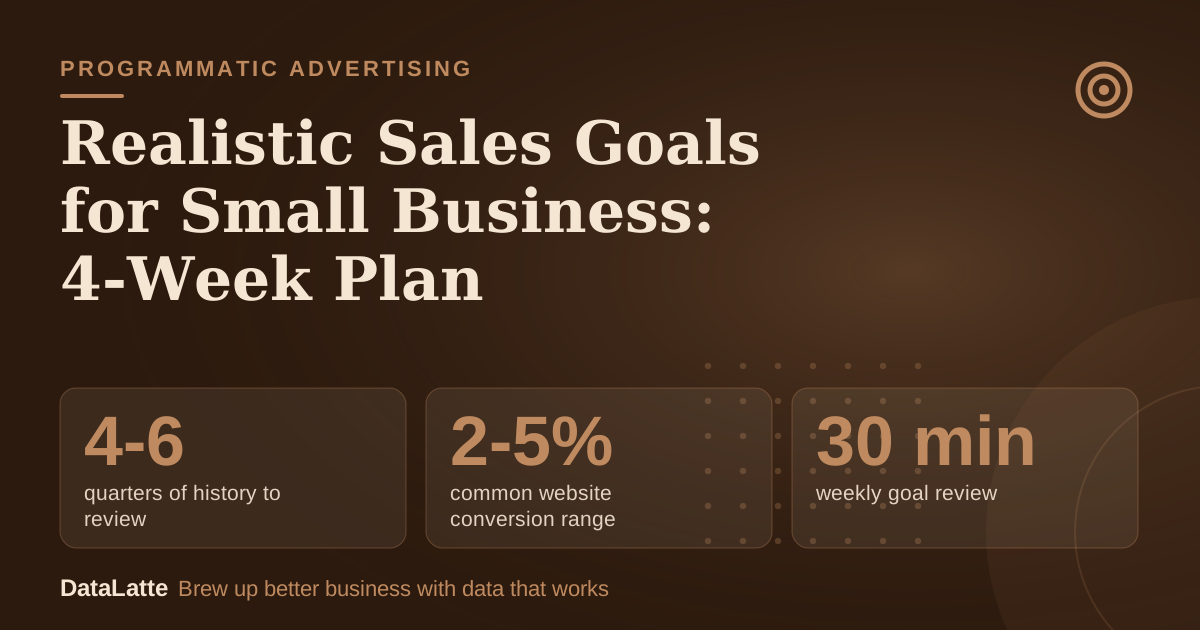
Realistic Sales Goals for Small Business: 4-Week Plan
November 13, 2026·Nataliia Rumiantsewa· 8 min All posts
A realistic sales goal starts with 4 to 6 quarters of past results, which Salesforce guidance cited by Adwave (secondary) recommends reviewing before assigning targets. Divide the revenue goal by average ticket size to get a sales count. Divide that count by the conversion rate to get the leads needed. Then check the result against how many customers the business can actually serve.
4-6→
quarters of history to review
Salesforce guidance via Adwave (secondary)
Assumption
$420,000↑
revenue needed in a sample service business
Adwave illustrative example, assumption (secondary)
2-5%↓
common website conversion range
Adwave, varies by industry and channel (secondary)
30 min→
weekly goal review
Adwave guidance (secondary)
See Sources at the end of the article. Cards marked Assumption are examples, not results.
What makes a sales goal realistic for a small business?
A goal is realistic when three checks agree. The first is history: the number must be a believable step from what the business has already done. The second is the funnel: the leads and conversion rates needed to reach it must be plausible. The third is capacity: chairs, appointments, class spots or staff hours must be able to deliver it.
Most missed goals fail one of these checks. A target pulled from ambition alone ignores all three. A target built from last year's revenue plus a round growth number passes the first check and ignores the other two.
Format matters less than the math. Adwave's goal-setting guide (secondary) recommends SMART goals over OKRs for solo operators and teams under ten people. For a salon, groomer or coffee shop, a single specific number with a deadline is enough.
Which method should set the number?
Several methods can produce a revenue target, and each answers a different question. Running two of them and comparing the results is a quick way to catch an unrealistic figure. If the history-based number and the cost-based number are far apart, one of the inputs is wrong.
Method
Inputs
Best used when
Main risk
Past revenue plus growth
4-6 quarters of sales
The business has a stable track record
Repeats last year's mistakes
Sales count
Revenue divided by average order value
Ticket size is steady
Hides mix changes between services
Cost-plus
Annual costs plus profit target
Profit matters more than growth
Target may exceed demand
Funnel backward
Target, deal size, conversion rates
A marketing channel is being added
Rates are guesses until measured
Capacity ceiling
Appointments or spots per week
Calendar is already near full
Ignores price changes
Seasonal index
Each period's average against overall average
Sales swing by month
Needs several cycles of data
The seasonal index is described on Adwave's seasonal planning page (secondary) as comparing each period's average sales with the overall average.
How much history is enough before setting a target?
The guidance cited by Adwave is 4 to 6 quarters, including win rates, average deal size and conversion rates by segment. That is one and a half years of data at the low end. A business younger than that can still set a goal, but it should be labeled provisional and revisited after the first full quarter.
Seasonal businesses need more. A seasonal forecasting guide cited on the seasonal strategies page (secondary) advises collecting at least 2 to 3 complete cycles of data before forecasting. For a pet groomer with a summer shedding rush or a fitness studio with a January surge, that means two or three full years before the seasonal pattern is trustworthy.
The baseline math is simple. In Adwave's illustration, a business that sold $120,000 last year at a $600 average order value made about 200 sales, or roughly 16 to 17 per month. That monthly count is the starting line, and growth is measured against it.
How do conversion rates turn a revenue goal into a lead goal?
Working backward from revenue shows how much marketing the goal demands. In Adwave's service-business example, $360,000 in annual costs plus a $60,000 profit target requires $420,000 in revenue. At a $1,400 average deal size, that means 300 closed deals. Each deal needs a lead behind it, and conversion rates set how many.
Adwave's funnel guide (secondary) lists common ranges: 2 to 5% for websites, 1 to 3% click-through for email campaigns, and 30 to 50% close rates for phone inquiries at service businesses. The guide notes these vary by industry and channel, so they work as sanity checks rather than forecasts.
The same guide's hypothetical shows why measuring matters. Spending $2,000 a month on Google Ads, 500 clicks and a 2% conversion rate yield 10 customers at $200 each. Lifting the rate to 5% yields 25 customers at $80 each. Tracking real rates, for example through Google Analytics 4, replaces the benchmarks with the business's own numbers.
What does a worked example look like for a pet groomer?
This example uses assumptions only. None of the figures below are real client data or benchmarks.
Input
Value (assumption)
Last year's revenue
$132,000
Average ticket
$66
Weekly capacity
50 appointments
Operating weeks per year
50
Practical capacity ceiling
90% of maximum
Growth target
8%
Bookings per new client in year one
4
Website conversion rate
3%
Step one: $132,000 divided by $66 is 2,000 appointments, or 40 per week. Against a maximum of 2,500 (50 times 50), that is 80% utilization.
Step two: 8% growth gives $142,560 in revenue, or 2,160 appointments. That is 43.2 per week and 86.4% utilization, under the 2,250-appointment ceiling (90% of 2,500).
Step three: the gap is 160 appointments. At 4 bookings per new client, that requires 40 new clients. At a 3% website conversion rate, 40 divided by 0.03 is about 1,333 visitors for the year, or roughly 111 per month. This assumes existing clients return at last year's rate.
A 15% goal would require $151,800, or 2,300 appointments. That breaks the 2,250 ceiling, so the goal would need a price increase or more hours before it counts as realistic.
What is a 4-week plan for setting the goal?
Four weeks is enough to gather data, run the math, test it against capacity and lock a review routine. The plan below is built for a business with a basic sales record and a website or booking page.
Week
Task
Output
1
Pull 4 to 6 quarters of sales, tickets and bookings by month
One sheet with revenue, count and average ticket
2
Run two methods from the table and compare
A target range, not a single number
3
Convert the range into leads using measured conversion rates, then check capacity
A lead goal and a utilization figure
4
Write one SMART goal, split it by month, set the review slot
A dated goal and a weekly 30-minute review
In week 3, a new channel should enter as a test, not a promise. Adwave's funnel guide (secondary) estimates that top-of-funnel changes, such as adding an advertising channel, can show results in 30 to 60 days. A referral program guide (secondary) gives similar advice for any new program: set a goal achievable within a planned timeline and start small.
How should seasonal peaks and promotions change the goal?
Annual goals hide the calendar. A flat monthly split overstates slow months and understates peaks. A seasonal index fixes that by weighting each month by its history.
Lead time matters too. A retail planning guide cited by Adwave (secondary) recommends starting at least 90 days before the target season, and other guidance points to 3 to 6 months. The same page suggests months 5 to 6 for research and planning, months 3 to 4 for creative and inventory, month 2 for channel setup, and month 1 for the main push.
Paid media needs its own check. Adwave's page cites an estimated $15 to $35 CPM range for TV and OTT, and the CTV cost breakdown covers current rate data in more detail. Ad prices around peak dates are not documented in these sources, so current rates should be requested before budgets are fixed.
On Google, Google's guidance recommends seasonality adjustments only for short events, where conversion rates are expected to change by more than 30% in less than 7 days. For longer promotions, it recommends manually adjusting ROAS or CPA targets.
How often should progress be reviewed, and when should the goal change?
Adwave's guide says a good weekly review takes about 30 minutes and should focus on activity that predicts revenue, not just revenue itself. For the groomer example, that means weekly website visits, booking requests, phone inquiries and appointments filled, compared with the monthly pace the goal implies.
Google Ads can report some of these actions directly. Google's documentation lists shop visits, shop sales, contacts and directions as conversion goals for shop-goals Performance Max campaigns. These are leading indicators a local business can attach to a goal.
A goal should change when an input changes, not when a single week disappoints. A new price, a lost groomer or a measured conversion rate far from the assumed one justifies a recalculation. Small test budgets help here: Adwave says CTV tests can start at $30 a day (secondary), and the small-budget CTV analysis covers whether that fits a given business.
A free review of existing numbers is a fast way to find the weakest input. Request a free audit to check conversion tracking and ad spend against the goal.
FAQ
How many months of sales history are needed to set a goal?
Salesforce guidance cited by Adwave (secondary) recommends 4 to 6 quarters. Seasonal businesses are advised to collect at least 2 to 3 complete cycles before forecasting, per the seasonal strategies page (secondary).
What conversion rate should be assumed for a website?
Adwave says 2 to 5% is a common range for small-business websites, varying by industry and channel. Measured rates from the business's own analytics are more reliable than any range, so the range works best as a starting assumption to replace after a few weeks of data.
Should a small business use SMART goals or OKRs?
Adwave's guide says SMART goals usually win for solo operators and teams under ten people. A SMART goal is specific, measurable, achievable, relevant and time-bound, which suits a single revenue or booking number with a deadline.
How early should seasonal goals be planned?
A retail planning guide cited by Adwave recommends starting at least 90 days before the season, and other guidance cited there points to 3 to 6 months. The article also recommends testing messages 4 to 6 weeks before the main season so weak offers can be swapped out.
Local marketing strategist with 10+ years at global agencies — OMD, Dentsu, GroupM, and BBDO. Now helping small businesses get the same data-driven edge. Based in Europe, working with clients in the US, UK, Australia, and beyond.