November 13, 2026·Nataliia Rumiantsewa· 9 min read All posts
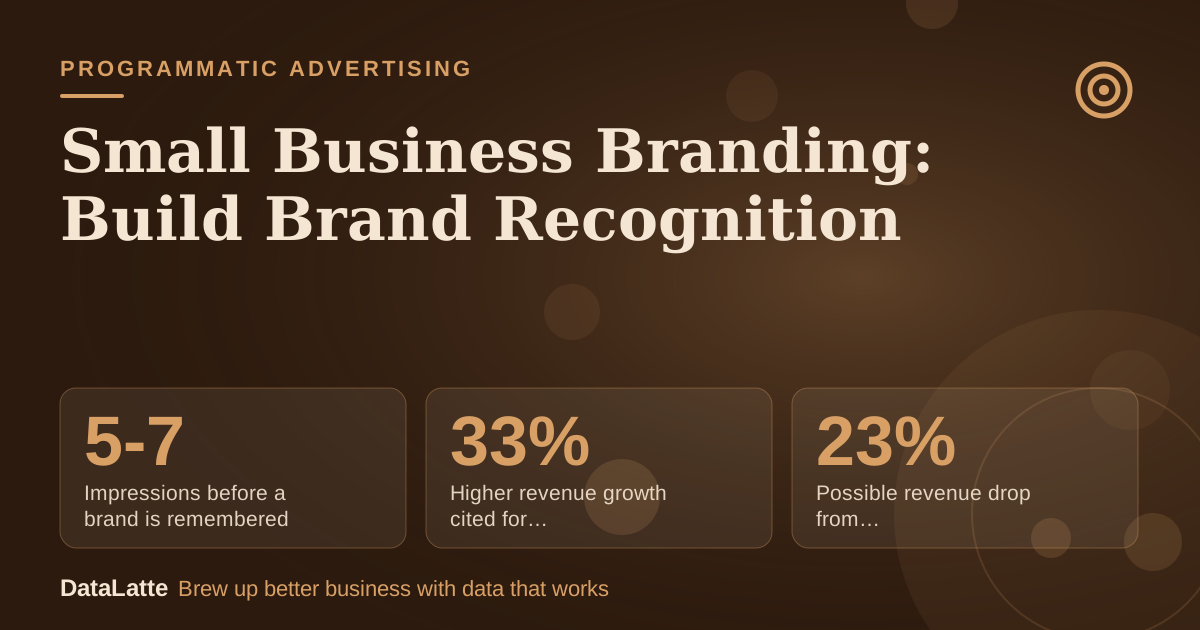
Small business brand recognition comes from repetition: the same name, colors, and message showing up in enough places that a customer remembers them. Adwave's branding guidance says consumers need 5 to 7 impressions before they remember a brand (secondary). The entry point is cheap. Basics such as a logo, colors, and fonts run $0 to $200, claimed profiles cost $0 per month, and paid reach starts around $200 to $500 per month. Below: a touchpoint table, a coffee shop budget example, and a 6-week plan.
5-7→
Impressions before a brand is remembered
Adwave (secondary)
33%↑
Higher revenue growth cited for consistent listings
Adwave, unnamed studies (secondary)
23%↓
Possible revenue drop from inconsistent listings
Adwave citing branding statistics (secondary)
3-6→
Months to see branded search movement
Adwave (secondary)
See Sources at the end of the article. Cards marked Assumption are examples, not results.
What does brand recognition actually mean for a small business?
Awareness is whether people know a business exists. Reputation is what they think once they know it. Adwave's brand awareness guide (secondary) separates the two, and recognition sits between them: a stranger sees a sign, a cup, or a post and thinks "that's the place on Main Street."
Visual identity carries much of that load. The same guide cites We Are Tenet's statistic that consumers are 81% more likely to remember a brand's color than its name (secondary). Another Adwave page, citing 2025 branding statistics, says brand recall alone drives 38.7% of brand lift (secondary).
The practical takeaway is narrow. A shop with two logos, three shades of green, and a different name on each profile resets the impression count each time. Recognition builds only when the repeated thing is identical.
Why does consistency matter more than a big budget?
Consistency is free, and the cited numbers on inconsistency are large. Adwave reports that 73% of users lose trust in a brand (secondary) when they find inaccurate business information online. The same page says some studies show consistent name, address, and phone (NAP) listings see up to 33% higher revenue growth than inconsistent competitors, and that inconsistent listings can cost up to 23% of revenue.
Treat these as directional. The studies are unnamed and the page is a vendor's. Still, the direction is clear enough to act on without spending anything.
The page's rules are simple. Use the name customers know, which matches Google's guidance favoring the real-world "doing business as" name. Check the most critical listings (Google Business Profile, Facebook, Yelp) every quarter, even with a plain spreadsheet.
Results arrive at different speeds. Fixing a major profile like Google Business Profile can show a shift in local rankings within days to a week. Smaller directories can take several weeks or a couple of months, and a full cleanup typically pays off in 1 to 3 months.
How much should a small business spend on branding?
Adwave's framework splits spending into four phases. Phase 1, locking down the basics such as logo, colors, fonts, and value proposition, costs $0 to $200. A separate line says a professionally designed logo typically costs $200 to $500. Phase 2, claiming digital profiles and posting, costs $0 per month.
Phase 3, adding paid awareness such as a connected TV (CTV) campaign and boosted social posts, runs $200 to $500 per month. Phase 4, expanding channels and sponsoring a local event, is budgeted at $500+ per month.
For the total envelope, one Adwave guide (secondary) gives a rule of thumb of 5% to 10% of total revenue for the entire marketing budget. It adds that a brand-new business may need 50% or more of that budget on top-of-funnel awareness.
Those are one vendor's rules of thumb, not universal benchmarks. For current CTV pricing, the CTV cost and CPM breakdown is the place to start.
Which touchpoints build recognition, and what do they cost?
Every place a customer meets the business is a touchpoint, and each needs the same name, colors, and tone. The table below pairs each touchpoint with the cadence or cost stated in the sources.
Touchpoint
What must stay identical
Sourced cost or cadence
Logo, colors, fonts
Same files on every surface
Phase 1 basics $0 to $200; professional logo $200 to $500
Google Business Profile, Facebook, Yelp
Name (DBA), address, phone
Free to claim; check every quarter
Primary social account
Visual style and voice
3 to 5 posts per week; start at 3
Email
Sender name, header, colors
One value-packed email per week or every two weeks
Blog article
Business name, answers to real customer questions
One per month; 6 to 12 months to build traffic
Online reviews
Business name as customers know it
Restaurant data: 94% of diners read reviews before dining (secondary)
Boosted social posts
Same creative as organic posts
$10 to $20 per day can extend reach of top posts
Connected TV
Same logo, colors, offer
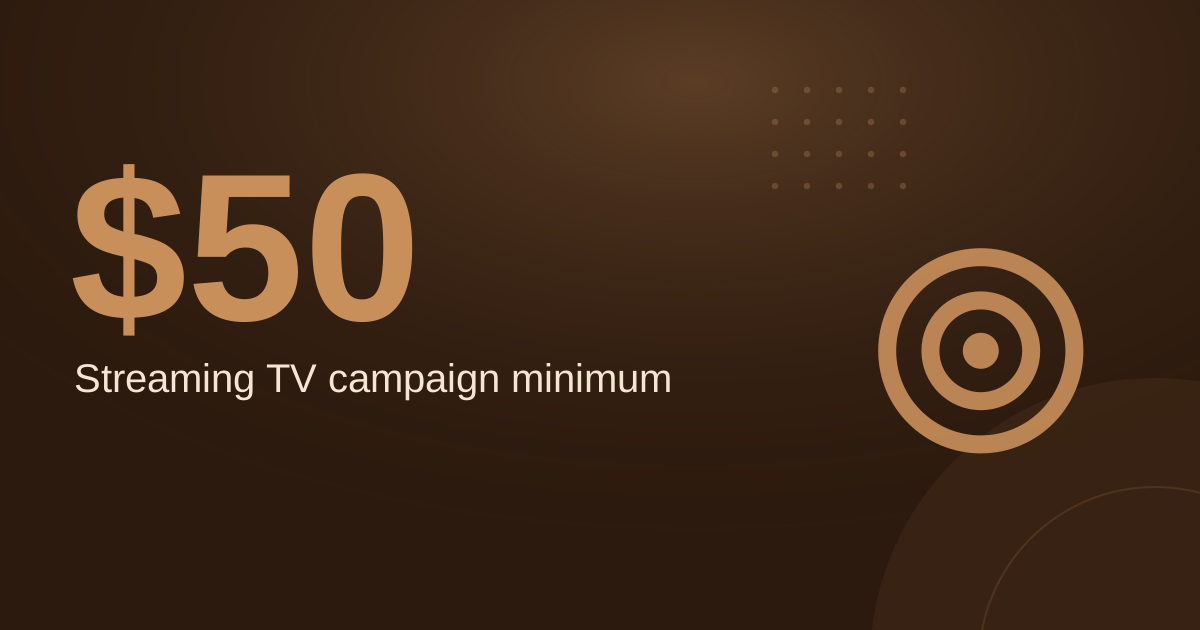
Campaigns from $30 a day; $50 minimum budget stated on one page
The review figure comes from restaurant research cited by Adwave (secondary), which also says 72% of diners trust online reviews as much as personal recommendations. It describes diners, so apply it to cafes with caution.
Can connected TV help a local brand get recognized?
CTV puts a repeated ad in front of a local audience on streaming channels. Adwave says its ads run across 100+ premium streaming channels such as NBC, Hulu, ESPN, and Fox, and that completion rates exceed 95%. The same page cites Thinkbox research that TV advertising generates 2.2 times more trust than digital display ads (secondary).
On awareness, Adwave's TV effectiveness page (secondary) cites Nielsen: a 23% brand awareness lift for TV versus 9% for digital. It also cites Comscore: a 25% awareness lift and a 25% improvement in ad recall for CTV.
These are national research findings relayed by a vendor. A VAB study of 201 first-time TV advertisers found brands spending $500,000 or less saw 8% launch-month traffic increases, so the evidence describes larger budgets than a single-location shop will spend.
What does a worked budget look like for a coffee shop?
The example below is built entirely on assumptions, applied to sourced rules of thumb. A single-location coffee shop with assumed monthly revenue of $20,000 applies the low end of the 5% to 10% rule.
Line item
Input
Math
Monthly revenue
$20,000 (assumption)
n/a
Total marketing budget
5% of revenue
$1,000
CTV awareness test
$500 (assumption)
$500 / $25 CPM x 1,000 = 20,000 impressions
Boosted social posts
$10 per day for 10 days (assumption)
$100
Local event or signage reserve
Remainder (assumption)
$400
The $25 CPM matches Adwave's own restaurant example (secondary), where $500 over two weeks buys roughly 20,000 impressions. Adwave's estimated range elsewhere is $15 to $35 CPM, which would turn the same $500 into about 33,333 or 14,286 impressions.
Now apply the 5 to 7 impression rule. If delivery averaged 6 impressions per person (assumption), 20,000 impressions would reach about 3,333 people. Real delivery is uneven, so that figure is a planning ceiling, not a forecast.
The takeaway: one month of spend reaches a small slice of a neighborhood. Recognition comes from repeating the budget and keeping the creative identical.
What does a 6-week brand recognition plan look like?
This sequence follows the order of Adwave's phases: basics first, free profiles second, paid reach last.
Week 1: Settle the logo, colors, fonts, and one-sentence value proposition. Write down the exact business name customers use, and apply it everywhere.
Week 2: Claim or audit Google Business Profile, Facebook, and Yelp. Fix name, address, and phone mismatches. Record a baseline of branded searches and direct traffic, since a pre-campaign baseline lets a business see whether the market responds differently afterward. The GA4 guide for small businesses covers the setup.
Week 3: Begin posting three times per week on the strongest social platform. Schedule one email, with a cadence of weekly or every two weeks.
Week 4: Publish one article answering a question customers ask often. Check the listings spreadsheet again.
Week 5: Prepare one ad creative that matches the logo and colors exactly. The CTV creative specs guide lists the technical requirements. Start boosted posts at $10 per day.
Week 6: Launch a small CTV test. Adwave suggests restaurants begin with $100 to $200 before committing more. Compare traffic and branded searches with the Week 2 baseline.
After week 6, the work is repetition. Adwave says meaningful movement in branded search and direct traffic typically appears within 3 to 6 months of consistent effort.
How long until recognition shows up in the numbers?
Brand work lags direct response. Adwave's brand awareness guide (secondary) says early signals show up in branded search, direct traffic, social engagement, and easier customer conversations before they show up in closed sales.
Timelines in the sources vary by channel:
Listing cleanup on major platforms: days to a week for ranking shifts, with full cleanup results in 1 to 3 months.
Branded search and direct traffic from consistent awareness effort: 3 to 6 months.
Organic traffic from one article per month: 6 to 12 months.
Weekly posting and monthly articles will not look impressive in week three. The sources describe a compounding process, and the measurement habit matters as much as the activity. A written baseline from Week 2, reviewed monthly, is how a small business can tell whether recognition is actually building.
A free audit can show where profiles, listings, and ads currently disagree with each other, which is usually the first thing to fix.
FAQ
How many times does someone need to see a brand before remembering it?
Adwave's guides say 5 to 7 impressions, with a cited We Are Tenet statistic putting it at 6 to 7. These are vendor-relayed figures, so treat them as a planning rule rather than a guarantee. The point is that one post or one ad rarely does the job.
What is the cheapest first step in small business branding?
Settling the visual basics (logo, colors, fonts, value proposition) is listed at $0 to $200, and claiming profiles and posting is $0 per month in Adwave's framework. Paid awareness starts in the next phase, at $200 to $500 per month.
Is CTV too expensive for a small shop?
Adwave states campaigns start at $30 a day, and a different page states a $50 minimum budget. Its estimated pricing is $15 to $35 CPM. Whether that fits depends on the shop's total budget, so ask any provider for current rates in writing. The CTV cost breakdown covers typical ranges.
How often should a small business post on social media?
Adwave recommends 3 to 5 posts per week on a primary platform, and suggests starting at 3 per week during the free phase. Quality and visual consistency matter as much as volume, because every post is an impression of the same brand.
Local marketing strategist with 10+ years at global agencies — OMD, Dentsu, GroupM, and BBDO. Now helping small businesses get the same data-driven edge. Based in Europe, working with clients in the US, UK, Australia, and beyond.