Sales Scripts for Small Business That Sound Natural
November 13, 2026·Nataliia Rumiantsewa· 8 min read All posts
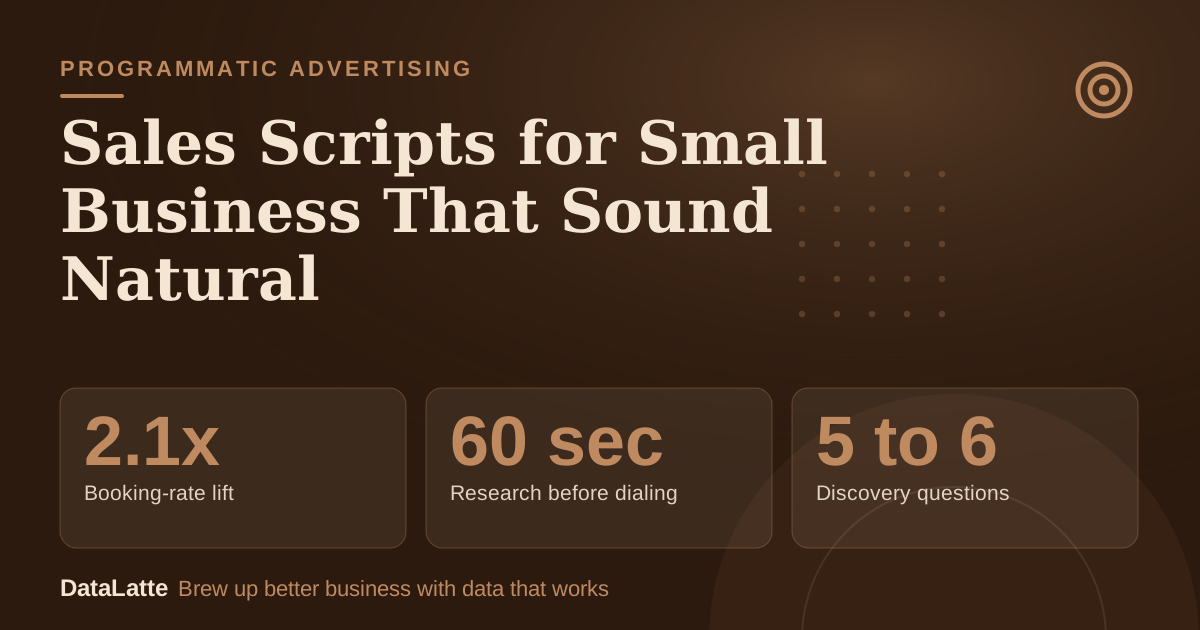
A sales script for a small business sounds natural when it is written the way people talk, opens with the reason for the call, asks a handful of real questions, and has a prepared answer for common pushback. Gong reports that opening with the reason for the call can produce a 2.1x higher success rate in booking the first meeting (secondary). The frameworks below cover the opener, discovery, objections and the close.
2.1x↑
Booking-rate lift
Gong, via Adwave (secondary)
60 sec→
Research before dialing
Prospecting guidance, via Adwave (secondary)
5 to 6→
Discovery questions
Prospecting guidance, via Adwave (secondary)
3-5 sec→
Pause after price pushback
HubSpot guidance, via Adwave (secondary)
See Sources at the end of the article. Cards marked Assumption are examples, not results.
What makes a sales script sound natural instead of scripted?
Scripts sound stiff when they are written for the eye. The first step in Adwave's rollout plan is to write a 20-second opener in spoken language (secondary). Reading the draft aloud is the fastest test: any sentence that would never come out of a real mouth gets rewritten.
Structure also matters more than exact wording. A script that is a short skeleton (reason for the call, a few questions, a few branches for pushback, one ask) leaves room to listen. A script that is a full monologue does not.
Research can stay small. The same guidance recommends only 60 seconds of research on the prospect before dialing (secondary): a glance at the website, the reviews, or the last visit date in the booking system. That one detail goes into the opener, and it is usually enough to signal that the call is not a mass dial.
For a walk-in, the same logic applies. The opener becomes a sentence or two at the counter, tied to something visible: a dog in the lobby, a class on the schedule, a half-finished drink.
Which script framework fits which situation?
No single framework covers every conversation. A reactivation call to a past client, a first-visit walk-in and a price pushback each need a different tool. The table maps each framework to the moment it fits, with sample wording that can be adapted. Sample lines are illustrative phrasing, not quotes from any source.
Framework
Use it when
Sample wording
Basis
Reason-for-call opener
First 20 seconds of any call
"Calling because it has been a while since your last visit."
How should the opener and discovery questions work together?
The opener earns permission to ask questions. It states who is calling, gives the reason for the call in one sentence, and ends with a low-pressure question. Everything after that is discovery.
Practical prospecting guidance suggests a short script built around 5 to 6 discovery questions (secondary). Day 2 of Adwave's rollout is simply to list them. Six questions fit in a short call, and each one should invite more than a yes or no.
SPIN selling gives those questions an order. It stands for Situation, Problem, Implication, Need-Payoff (secondary), a staged method that helps prospects reach their own conclusions. A salon owner might run it this way:
Situation: "How are you handling color appointments right now?"
Problem: "What gets in the way of keeping a regular schedule?"
Implication: "What happens when a slot goes empty?"
Need-payoff: "If a standing appointment were held for you, how would that help?"
The listing step matters more than polish. Writing the questions down before the call prevents the common failure of pitching before the prospect has said anything.
How do objections get handled without sounding defensive?
Price is the objection that most often needs a plan. Sales guidance cited by Adwave recommends pausing for 3-5 seconds (secondary) and asking what specifically feels too high before responding. The pause feels long on the phone, but it prevents an instant discount.
The same article argues that a price objection usually hides one of four things: budget pressure, cash-flow timing, approval friction, or a scope mismatch (secondary). Each needs a different response. Cash-flow timing may call for a smaller first package, and scope mismatch calls for a clarifying question rather than a lower number.
A simple sequence keeps the reply calm: listen to the full objection, restate it, answer it, then confirm the answer helped. When value needs to be stated, Matt Haycox recommends quantifying it in revenue, hours, risk and speed (secondary).
The other two carry risk. The now-or-never example offers an additional 10% discount for same-day sign-ups, and the take-away example says only a couple of slots remain. The source treats the scarcity line as an illustrative tactic, not a reported figure. A small business should use urgency only when the deadline or limited capacity is real, because regulars notice when it is not.
Studios that generate trial inquiries through advertising can pair these closes with the channel guidance in CTV ads for fitness studios.
What does a lapsed-customer call look like in practice?
Worked example (pet groomer). All inputs below marked assumption are illustrative.
Lapsed customers past the 120-day threshold: 120 (assumption)
Customers called after picking the 40 most recent: 40 (assumption)
Time per call, including voicemails: 4 minutes (assumption)
Average groom ticket: $65 (assumption)
Reactivation range applied: 15% to 30% (the low end matches the vendor's call-everyone rate, the high end sits inside its scored-list range)
Forty calls take about 160 minutes. At 15%, that is 6 rebookings, or $390. At 30%, it is 12 rebookings, or $780. The numbers are small, which is the point: the test costs an afternoon, and the call log shows whether the real rate lands closer to the low or the high end.
Sample opener: "Hi [Name], this is [Your name] from [Shop]. Calling because it has been a few months since [Pet]'s last groom, and there are openings this week. Is a morning or afternoon easier?"
What is a four-week plan for building and testing a script?
A script improves only when it meets real conversations. The plan below combines Adwave's five-day build steps with the order of its 30-day price-objection practice plan (diagnosis, then the Listen Understand Respond Confirm sequence, then value framing). The weekly grouping is an adaptation, not a published schedule.
When calls come from advertising, the phone tracking setup affects what gets counted. Adwave's conversion tracking checklist notes that only calls lasting at least the minimum length set by the advertiser count as conversions (secondary), and suggests a value per qualified call of average job value multiplied by close rate. It also warns that reported conversions are a floor, since ad blockers and privacy features can block tags. For web-side tracking basics, see Google Analytics 4 for small business.
Shorter than most owners expect. The guidance cited above uses a 20-second opener, 5 to 6 discovery questions, and prepared responses to common objections. Starting with three objection branches and expanding to the 6 to 8 that Prospeo recommends keeps the first version manageable.
Should staff read the script word for word?
Reading verbatim tends to sound stiff. Writing the opener in spoken language and treating the rest as a skeleton of questions and branches leaves room to listen. Practicing aloud, then logging real calls, shows which lines to keep.
How much research should happen before a call?
Prospecting guidance cited by Adwave recommends only 60 seconds. One relevant detail, such as the last visit date or a recent review, is enough to personalize the opener.
When is a discount close appropriate?
Only when the offer is real and the business will honor it. The FLiiP example offers an additional 10% for same-day sign-ups, but it is a sample script, not a recommendation to discount. Diagnosing the price objection first often shows that a smaller package or a payment timing change is a better answer.
Scripts handle the conversation once a lead exists. For a look at where those leads come from and what the current marketing is producing, request a free audit.
Local marketing strategist with 10+ years at global agencies — OMD, Dentsu, GroupM, and BBDO. Now helping small businesses get the same data-driven edge. Based in Europe, working with clients in the US, UK, Australia, and beyond.