Repeatable Sales Process for Small Business: 6 Steps
November 13, 2026·Nataliia Rumiantsewa· 8 min read All posts
A repeatable sales process is a fixed path that every lead follows: four to six stages, a set follow-up schedule, and one place to record results. One Adwave guide (secondary) reduces the practical checklist to four deliverables: defined sales stages, a playbook, a CRM setup, and a KPI dashboard. For a service business, that means every inquiry gets the same response, the same booking step, and the same follow-up, no matter who answers the phone.
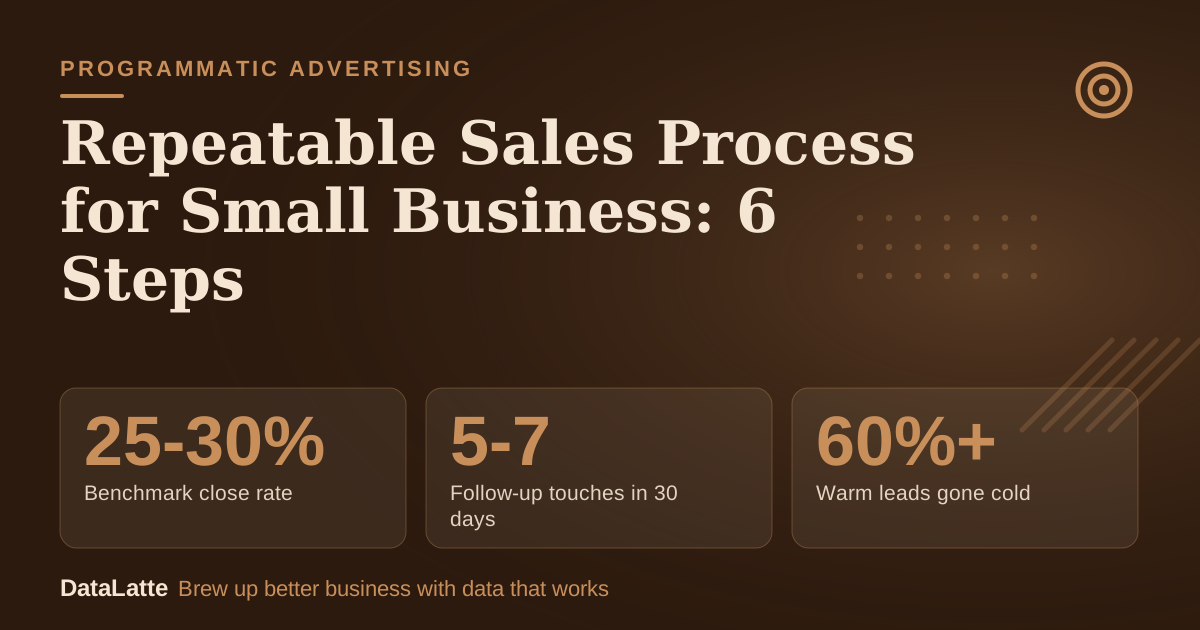
25-30%→
Benchmark close rate
M Accelerator via Adwave (secondary)
5-7↑
Follow-up touches in 30 days
Prospeo via Adwave (secondary)
60%+↓
Warm leads gone cold
When fewer than 3 touches are made (Prospeo, secondary)
78%→
Sales pros crediting CRM
Fit Small Business via Adwave (secondary)
See Sources at the end of the article. Cards marked Assumption are examples, not results.
Why does a small business need a repeatable sales process?
Without a written process, results depend on who picked up the call and how busy the day was. The same lead can get a quote in ten minutes from one person and no reply from another.
The Adwave guide says a repeatable sales process becomes critical once a small business reaches $500,000 in ARR (secondary). That is one article's threshold, not a law. A studio owner who handles every inquiry personally may feel the strain earlier or later.
The guide also cites M Accelerator benchmarks: a 25-30% close rate, and new reps reaching full productivity in less than 60 days (secondary). The second number is the practical argument for writing things down. A new front-desk hire cannot reach full productivity in under 60 days by copying whatever the owner does from memory.
Follow-up is where the gap shows most. Prospeo's small business analysis, as retold in the same guide, found that most small businesses make fewer than 3 follow-up touches, and 60%+ of warm leads go cold as a result (secondary).
Which six stages fit a service business?
The Adwave guide suggests 4 to 6 stages as a design principle for most small businesses (secondary). Six is the upper end, and it suits services where a quote or consultation comes before the booking. The stage names below are a design choice, not a sourced standard. Fewer stages work too, as long as each one has a clear exit condition.
Stage
Exit condition
Pet groomer example
1. Capture
Name, phone, and email logged
Web form or call entered in the CRM
2. Qualify
Service type, location, and timing confirmed
Breed, size, and coat condition noted
3. Discovery
Pain point and next step agreed
Short call about matting or anxious behavior
4. Offer
Price and date sent in writing
Quote with the first open slot
5. Decision
Yes, no, or a dated follow-up
Booked, declined, or "check back in two weeks"
6. Onboard and review
First service done, review requested
Groom completed, rebooking offered
One customer journey guide (secondary) describes five journey stages: awareness, consideration, purchase, retention, and advocacy. Sales stages 1 to 5 sit inside awareness through purchase. Stage 6 covers retention and advocacy.
How quickly and how often should leads be followed up?
The Adwave guide's sample cadence starts with a same-day recap after discovery: confirm the pain point, the next step, and the timeline (secondary). Prospeo's recommended standard is 5 to 7 touches over 30 days (secondary).
Only the same-day recap and the 5-7 touch range are sourced. The schedule below is an example cadence, labeled assumption, that fits seven touches into 30 days.
Day
Touch
Channel (assumption)
0
Recap: pain point, next step, timeline
Email or text
2
Answer likely questions, restate the offer
Phone call
5
Short proof: a before-and-after or a review
Text
10
Check in on timing
Email
17
Call with an open slot
Phone call
24
New angle: seasonal slot or limited availability
Email
30
Close the loop: book, or ask permission to pause
Text
Longer buying cycles need a longer tail. A construction lead gen guide (secondary) says significant renovations can run a 3 to 12 month buying cycle. For services like that, a 30-day cadence is a starting point, followed by a slower nurture schedule. That adjustment is an inference, not a documented rule.
What should the first-touch form and page ask?
Stage 1 often starts on a landing page, and a long form can stall the process before it begins. The landing page best practices guide (secondary) advises asking only for the information required to move the lead to the next stage. That means name, email, and phone if follow-up calls are part of the process, plus at most one qualifier that changes routing or eligibility.
Focus matters too. Leadpages reports an average landing page conversion rate of 6.6% across industries, with top performers at 10% or higher (secondary). ZoomInfo's analysis of more than 18,000 pages found these averages:
a single primary CTA or link: 13.5%
2 to 4 links: 11.9%
5 or more links: 10.5%
The same guide adds that more than half of landing page visits now happen on phones. It recommends a single-column form, labels outside the fields, and button copy that matches the action rather than a generic "Submit." A quick test it offers: if a visitor can look at the hero for 10 to 15 seconds and accurately describe the offer, the audience, and the next action, the page is probably clear enough.
Tracking turns the process from a habit into something that can be fixed. The Adwave guide lists a CRM setup and a KPI dashboard among its four deliverables. It cites Fit Small Business data that 78% of sales professionals say CRM use directly facilitates sales improvements (secondary).
A small dashboard can stay short. Five numbers cover most of what a service business needs:
leads captured per week
share of leads that reach a booked consultation or trial
share of booked appointments that show up
close rate, compared with the 25-30% benchmark (secondary)
follow-up touches completed per lead, compared with the 5-7 standard
Compare like with like. A close rate measured from raw leads will look far lower than one measured from completed consultations. Pick one definition and keep it.
Cost per lead alone says little. One benchmark table lists Facebook Lead Ads at $27.66 per lead across all industries and $41.26 in Home and Home Improvement, both dated Sept 15, 2025 (secondary). The more useful number is cost per won customer, which needs the stage data above. For website-side tracking, see Google Analytics 4 for small business.
What does a repeatable process change in practice?
This worked example uses a fitness studio. Every input is an assumption, not a benchmark or a client result.
Assumptions:
60 leads per month from paid and organic sources
$25 cost per lead, so $1,500 of monthly ad spend
50% of leads book an intro session before the process, 60% after follow-up improves
70% of booked intro sessions show up
30% of those who attend join (inside the 25-30% benchmark range)
$120 monthly dues, and an average membership of 8 months
Metric
Before
After
Leads
60
60
Intro sessions booked
30
36
Intro sessions attended
21
25.2
New members
6.3
7.56
Ad cost per new member
about $238
about $198
Added lifetime dues from one month's leads
n/a
about $1,210
The arithmetic: 1,500 divided by 6.3 is about $238, and 1,500 divided by 7.56 is about $198. The gain of 1.26 members times $120 times 8 months is about $1,210. Spend and lead volume did not change. Only the booking step and follow-up did.
Real results will differ. The example shows where to look, not what to expect. For studio-specific ad context, see CTV ads for fitness studios.
How do you roll it out in four weeks?
Rolling out all six stages at once rarely sticks. A week-by-week order keeps the work small. The Adwave guide's sources, such as Vouris, describe a structured 90-day enablement plan with weekly coaching, role-play, and stage-specific checkpoints outperforming ad-hoc trained teams by 45% in win rate (secondary). The four weeks below are the setup phase of that kind of plan.
Week
Focus
Checklist
Done when
1
Define
Write the six stage names and exit conditions. Choose one close-rate definition. Draft the same-day recap message.
Every team member can recite the stages
2
Build
Set up the CRM with the six stages. Trim the lead form to name, phone, email, and at most one qualifier. Load the seven-touch cadence as templates.
A test lead moves through every stage
3
Run
Route every new lead through the CRM. Send recaps the same day. Hold one short role-play session on the discovery call.
No lead sits without a logged stage
4
Measure
Build the five-number dashboard. Review where leads stall. Adjust one stage or one message.
One change is made based on the data
Weekly coaching continues past week 4. The guide also cites data that 76% of companies report a 6% to 20% increase in overall sales revenue after implementing structured sales enablement strategies (secondary). That figure comes from companies with enablement programs, so a one-person shop should treat it as directional.
How many stages should a small business sales process have?
The Adwave guide suggests 4 to 6 stages as a design principle for most small businesses (secondary). Each stage needs a clear exit condition, such as "quote sent in writing," so staff can tell when a lead moves forward.
How many follow-up touches does a lead need?
The recommended standard cited from Prospeo is 5 to 7 touches over 30 days. Most small businesses execute fewer than 3, and 60%+ of warm leads go cold as a result (secondary).
Does a small business need a CRM?
The Adwave guide lists a CRM setup as one of four deliverables, and cites Fit Small Business data that 78% of sales professionals say CRM use directly facilitates sales improvements (secondary). The tool matters less than logging every lead with a stage and a next action.
What close rate should a service business aim for?
M Accelerator's benchmark, as cited by Adwave, is a 25-30% close rate (secondary). The result depends on where counting starts: raw leads, qualified leads, or completed consultations. Define it once and compare against the same definition over time.
Want an outside look at how leads are captured and followed up today? Request a free audit from DataLatte.
Local marketing strategist with 10+ years at global agencies — OMD, Dentsu, GroupM, and BBDO. Now helping small businesses get the same data-driven edge. Based in Europe, working with clients in the US, UK, Australia, and beyond.