November 13, 2026·Nataliia Rumiantsewa· 8 min read All posts
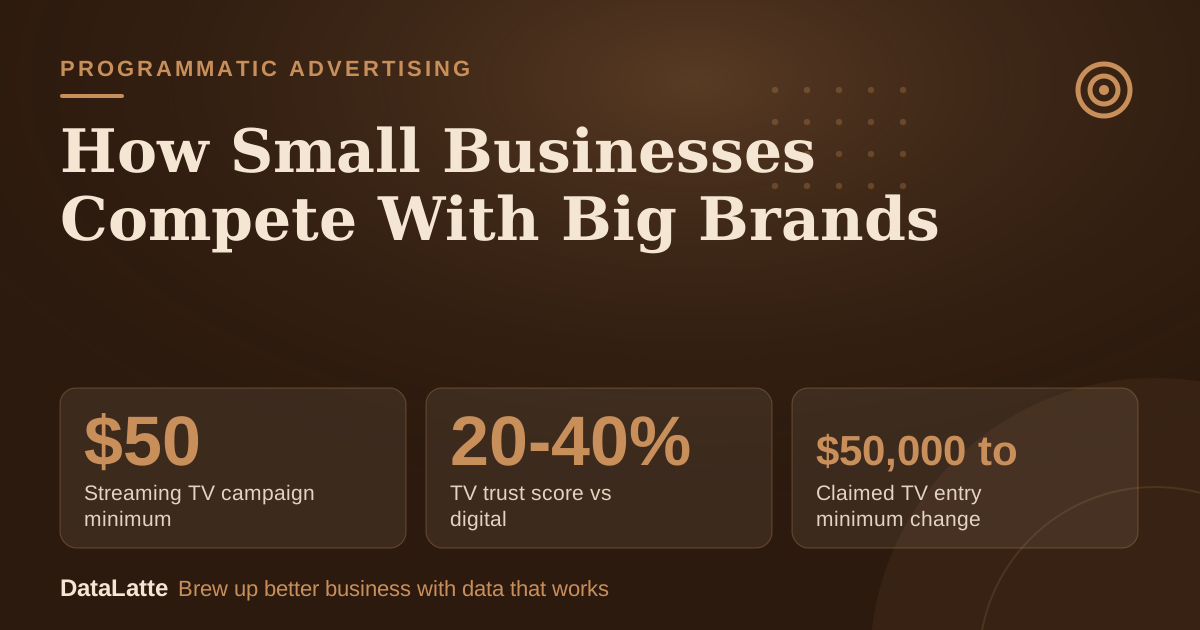
Small businesses compete with big brands by winning where chains are weakest: the neighborhood. That means a well-kept local listing, real customer reviews, community ties, fast decisions, and ads aimed at a tight radius around the shop. Channels once reserved for large budgets, such as TV, are now sold with small entry points. One vendor reports a $50 minimum for streaming TV campaigns (Adwave, secondary).
$50→
Streaming TV campaign minimum
Adwave, vendor claim (secondary)
20-40%↑
TV trust score vs digital
Marketing Week and Nielsen, via Adwave (secondary)
$50,000 to $50↓
Claimed TV entry minimum change
Adwave, vendor claim as of 2025 (secondary)
4-6 weeks→
Time to measurable awareness lift
Adwave, vendor claim (secondary)
See Sources at the end of the article. Cards marked Assumption are examples, not results.
Where do small businesses actually have the edge over chains?
A chain has bigger budgets, but a local shop has proximity, flexibility, and a face. Each of those can be turned into a specific tactic. The table below pairs each local advantage with an action and a way to check whether it worked.
Local advantage
Tactic
How to check it
Reviews
Ask every happy customer at the counter or chair, and reply to each review by name
Count new reviews per month
Local search
Keep the business listing complete and current; run search ads limited to the service area
Calls, direction requests, and store visits
Community
Target a tight radius around the location; feature neighbors, staff, and local events in creative
Reach inside the radius; new customers who mention the ad
Speed
Change an offer, photo, or headline the same day, with no approval chain
Number of creative tests per month
Trust
Add a streaming TV test to build familiarity alongside search and social
Branded searches and walk-in mentions
Low production cost
Use AI tools to produce video from a website instead of a crew shoot
Cost per finished ad
No single row carries the strategy. The point is to stack small advantages that a national brand cannot copy from a regional office.
Reviews and local listings cost time rather than media dollars. None of the sources used here quantify their effect, so tracking is the only way to learn what they are worth for a specific shop.
Has the cost barrier to big-brand channels really dropped?
Partly, according to the vendors that sell these products. Adwave (secondary) states that TV advertising went from a $50,000 minimum to a $50 minimum, and that a business with $50 and an internet connection can reach channels that used to be enterprise-only. That is a vendor claim as of 2025, not an independent price survey.
Its own example: a restaurant running a $500 per month TV campaign aimed at its neighborhood gets visibility that used to require $50,000. The same article notes that professional video production that once meant a $10,000 shoot can now be done with AI tools from a website.
Another Adwave page (secondary) says a basic TV commercial used to cost $50,000 to $500,000 to produce, and that most traditional TV buys required $10,000 or more in minimum spend (Adwave).
A $50 minimum is the entry ticket, not the price of a meaningful campaign. Real costs depend on targeting, market, and season. For current CPM ranges, see real CTV CPM data, and ask any vendor for current rates before committing budget.
How does a local business win trust against a national name?
Familiarity matters in categories where customers choose from several similar options: coffee, haircuts, grooming, workouts. National brands arrive with recognition built over decades. A local business has to build it street by street.
Adwave cites research from Marketing Week and Nielsen stating that TV scores 20-40% higher on trust metrics than digital alternatives, and says small businesses can access that trust advantage for under $100 (Adwave, secondary). Treat that as a vendor-reported figure and a reason to run a test, not a guarantee.
The same page suggests a simple experiment: launch a $50-100 TV campaign and let it run for 2 weeks. It adds that most advertisers see measurable awareness lift after 4-6 weeks of consistent advertising.
For a local business, the practical reading is to pair TV with the basics above. A viewer who sees the shop on a streaming service and then finds a strong review profile and a clean listing has more reasons to walk in. For how streaming TV differs from broadcast on a local budget, see CTV versus traditional TV for local business.
What does a 6-week plan look like?
The plan below fits a single-location business with one person handling marketing part-time. It uses sourced test lengths: a 2-week TV test, 7-14 day ad testing windows, and a 4-6 week read on awareness.
Week 1: set the foundation.
Complete the business listing with hours, photos, services, and links.
Ask for reviews at every visit and reply to existing ones.
Set a radius around the location. Adwave describes a 10-mile radius as one option for local targeting (secondary).
Start with a $50-100 test budget, as the Adwave experiment suggests.
Use a short video built from the website or from phone footage of the shop.
Week 3: add search and social.
Start a search campaign limited to the service area.
Launch a small set of social ad variations, each testing a different hook.
Week 4: read early signals.
Review calls, direction requests, and mentions at the counter.
End the 2-week TV test and decide whether to extend it.
Week 5: change one thing at a time.
Replace the weakest social ad.
Adjust the TV creative if the first seconds failed to hold attention.
Week 6: decide.
Compare cost per new customer across channels.
Keep the channel that brought customers and cut the one that did not.
What does a worked example look like for a coffee shop?
All inputs below are assumptions chosen for arithmetic, not benchmarks.
Assumptions: a single coffee shop, a $500 monthly ad budget, an average ticket of $6, and 65% of each ticket remaining after ingredients and cups. Each new customer is assumed to visit 3 times in the first month.
Transactions needed to cover $500: 500 ÷ 3.90 = about 128.2, so 129 transactions.
Per day over 30 days: 129 ÷ 30 = about 4.3 extra transactions.
New customers needed at 3 visits each: 129 ÷ 3 = 43.
So the plan pays for itself in the first month if roughly 43 new customers come in, each visiting 3 times. Hitting that depends on real conversion, which the first 6 weeks are meant to measure. If the number looks out of reach, shrink the TV portion or lengthen the test before scaling.
One more constraint: a source on Meta ads says small businesses with about $1,000-$3,000 per month in ad spend can benefit from AI-powered optimization (HeyOz, secondary). At $150, treat automation as a settings choice, not a program.
How should a small team handle ad creative?
Creative is where small teams can move faster than a corporate approval chain. The tactics below come from a vendor blog on Meta ads and should be read as guidance, not proof (secondary).
Mobile comes first. The page states that over 98% of Facebook users access the platform on mobile (HeyOz, secondary). Video should have a strong hook in the first 2 seconds, and the value proposition should land within 3-5 seconds.
Testing is the second habit. The page recommends running all variations for 7-14 days before killing underperformers, and suggests 15-25 variations for a first test cycle. That volume suits larger budgets. A coffee shop with a $150 social budget might start with only a few and keep the 7-14 day window.
Meta's Advantage+ features are described as available to all advertisers regardless of budget, requiring no additional budget, and typically improving performance within 1-2 weeks. A separate article on Advantage+ shopping campaigns for e-commerce recommends starting with 10-20% of the total budget and watching results for 7-10 days (LeadEnforce, secondary). That advice targets online stores, so a local service business should treat it only as a pacing idea.
Is a small streaming TV budget worth it for a local business?
That depends on what else is in place. Streaming TV works as a familiarity channel. It does not replace a strong listing, reviews, and search presence, and it is hard to judge in under a month. Adwave's own claim is that awareness lift typically appears after 4-6 weeks of consistent advertising (secondary).
A reasonable approach is to fund the basics first, then run the 2-week test and read the results against calls, visits, and new-customer mentions. The article on whether CTV is worth it on a small budget goes through that decision in more detail, and OTT advertising for local business explains where the ads appear.
If the test shows no movement, the cost was small and the plan can shift to search and social. If it does move numbers, the budget can grow in steps rather than in one jump.
FAQ
Can a small business really afford TV advertising?
Adwave reports campaigns starting at $50 and describes under $100 as enough to start (secondary). A $50 start is a test, not a full campaign. Ask vendors for current rates and minimums, since pricing differs by platform and market.
How long should a small-budget test run?
Adwave suggests a 2-week TV test and says most advertisers see awareness lift after 4-6 weeks (secondary). For social ads, a vendor blog recommends 7-14 day testing windows before cutting underperformers (secondary).
Does a 10-mile radius suit every local business?
Adwave describes a 10-mile radius as an example of local targeting (secondary). A dense city shop may want a smaller area and a rural business a larger one. Match the radius to how far customers realistically travel.
Should reviews come before ads?
Reviews and listings cost time rather than media spend. No source here measures their effect, so the sensible order is to fix the basics, then add paid channels and compare results.
For a second opinion on where a local budget should go first, request a free audit.
Local marketing strategist with 10+ years at global agencies — OMD, Dentsu, GroupM, and BBDO. Now helping small businesses get the same data-driven edge. Based in Europe, working with clients in the US, UK, Australia, and beyond.