TV Advertising for Pizzerias and Local Restaurants
November 13, 2026·Nataliia Rumiantsewa· 9 min read All posts
TV advertising can work for a local pizzeria when it is geo-targeted, small enough to test, and measured against similar areas without ads. In one case described on the Universal Ads blog (secondary), Slice pizzerias running geo-targeted TV ads saw a 5% incremental lift in orders. Streaming campaigns are advertised from $30 a day, while traditional buys often carry minimums in the thousands. This guide covers costs, targeting, creative, measurement and a 6-week test.
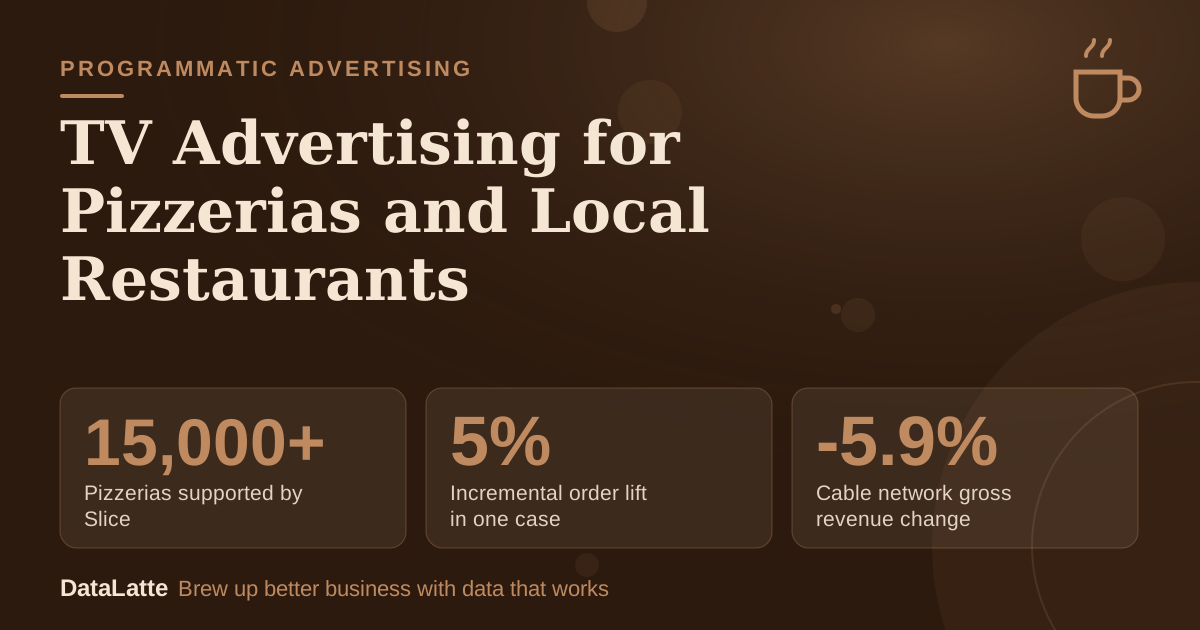
15,000+→
Pizzerias supported by Slice
Universal Ads blog (secondary)
5%↑
Incremental order lift in one case
Universal Ads blog case (secondary)
-5.9%↓
Cable network gross revenue change
Adwave citing third-party data (secondary)
$30/day→
Starting daily streaming TV spend
Adwave vendor claim (secondary)
See Sources at the end of the article. Cards marked Assumption are examples, not results.
Does TV advertising work for a local pizzeria?
The best pizzeria-specific evidence comes from Universal Ads (secondary). Its blog describes Slice, a platform supporting more than 15,000 local pizza shops nationwide. Slice pizzerias that ran geo-targeted TV ads in their served zip codes saw a 5% incremental lift in orders and a 3.2% incremental lift in sales, compared with similar shops that did not advertise on TV.
Two cautions apply. The figures come from a vendor's own write-up, not an independent study, and a lift of a few percent is modest. Whether it pays off depends on order volume, average ticket and ad cost, which the worked example below walks through.
Another data point cuts the other way. Adwave (secondary) cites EDO research finding linear TV ads were 5% more effective than streaming ads for quick service restaurant advertisers in Q1 2024. Streaming is cheaper to enter, but it is not automatically more effective per impression.
What does TV advertising cost a restaurant?
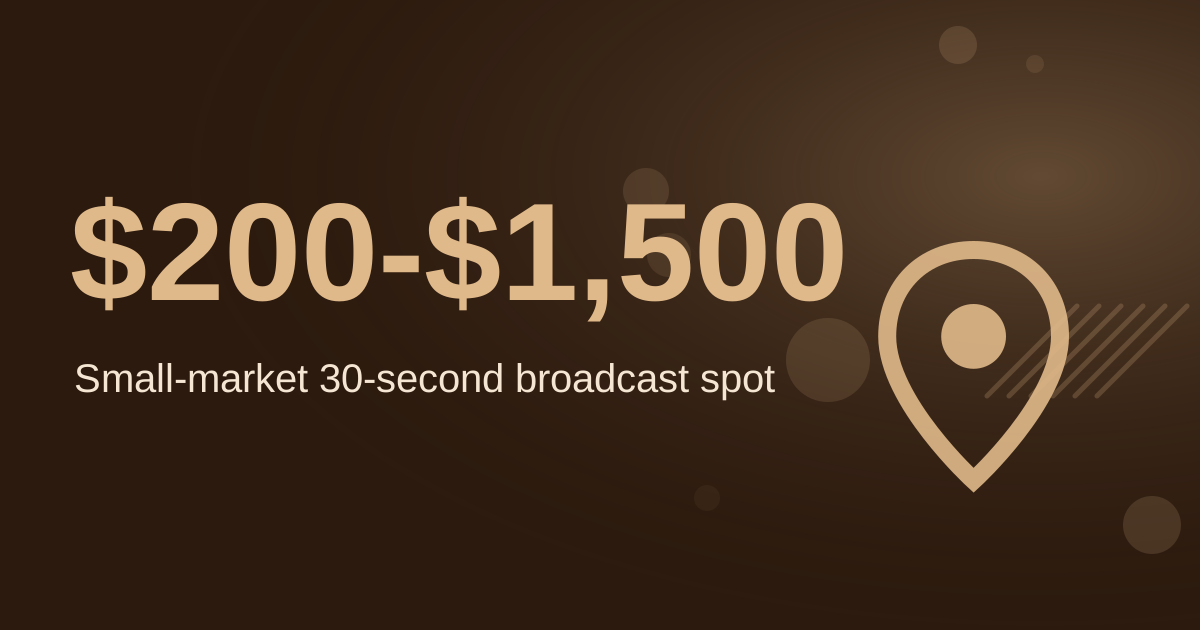
Cost depends on whether the buy is traditional or streaming. Adwave (secondary) says a cable spot can run from a few hundred dollars locally to many thousands in prime time on a major network. Its illustration is a 30-second evening news spot at a flat rate of about $300. Agencies often take 15-20% of total spend, and minimum campaign spends often run $5,000 to $25,000.
Streaming sits at the low end. Adwave advertises campaigns from $30 a day, a vendor claim. The table below pulls the figures together. Every figure is a vendor-published range, not a quote, so current rates need to be requested for the specific market. For CPM benchmarks by platform, see CTV advertising cost and real CPM data.
Restaurants typically allocate 2-6% of monthly revenue to marketing, according to industry benchmarks cited by Adwave (secondary). For a restaurant making $50,000 a month, that is $1,000-$3,000. Another Adwave guide says TV and video might be 20-40% of the total marketing budget. Applying that share to $1,000-$3,000 gives roughly $200-$1,200 a month (arithmetic on vendor figures).
The same guide lists monthly TV budgets by restaurant type:
Restaurant type
Monthly TV budget
Focus
Single location, limited service
$300-800
Local awareness, specials
Single location, full service
$500-1,500
Brand building, events
Multi-location (2-5)
$1,000-3,000
Market presence, promos
Small chain (5+)
$3,000+
Regional awareness
Most single-shop pizzerias fall in the first row. The guide also says successful restaurant TV campaigns often run $500-2,500 a month, and Adwave suggests starting with $100-200 to learn what resonates before committing more. Production adds to the total, covered further down.
How should a pizzeria target and time TV ads?
Geography matters more than reach. Adwave suggests a radius around the location, typically 5-15 miles depending on restaurant type. Its restaurant TV guide puts dine-in targeting at a 10-20 minute drive. A delivery-heavy pizzeria should match the radius to the real delivery zone, because impressions outside it cost money without producing orders.
Daytime (9 AM-4 PM): far more affordable than prime time.
Early fringe (4 PM-7 PM): viewership picks up as people get home from work.
Prime time (8 PM-11 PM): the most expensive slot.
Late night (11 PM-2 AM): described as a cost-effective choice for night owls.
Early fringe lines up with the dinner decision, and late night suits a shop open late. Streaming buys may not follow these dayparts, so ask the platform which controls exist.
Seasonal timing is covered in Adwave's guide. It recommends 2-3x normal budget starting 2-3 weeks before Valentine's Day (ad start January 25) and 2x for Mother's Day (start April 20). Graduation season, May-June, gets 1.5x. Football season is another local hook; see NFL CTV advertising for local business.
What creative does a pizzeria TV spot need?
The industry-standard commercial is 30 seconds, and a 15-second ad costs less, per Adwave. A pizzeria with one offer and one action can often work in 15 seconds: show the food, state the offer, give a way to order. Technical requirements differ by platform, so check CTV ad creative specs before filming.
Production is the hidden line item. Adwave says professional production can cost thousands, possibly tens of thousands, of dollars. Its restaurant guide breaks it down:
Professional production: $2,000-10,000+ for polished, high-end spots.
Food photographer plus editor, still-to-video approach: $500-2,000.
DIY with guidance: $200-500 for basic equipment and editing software.
For a first test, the DIY or still-to-video route keeps production from outweighing media spend. Video also appears to help in general: Marketing LTB analysis, reported by Adwave, found video ads achieve 1.8x higher click-through rates than image-based restaurant campaigns. That figure is about clicks, not TV-driven orders.
Interactive formats can connect a TV screen to an order page. New CTV ad formats covers QR codes and shoppable options.
How can a pizzeria measure whether TV ads worked?
The Universal Ads case compared shops running TV ads in their served zip codes against similar shops that did not. A single pizzeria can borrow the logic: record orders per zip code or delivery zone before the test, then compare zones that saw ads with comparable zones that did not. Comparing only to last month confuses ad effect with weather, holidays and school schedules.
Supporting signals help:
A dedicated phone number, order link or offer code used only in the TV spot.
A simple "how did you hear about us" prompt at the counter or checkout.
The online path is worth preparing. Marketing LTB data cited by Adwave says 88% of diners search online before choosing a restaurant, and 91% look up menus before visiting. A viewer who sees a TV spot is likely to search the shop's name next, so Google listing, menu and ordering link should be current before the ads start.
What does a 6-week pizzeria TV test look like?
A test needs a fixed window, a fixed budget and a decision rule written down in advance. Six weeks leaves a setup week, four live weeks and a read-out week. The plan below uses the sourced $100-200 starter guidance as a floor and the $30 daily start as a reference point. It is a suggested structure, not a documented benchmark.
Week
Task
Output
1
Pull baseline orders by zip code or delivery zone. Set the radius (5-15 miles per Adwave). Choose one offer. Create offer code or QR link. Confirm menu and Google listing are current.
Baseline sheet, one script, tracking link
2
Launch the 15- or 30-second spot in the target zones. Keep similar zones as the comparison group.
Live campaign, daily spend logged
3
Check delivery pacing and impressions. Count orders with the code. Change nothing else yet.
Mid-test check
4
Swap in a second version of the spot, such as a different offer or opening shot.
Version A vs. B notes
5
Hold budget steady. Compare ad zones against comparison zones.
Order gap by zone
6
Ads stop or continue per the written rule. Calculate cost per incremental order and compare with average ticket.
Go, adjust or stop decision
If the campaign aims at a holiday, work backward from the dates in Adwave's guide so week 2 lands before the ramp-up window.
What could a six-week test look like in numbers?
The inputs below are assumptions for a single-location pizzeria, not benchmarks. The $25 CPM matches the example in Adwave's restaurant TV page (secondary), where $500 at a $25 CPM yields approximately 20,000 impressions.
Input
Value
Live days (weeks 2-5)
28 (assumption)
Daily spend
$30 (assumption, matching the advertised starting point)
CPM
$25 (assumption)
Orders in target zones per 4 weeks
400 (assumption)
Average ticket
$30 (assumption)
The math:
Media spend: 28 days x $30 = $840.
Impressions: $840 / $25 x 1,000 = 33,600.
Break-even on gross revenue: $840 / $30 = 28 orders, or 7% of 400.
A 5% lift, the figure from the Universal Ads case, would mean 20 extra orders, or $600 in gross revenue.
At these inputs, a 5% lift would not cover the media cost, and the figure is gross revenue before food and labor. The case lift is not a forecast for any individual shop. Higher ticket sizes, more orders in the target zones, repeat customers and a smaller test budget all change the result. A $200 test at the same CPM would deliver 8,000 impressions.
This is why the decision rule belongs in week 1. Whether ad prices change later in the year is not documented in these sources, so ask any platform for current rates.
How does streaming TV compare with other restaurant channels?
Adwave's tables describe streaming TV as suited to brand awareness and events, with results in weeks. Google Ads is listed as better for immediate orders, with results in days. Adwave also lists keyword clicks at $2-8+ each in metro areas for competitive terms, and says most restaurants see $7-15 cost per lead.
Channel
Best for (per Adwave)
Monthly cost
Streaming TV (CTV)
Brand awareness, events
$50-500+
Google Ads
Immediate reservations or orders
$500-2,000+
Meta (Instagram/Facebook)
Brand building, events
$300-1,500+
Email marketing
Repeat customers
$50-300
Direct mail
Neighborhood awareness
$500-2,000+
The reasoning is practical: TV creates awareness, and search and email capture it. Adwave says 65% of restaurant revenue comes from repeat customers, so an email list gives a new TV-driven customer a reason to return. For a broader look at the restaurant category, read CTV ads for restaurants.
FAQ
How much does TV advertising cost for a small pizzeria?
Streaming campaigns are advertised from $30 a day, and Adwave lists restaurant streaming TV at $50-500+ per month. Traditional cable minimums are often $2,000-5,000+, and agency-run campaigns can require $5,000-25,000. These are vendor-published ranges, so request current rates for the specific market.
Is streaming TV better than cable for restaurants?
Not necessarily. EDO research cited by Adwave found linear TV ads were 5% more effective than streaming ads for quick service restaurants in Q1 2024. Streaming offers lower minimums and tighter geographic targeting, while cable offers set dayparts and local news placements. The right choice depends on budget and the audience the shop needs to reach.
How long should a pizzeria test TV ads?
Adwave recommends starting with $100-200 to learn what resonates. A six-week structure, with one setup week, four live weeks and one read-out week, gives enough time to compare ad zones against similar zones. The length is a planning suggestion, not a documented standard.
How can a pizzeria tell if TV ads drove orders?
Compare orders in zones that saw the ads with similar zones that did not, as in the Universal Ads case. Add a dedicated offer code or QR link, track menu and ordering page visits in analytics, and ask new customers how they heard about the shop.
Local marketing strategist with 10+ years at global agencies — OMD, Dentsu, GroupM, and BBDO. Now helping small businesses get the same data-driven edge. Based in Europe, working with clients in the US, UK, Australia, and beyond.