Local TV Advertising Cost 2026: Broadcast vs Streaming
November 11, 2026·Nataliia Rumiantsewa· 9 min read All posts
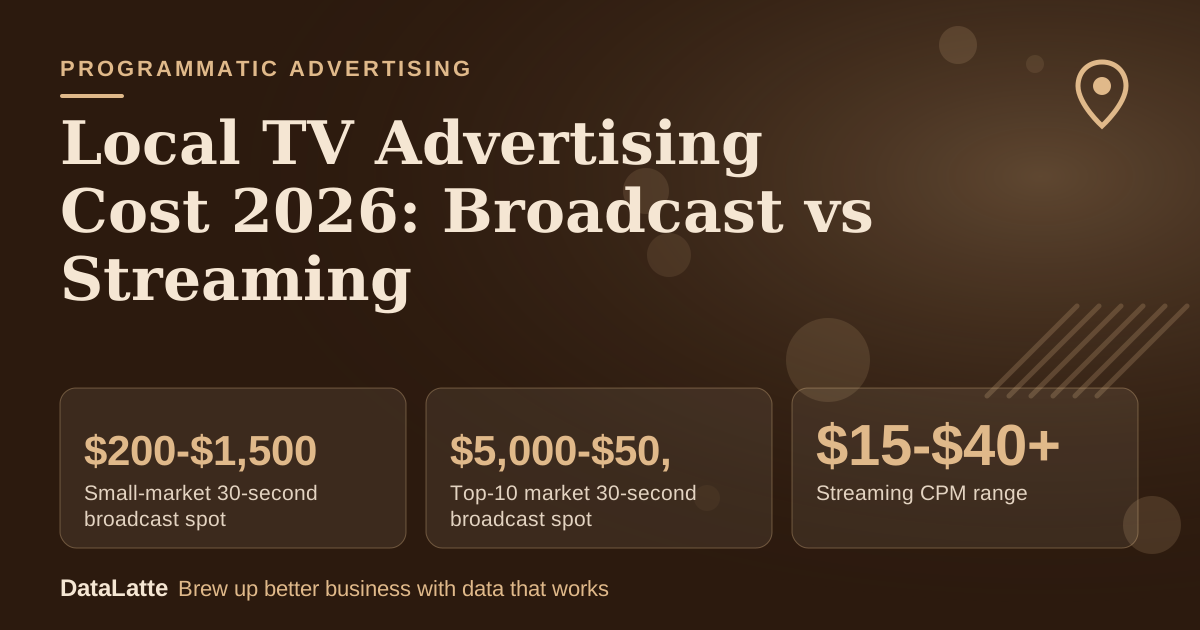
A local TV ad in 2026 runs from a few hundred dollars to several thousand per 30-second broadcast spot, depending on market size and time of day. One guide reports $200 to $1,500 in small markets and $5,000 to $50,000+ in the top 10 markets (Simulmedia (secondary)). Streaming is sold per thousand impressions, reported at $15 to $40+ CPM (AdWave (secondary)). Production costs extra. Every figure below is a reported range that differs between sources, not a station rate card.
$200-$1,500→
Small-market 30-second broadcast spot
Simulmedia, DMAs 151-210, 2025 rates (secondary)
$5,000-$50,000+→
Top-10 market 30-second broadcast spot
Simulmedia, top 10 markets (secondary)
$15-$40+→
Streaming CPM range
National Media Spots via AdWave (secondary)
$25/day→
Typical small-business streaming budget
Trusted TV, 4 weeks ending May 29, 2026 (secondary)
See Sources at the end of the article. Cards marked Assumption are examples, not results.
How much does a local TV ad cost by channel?
The table lists each channel with the range reported by vendor and agency guides. Units differ on purpose: a per-spot price, a monthly budget and a CPM answer different questions.
All rows are airtime unless noted. Daypart moves the number inside each row. The Simulmedia guide lists local prime time at $2,000 to $50,000+ against $200 to $1,000 for late night.
Why do the reported ranges disagree?
Three things explain most of the gaps. First, the market buckets differ. Simulmedia calls DMAs 51 to 150 mid-sized, while the AdWave political guide treats DMAs 11 to 50 as mid-size and DMAs 51 and up as small (AdWave (secondary)). A market ranked 80th lands in a different tier depending on the guide.
Second, daypart. The political guide lists small-market daytime spots at $25 to $150 and prime time at $200 to $2,000. A single "small market" figure hides that spread.
Third, none of the cost sources states a methodology or measurement period. AdWave's own guide notes that no public, dated dataset breaks local spot rates down by market size and daypart (AdWave (secondary)).
Stations reportedly set the price from the market's SQAD cost per point multiplied by the program's Nielsen rating, so a rep's quote can sit anywhere inside these ranges.
What does local cable cost, and what are the minimums?
Cable sells by system or by zone, and the per-spot prices look small. The AdWave political guide reports full-system buys at $25 to $200 per spot with a $5,000 to $20,000 monthly minimum. Zone targeting is reported at $35 to $250 per spot with a $3,000 to $15,000 minimum (AdWave (secondary)).
That guide was written for political campaigns, so local business quotes may differ. It also says zone buying adds 10% to 25% to base rates. National Media Spots reports regional cable at $1,000 to $20,000 per month (AdWave (secondary)).
The minimums matter more than the per-spot price. A $1,500 month sits below both minimum ranges in the political guide. Whether a cable sales team accepts a smaller test is not documented, so ask directly.
What does streaming cost for a small local business?
Streaming lets a business target a DMA, ZIP code or radius and pay by CPM, with lower minimums than a broadcast schedule. National Media Spots notes campaigns can launch at $500 to $1,000 a month (AdWave (secondary)). The political guide lists self-serve CTV minimums as low as $50 to $100 (AdWave (secondary)).
Trusted TV's platform data is the most specific small-business benchmark in the sources. Over four weeks ending May 29, 2026, the typical budget was $25 per day, roughly $700 per cycle. That earned about 9,100 views and reached about 5,900 people, at an average all-in CPM near $42.50. The median target was a 10-mile ZIP radius, and larger budgets tended to earn lower CPMs (Trusted TV (secondary)).
Platform pricing varies widely. The political guide lists Tubi at $12 to $22 CPM and Hulu at $30 to $45, while Simulmedia lists Hulu at $10 to $30, so one "streaming CPM" is a rough guide. Streaming usually guarantees impressions, not delivery within a target demographic, per AdWave. More on CPM ranges is in how much CTV advertising costs, and CTV versus traditional TV covers the trade-offs.
How much does the commercial itself cost?
Airtime figures exclude production. Moonb's 2026 guide, as reported by AdWave, puts a simple local spot at $1,500 to $10,000 and professional mid-range work at $10,000 to $50,000 (AdWave (secondary)). Simulmedia reports $3,000 to $15,000 for local production and $0 to $5,000 for DIY or AI tools (Simulmedia (secondary)).
On a small schedule, production can rival or exceed the first month of media. That is the main hidden cost of cable and broadcast for a one-location shop.
Some streaming providers bundle video creation into the monthly price. Trusted TV's $42.50 CPM includes the video and management (Trusted TV (secondary)). Bundled creative is a vendor claim, so check the file specs and ownership, using the CTV creative specs guide.
How does the 2026 political season affect local TV rates?
BIA Advisory Services' September 2026 update projects local political spending at $9.7 billion for 2026, up from $8.4 billion in its April estimate. Of the $1.3 billion increase, $1.2 billion went to broadcast and streaming TV (BIA via AdWave (secondary)). These are forecasts, not measured spending.
AdWave describes the practical effect as inventory pressure: campaigns compete for the same local broadcast time, so commercial advertisers can face higher rates or fewer spots. The same guide lists fourth quarter and local election cycles among the crowded windows that raise rates.
BIA's first look at 2027 has political spending falling to about $1.1 billion in the off-cycle year, with total local revenue roughly flat. No source documents what that means for the price of a spot. Ask the rep for current rates for the exact weeks planned, and see midterm political ads and CTV prices for more.
What does $1,500 a month buy on cable versus streaming?
This example uses a single-location coffee shop. Every input is an assumption chosen inside the reported ranges above, so swap in real quotes before deciding.
Input or result
Local cable (zone)
Streaming
Monthly media budget (assumption)
$1,500
$1,500
Unit price (assumption)
$60 per 30-second spot
$35 CPM
Delivery
25 spots
42,857 impressions
Impressions per spot (assumption)
5,000
Not applicable
Total impressions
125,000
42,857
Production (assumption)
$1,500, low end of the reported $1,500-$10,000
$0, creative bundled
First-month total
$3,000
$1,500
The cable math: $1,500 divided by $60 gives 25 spots, and 25 spots at 5,000 assumed impressions give 125,000. That works out to a $12 CPM, inside the reported $8 to $20 zone range. The example also assumes the cable team accepts a $1,500 month, below the $3,000 to $15,000 minimums reported for zone buys.
The streaming math: $1,500 divided by $35, times 1,000, gives 42,857 impressions. At the $42.50 benchmark CPM instead, the same budget buys about 35,294.
Raw impressions are not equal goods. Per AdWave, a TV impression is often a shared household view, while a streaming impression can be a phone. Cable counts spots across the whole zone, while a streaming campaign can sit inside a 10-mile radius of the shop.
For payback, assume a new regular is worth $120 in gross margin over a year (assumption). Cable's $3,000 first month needs 25 new regulars, and streaming's $1,500 needs about 13 (12.5, rounded up). Month two on cable, without new production, needs the same 13. Whether that is realistic depends on whether CTV is worth it on a small budget.
What should be asked of a station rep, and in what order?
A short plan keeps quotes comparable. The six weeks below apply to any of the four business types.
Week
Task
Output
Week 1
Fix the service area (ZIP codes or radius) and a monthly cap
One-line brief sent to every seller
Week 2
Request written quotes from a broadcast station, the local cable system and one streaming seller
Three quotes with units stated
Week 3
Convert each quote to cost per 1,000 and add production
One comparison sheet
Week 4
Negotiate the schedule, confirm spot dates and creative specs
Is the price per spot, per month or per thousand impressions?
Which DMA tier does the quote assume, and does it match where customers live?
What are the cost per point and rating behind the price?
Is any of the schedule remnant or off-peak time that can move?
Is there a monthly minimum, and does zone targeting add a premium?
What does a 15-second or 60-second version cost? Simulmedia reports 60-second spots at 1.5 to 2 times the 30-second rate.
What happens to spots if political advertising bumps them?
Does the quote include creative, and who owns the final file?
Is delivery reported as impressions only, or against a demographic?
FAQ
How much does a 30-second local TV ad cost in 2026?
Reported ranges run from $200 to $1,500 in small markets to $5,000 to $50,000+ in the top 10 markets, per Simulmedia (secondary). Daypart and market tier move the price, and a station rep's quote is the only binding number.
Is streaming TV cheaper than local cable for a small business?
Not always per impression. Streaming has lower reported entry points, from $500 to $1,000 a month, while cable minimums in the political guide start at $3,000 for zone buys. In the worked example, cable bought more raw impressions per dollar, but the first month cost twice as much once production was added. All inputs there are assumptions.
Is production more expensive than airtime?
It can be. AdWave notes production can rival or exceed the first month of media on a modest local schedule. Reported simple local production is $1,500 to $10,000 (Moonb via AdWave, secondary). Some streaming sellers bundle video into the monthly price.
Will local TV ad prices drop after the election?
No source documents that. BIA forecasts political spending falling to about $1.1 billion in 2027, but that is a spending forecast, not a rate forecast. Ask the rep for current rates for the specific weeks planned.
Quotes for TV, streaming and search can be compared side by side with a free audit of the current ad mix and local market.
Local marketing strategist with 10+ years at global agencies — OMD, Dentsu, GroupM, and BBDO. Now helping small businesses get the same data-driven edge. Based in Europe, working with clients in the US, UK, Australia, and beyond.