DataLatte☕
Programmatic Advertising

Midterm Political Ads and CTV Prices for Local Business
Infographic: Midterm Political Ads and CTV Prices for Local Business
November 10, 2026·Nataliia Rumiantsewa· 8 min read All posts
Record political spending pushed CTV to the center of the 2026 midterms, and platforms that accept political ads were forecast to see the sharpest CPM increases. Election Day was November 3, 2026, but none of the sources reviewed here document what CTV prices did afterward. For a local business, the practical move is to request current rates in writing, compare them with pre-election bids, and re-enter in stages instead of assuming a drop.

How much political money went into CTV in 2026?

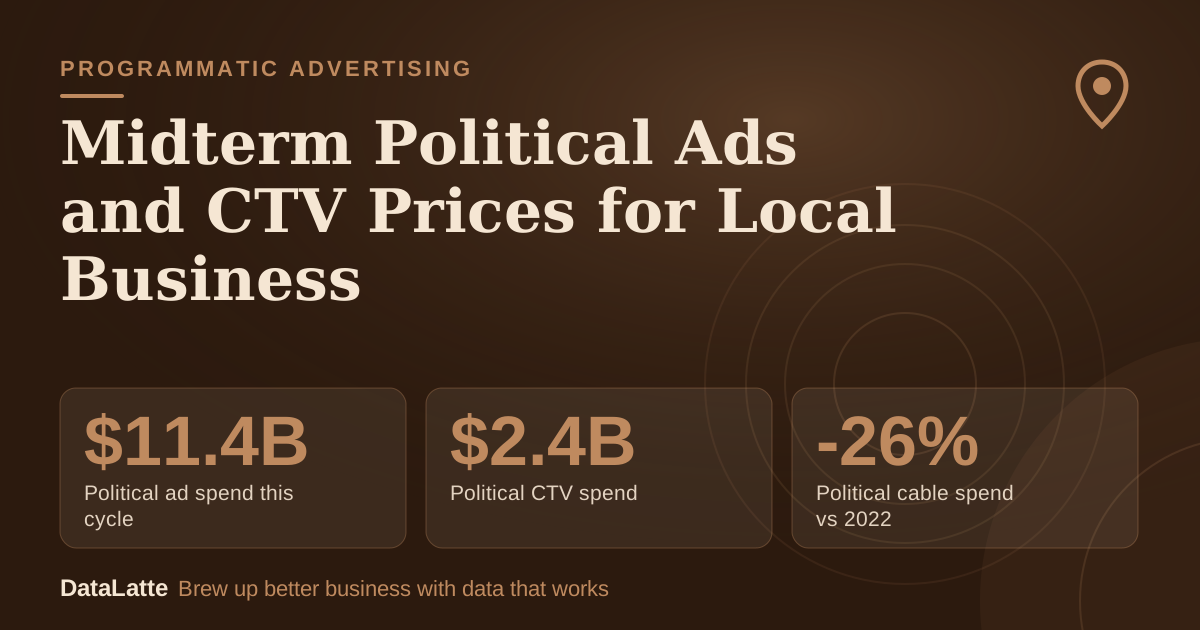
According to Adweek, using AdImpact data, political advertisers had spent $11.4 billion this cycle as of November 2, up 28% from the 2022 midterms. That already tops every cycle AdImpact tracks, including the 2024 presidential cycle's $11.2 billion.
CTV drove much of the growth. Spend grew 122%, from roughly $1.1 billion in 2022 to $2.4 billion, while cable fell 26% to under $1.3 billion. Of the $2.5 billion increase over 2022, 53% went to CTV.
$11.4B→

Political ad spend this cycle

Adweek citing AdImpact, as of Nov 2, 2026

$2.4B↑

Political CTV spend

Adweek citing AdImpact, up 122% from 2022

-26%↓

Political cable spend vs 2022

Adweek citing AdImpact, now under $1.3B

~50%→

Political dollars in final 30 days

Basis, secondary source, historical pattern

See Sources at the end of the article. Cards marked Assumption are examples, not results.

Before the cycle peaked, AdImpact's projection as reported by Campaigns & Elections (secondary) put CTV at nearly $2.5 billion, a 23% share of political spend. The $11.4 billion figure is "to date," so the sources do not provide a final cycle total.

Why does political money affect CTV prices for local advertisers?

Political campaigns and nonpolitical advertisers compete for the same inventory. Basis (secondary, vendor blog) says this competition drives up costs and limits availability, and it described 2026 as set to reach new heights, with tighter inventory and higher CPMs for nonpolitical advertisers.
Timing matters as well. Basis reports that roughly 50% of a cycle's political dollars run in the final 30 days before Election Day, with about 25% in the final 10 days. It also notes that campaigns moved their ad timelines earlier to secure inventory before demand pushed them out of competitive markets.
Two eMarketer headlines from June and September framed the cycle as one that could drive record CPMs. None of the sources gives a specific dollar CPM for a local market. For baseline price ranges, see this CTV cost and CPM data guide.

Which CTV platforms and markets were most exposed?

Basis projected that platforms accepting political ads, including Hulu, Roku, and YouTube, would see the sharpest CPM increases. Netflix and Amazon Prime Video do not accept political ads and were described as a comparatively sheltered alternative. That was a forecast published in April, and the sources do not report realized CPMs by platform.
For platform context, the CTV platform comparison, the Roku ads guide, and the Prime Video ads guide cover how each works for small budgets.
Geography mattered too. AdImpact projected California at $1.1 billion, Michigan near $1 billion, and Texas, Georgia, and North Carolina each above $550 million, per Campaigns & Elections (secondary). Basis adds that 12 of the 40 competitive House seats sit in the New York and Los Angeles markets. The sources do not say how far the pressure spread to quieter markets, so that is a question for the rep.

Have CTV prices dropped now that Election Day has passed?

That is not documented. Basis advised nonpolitical advertisers to plan pacing around the September-through-November window and to look for favorable post-election pricing. That is advice and expectation, not a record of what quotes actually looked like after November 3. No source reviewed here reports post-election CPMs.
The safe reading is that prices may have moved, may not have, and may differ by platform and market. Rates also depend on factors the sources do not cover, such as other seasonal demand, contract terms, and targeting. Any assumption of a drop is a prediction, not a fact.
The better approach is to turn the question into a measurement. Pull the CPMs from bids or invoices placed before the election, get fresh quotes with dates on them, and compare the two. Whatever the difference turns out to be, it is evidence for that platform and that market.

What should a local business ask a CTV rep?

Treat the first call as a quote-gathering exercise. The table lists the questions that turn a vague "prices should be better now" into numbers that can be compared.
Question for the repWhy it mattersWhat to record
What is the CPM today for my zip codes or DMA, and what is the quote date?No source documents post-election pricing, so a dated quote is the only evidenceCPM, date, rep name
How does it compare with the CPM quoted before November 3?Sets the baseline for the comparisonPercent difference
What are the minimum budget and flight length?Minimums change the cost of a testMinimum spend, minimum weeks
Is inventory in my market still limited, or fully available?Political demand was said to limit availabilityAvailability notes
Which placements does the quote cover?Platforms that accept political ads were more exposed than those that do notPlacement and platform list
Will rates be reviewed again soon, and when?A quote may not hold for the whole flightReview date
Can the quote be held in writing, and for how long?Prevents surprises between approval and launchExpiry date
Quotes from two or three platforms make the comparison stronger. The small-budget CTV guide explains how to judge whether a test is worth running at all.

What does a re-entry comparison look like in numbers?

The example below is built for a fitness studio. Every input is an assumption, not a market benchmark.
Assumptions: a monthly CTV budget of $3,000, a pre-election CPM bid of $28, and a rule that the studio accepts a quote up to 10% above its old bid, which is $30.80. Impressions equal budget divided by CPM, times 1,000.
Scenario (assumption)New quote CPMChange vs $28Impressions for $3,000Under the 10% rule
Lower quote$24about 14% lower125,000Proceed
Unchanged quote$280%107,143Proceed
Higher quote$34about 21% higher88,235Hold, or test another platform
The same budget buys about 17% more impressions at $24 than at $28, and about 18% fewer at $34. The rule only sets a ceiling on CPM. The real test is whether tracked sign-ups, trial bookings, or QR scans justify the spend. For studio-specific creative and offers, see CTV ads for fitness studios.

What is a 3-week re-entry checklist?

Staging the return keeps spend small until the quotes and early results are known.

Week 1: gather the evidence

  • Collect pre-election bids, insertion orders, and invoices to find the CPMs paid before November 3.
  • Request written, dated quotes from at least two platforms, using the questions in the table above.
  • Record minimum budgets, flight lengths, and quote expiry dates.
  • Confirm that creative is current and meets the platform's specs, using the creative specs guide.

Week 2: compare and test

  • Calculate the percent difference between each new quote and the pre-election bid.
  • Set a CPM ceiling before talking budget, so the decision rule exists ahead of any sales pressure.
  • Launch a small test flight on the platform that clears the ceiling.
  • Set up tracking for visits, bookings, calls, or QR scans, and write down the baseline before launch.

Week 3: review and decide

  • Compare delivered CPM with the quoted CPM and check for gaps.
  • Ask the rep whether rates are being reviewed again, since the sources do not document post-election price movement.
  • Scale the flight, hold it, or move budget to another platform based on tracked results.
  • File the quotes and results so the next seasonal decision starts with data.

FAQ

Did CTV ad prices drop after the 2026 midterms?

None of the sources reviewed documents post-election CTV pricing. Basis suggested looking for favorable post-election pricing, but that is advice rather than data. Ask platforms for current dated quotes and compare them with pre-election bids.

Which CTV platforms were most affected by political ads?

Basis projected the sharpest CPM increases on platforms that accept political ads, naming Hulu, Roku, and YouTube. It described Netflix and Amazon Prime Video, which do not accept political ads, as comparatively sheltered. These were forecasts, not reported results.

Should a small business have paused CTV during election season?

Basis advised nonpolitical advertisers to plan pacing adjustments around the September-through-November window. It also flagged that spending would cluster in specific states and metro areas. Whether to pause depended on the market and the quotes available.

Is CTV still worth testing on a small budget?

It can be, but the answer depends on current CPMs and tracked results. A small test with a pre-set CPM ceiling limits the risk. The small-budget CTV guide walks through how to judge a test.

Sources

A free audit can compare current CTV quotes against pre-election bids for a specific market and budget.

Free for local businesses

Want this applied to your business?

I'll review your Google presence, local SEO, and ad accounts — and send you a specific action plan within 48 hours. No pitch, no pressure.

ctv advertisingpolitical adscpmlocal businessmidterms

Want hands-on help?

See how DataLatte handles CTV Advertising for local businesses.

Learn more
Nataliia — local marketing expert
Nataliia Rumiantsewa

Local marketing strategist with 10+ years at global agencies — OMD, Dentsu, GroupM, and BBDO. Now helping small businesses get the same data-driven edge. Based in Europe, working with clients in the US, UK, Australia, and beyond.

Want this applied to your business?

Let's review your current marketing setup together — free, no obligations.

Get Your Free Marketing Audit