DataLatte☕
Marketing Strategy

Loyalty Program Software for Small Business Compared
Infographic: Loyalty Program Software for Small Business Compared
November 11, 2026·Nataliia Rumiantsewa· 8 min read All posts
Loyalty software for a single coffee shop, salon or studio is listed at anywhere from $19.95 to $269 a month at the entry tier, according to a third-party price tracker. Only one vendor page, Stamp Me at $49 a month, could be read directly. The software fee is also only one line of the real cost. Rewards and staff time usually outweigh it, so the useful question is how many extra visits a month cover all three.
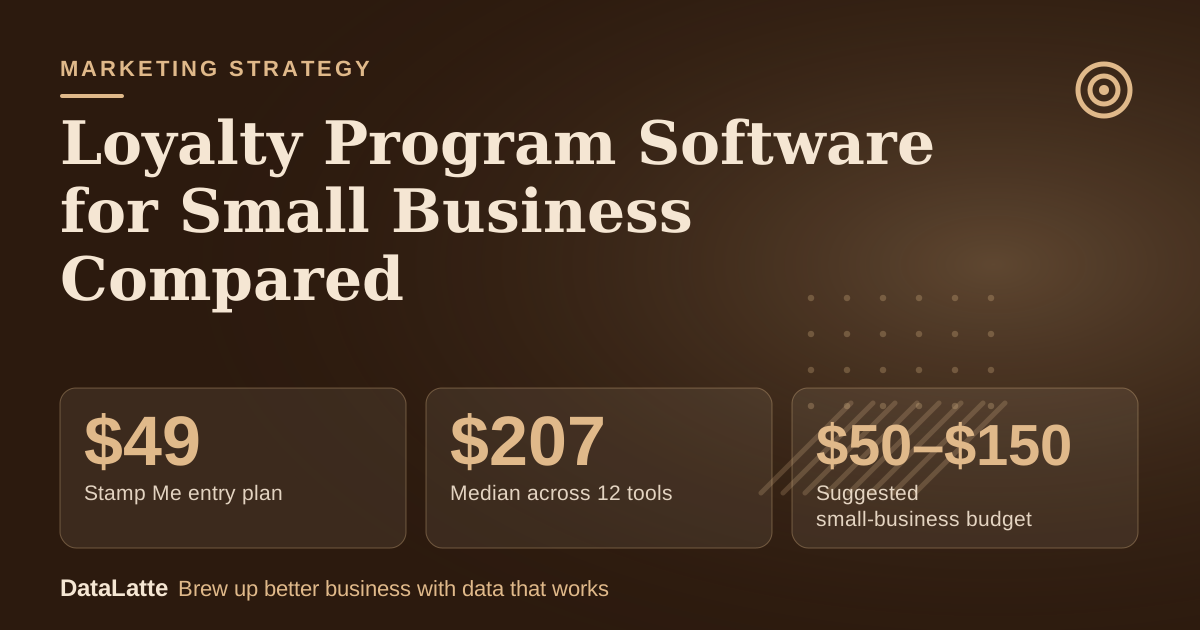
$49→

Stamp Me entry plan

Stamp Me pricing page, USD per month

$207→

Median across 12 tools

CostBench, per month (secondary)

$50–$150→

Suggested small-business budget

CostBench, per month (secondary, unconfirmed)

Assumption
$150→

Illustrative café monthly cost

Loop cost model, assumption-based example

See Sources at the end of the article. Cards marked Assumption are examples, not results.

What does loyalty program software cost for a single location?

Prices below come from two kinds of source. Stamp Me's own pricing page is the only vendor page with readable prices in the material reviewed. Every other figure comes from a CostBench listing, which is a third-party estimate (secondary) and should be confirmed on the vendor's site before any decision. Where a source gives no detail, the table says "not stated".
ToolEntry price listedHigher tiers listedIncluded or notesLimitsSuits
Stamp Me$49/mo "Simply the Basics" (vendor page)$79/mo "The Full Works" (vendor page)Basics is described as a simple, no-frills digital stamp card; Zapier integrations push member data to mailing or CRM tools; no lock-in contractWhich features sit in which plan: not statedSingle location wanting a plain stamp card
Loopy Loyalty$25/mo Starter (secondary)$69 Growth, $95 Ultimate (secondary)Not statedNot statedNot stated
Marsello$60/mo Loyalty Launch (secondary)$120 Loyalty Accelerate (secondary)Supports online and physical locations; no order volume limits (secondary)Priced per site; each physical location and the online store counts as oneShops with a physical location, per the listing
Kangaroo Rewards$79/mo Core (secondary)$199 Plus, $349+ Elite (secondary)Not statedNot statedNot stated
Preferred Patron$29/mo Small Business (secondary)Growth and Enterprise tiers up to $10K (secondary)Not statedNot statedNot stated
Rewardify$19.95/mo Basic (secondary)$59.95 Professional, $149.95 Plus (secondary)Not statedNot statedNot stated
Fivestars (now with Lightspeed)$269/mo Connect Plus (secondary)$349 Connect Pro (secondary)Not statedNot statedNot stated
Square LoyaltyNot statedNot statedNot statedNot statedNot stated
Current pricing for Loopy Loyalty and Square Loyalty should be read on their own pages. This comparison does not rank the tools, because the sources do not document features or limits evenly.

Why do the published prices conflict?

Several tools show two different prices depending on where they are read. The conflicts should be treated as open questions, not averaged into a single number.
Stamp Me's own page lists "Simply the Basics" at $49 and "The Full Works" at $79 per month. The same page also shows a $199 figure next to a $100 figure in a Full Works block, without labelling which is current. CostBench lists Stamp Me as Lite $49, Pro $79 and Elite $199, using different plan names.
Marsello appears as $60–$120 per month per site in one CostBench article. The same article gives $60–$240 depending on the number of locations. A second CostBench page lists Loyalty Launch at $60 and Loyalty Accelerate at $120. The per-site rule explains part of the spread, but not every difference.
Stamped Loyalty is listed at $49 a month alone in one article. Another CostBench page lists a Loyalty plan at $299. Smile.io shows $199–$999 in one place and $49–$199 for online-only stores in another. Both brands are described in those listings as suited to online stores, so they are of limited relevance to a single café or salon.
Two further cautions apply. CostBench's tool pages carry a 2026 date, and the article that cites them says its products were last researched on 2026-01-30, so prices may have moved. One page also claims loyalty programs raise repeat retail visits by 30–40%, without naming a source. That figure should not be used in a budget.

What must a loyalty program earn to pay for itself?

A loyalty program pays for itself only when the margin on the extra visits it causes exceeds its total monthly cost. A Loop cost article defines that cost as software plus reward cost plus communications plus integrations or equipment plus staff time plus other fees. The software fee is one of six lines.
The break-even rule is simple:
extra visits needed = total monthly cost ÷ gross margin per extra visit
Only visits that would not have happened anyway count. A regular who would have bought a latte at full price, and now gets a stamp for it, adds cost and no margin.
The same Loop article walks through an illustrative café. With 300 active members, 30 free-drink redemptions a month at a $2 marginal cost each, and two hours of administration at $25 an hour, the monthly cost is $150. That is $60 for rewards, $50 for staff time and $40 for tools. If each extra visit adds $6 of gross margin, 20 extra visits contribute $120 and leave the program below break-even. By the same arithmetic, break-even in that model is 25 visits ($150 ÷ $6).
CostBench suggests most small businesses budget $50–$150 a month for a loyalty program (secondary, unconfirmed). That figure is a useful screen for software cost alone, and it leaves out rewards and staff time.

What does a worked example look like for a coffee shop?

All inputs below are assumptions for a single-location coffee shop. The reward and staff inputs mirror the Loop illustration, and the software prices are the listed ones.
Assumptions: 300 active members, 30 reward redemptions a month at a $2 marginal cost ($60), two hours of administration at $25 an hour ($50), and $6 gross margin per extra visit.
Software option (listed price)SoftwareRewardsStaffTotal monthly costExtra visits to break even
Stamp Me Simply the Basics$49$60$50$15927 (26.5 rounded up)
Stamp Me The Full Works$79$60$50$18932 (31.5 rounded up)
Marsello Loyalty Launch (secondary)$60$60$50$17029 (28.3 rounded up)
On the first row, 27 extra visits at $6 is $162, just above the $159 cost. Across 300 members, 27 visits is 0.09 extra visits per member per month, about one extra visit for every 11 members. Whether that is realistic depends on the shop's own repeat rate, which only its own sales data can show.
Margin changes the answer quickly. If the gross margin per extra visit is $4 (assumption), the first row needs 40 visits ($159 ÷ $4, rounded up). The software fee barely moves the result. The gap between the cheapest and priciest option in the table is only five visits, so the reward design and the margin on an extra visit matter more than the plan choice.
Salons and studios can run the same arithmetic with a visit margin that reflects an average service. Those that take bookings online can pair the stamp or points card with the booking flow, as covered in online booking systems for salons.

What should a two-week launch checklist cover?

Two weeks is enough for a plain stamp card at one location. The schedule below assumes a tool has already been chosen and the free or no-card trial has been used to test it (Stamp Me states no credit card is required to see how the service works).
DayTask
Week 1, Day 1Calculate the break-even number of extra visits using the worksheet above and the shop's real margin
Week 1, Day 2Confirm current prices on the vendor page, including which plan holds the needed features, and ask about contract length and cancellation terms
Week 1, Day 3Define the reward (for example, a free drink or service after a set number of visits) and cost it at marginal cost
Week 1, Day 4Set up the card, branding and reward rule in the tool; run a test sign-up from a phone
Week 1, Day 5Check what member data can be exported or pushed to email or text tools, for example via an integration such as Zapier
Week 1, Day 6Write a one-line staff script and decide who stamps, who handles disputes and who reviews the numbers
Week 1, Day 7Print a counter sign or QR code; do a full staff walk-through
Week 2, Day 8Soft launch with regulars; record a baseline of weekly visits before the program counts
Week 2, Days 9–11Ask every customer at the register to join; log sign-ups per day
Week 2, Day 12Send a first message to members; see email campaign ideas for small businesses and SMS platform comparisons for channel options
Week 2, Day 13Compare visits against the baseline; check redemptions against the reward budget
Week 2, Day 14Decide whether to adjust the reward threshold or keep it for a full month before judging results
Members who stop visiting can be targeted later with the approach in customer reactivation campaigns.

Which questions should be asked before paying?

A short list of vendor questions helps compare plans that do not list features evenly:
  • Which features sit inside the entry plan, and which require an upgrade?
  • Is there a contract, and can the plan be cancelled at any time? Stamp Me states no lock-in contract and cancellation at any time. For other tools the sources do not say.
  • What support is included? Stamp Me lists webchat and email on one tier, and webchat, email and phone on another. Which plan carries which is not stated.
  • Can member data reach the email or text tool already in use?
  • How is the price counted, per location, per site or per user? Marsello counts each physical location and the online store as one site. The CostBench figures for Yotpo Loyalty are per user.
  • Is any price listed in another currency or labelled "excl. GST"? Stamp Me's page shows AUD, GBP and EUR price points next to the USD ones.
Prices are not documented as likely to rise or fall at any particular date. Current rates should be requested directly from the vendor.

FAQ

Is there free loyalty software for a coffee shop?

CostBench reports that 2 of the 16 loyalty tools it tracks offer free tiers for small teams or limited use. One free option it names is Yotpo Loyalty, and a Shopify-based tool, S Loyalty, also has a free plan. Whether any free tier suits a physical single-location shop is not stated, so the plan's limits need checking.

How much should a small business budget for loyalty software?

CostBench recommends $50–$150 a month for most small businesses (secondary, unconfirmed). Across 12 tools with listed monthly prices, it reports a range of $0 to $999 and a median of $207. Rewards and staff time come on top of the software fee.

Do digital stamp cards require a long contract?

Stamp Me states that its plans have no lock-in contract and can be cancelled at any time. For the other tools in the table, contract terms are not stated in the material reviewed, so they should be asked about before signing.

Does a loyalty program reliably increase repeat visits?

No source reviewed documents a reliable figure for a single café or salon. One CostBench page asserts a 30–40% increase for retail stores without naming a source. The safer approach is to record a baseline and compare it to visits after launch, using the break-even arithmetic above.
If the loyalty card is meant to feed a wider local growth plan, a free marketing audit can show where repeat-visit spend fits against ads and other channels.

Sources

Free for local businesses

Want this applied to your business?

I'll review your Google presence, local SEO, and ad accounts — and send you a specific action plan within 48 hours. No pitch, no pressure.

loyalty programdigital stamp cardsmall businesscustomer retention

Want hands-on help?

See how DataLatte handles Analytics & Reporting for local businesses.

Learn more
Nataliia — local marketing expert
Nataliia Rumiantsewa

Local marketing strategist with 10+ years at global agencies — OMD, Dentsu, GroupM, and BBDO. Now helping small businesses get the same data-driven edge. Based in Europe, working with clients in the US, UK, Australia, and beyond.

Want this applied to your business?

Let's review your current marketing setup together — free, no obligations.

Get Your Free Marketing Audit