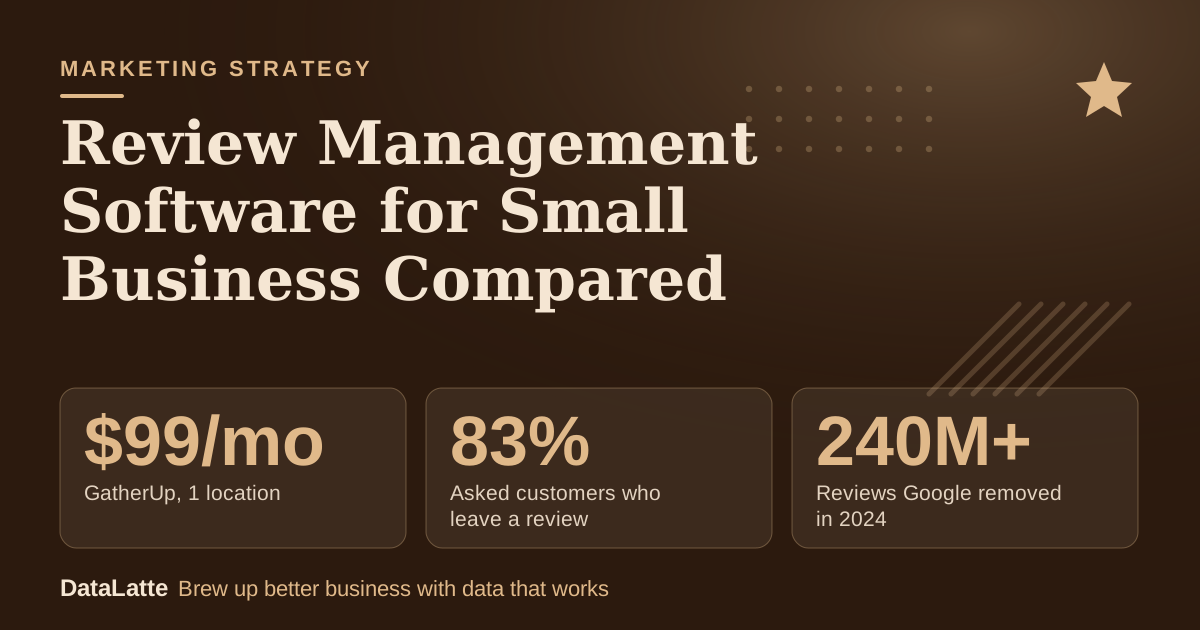
Review management software does three jobs for a single-location business: it sends review requests, monitors new reviews, and helps write replies. Of the four vendors compared here, only GatherUp publishes a one-location price ($99 per month, billed annually). Birdeye and Podium route buyers to a sales quote. NiceJob's pricing page shows no confirmed dollar figure. Google and the FTC rules matter more than any feature list.
→
GatherUp, 1 location
GatherUp pricing page, billed annually
↑
Asked customers who leave a review
BrightLocal figure as reported by Swydo (secondary)
↓
Reviews Google removed in 2024
Google figure as reported by Swydo (secondary)
→
FTC fine per violation
FTC rule figure as reported by Swydo (secondary)
See Sources at the end of the article. Cards marked Assumption are examples, not results.
What does review management software actually do?
Vendor pages describe the same core workflow. Requests go out by text or email after a visit. Monitoring pulls new reviews from Google, Facebook and other sites into one inbox. Replies are drafted by hand, from templates, or with AI help.
The feature lists differ in what surrounds that core.
NiceJob puts review requests, website widgets, social sharing and a team leaderboard in every plan, and keeps AI replies, referrals and NPS surveys for its Pro tier.
Podium's Core plan includes review management with AI responses inside a wider lead-conversion and messaging platform.
GatherUp's local plan is described as keeping reviews, feedback and customer conversations in one place. It also sells a separate Review Defense product, which analyzes review authenticity, starting at $45 per month per location billed annually.
The core workflow is the same across tools. The differences that matter for one location are the price, the contract terms, and how much extra software comes bundled.
A business that only wants more reviews and faster replies is paying for the bundle whether it uses it or not. That is the main reason to check the free route first (covered below).
How do the main tools compare on price?
Published prices are scarce. The table separates what each vendor's own page shows from third-party estimates, which stay unconfirmed and are never averaged with the vendor figures.
| Tool | Published price (vendor page) | Third-party estimate (secondary, unconfirmed) | Trial | Suits |
|---|
| GatherUp | $99/month, 1 location, billed annually; a month-to-month option exists (rate not confirmed here) | Costbench lists $40, $60 and $99/month tiers (secondary); conflicts with the vendor page, so not used | "Start free trial" button; length not stated | One-location businesses wanting requests, monitoring and replies in one tool |
| NiceJob | No dollar figure confirmed | $75/month starting price per Swydo (secondary) | "Start for free" button; terms not stated | Service businesses; the site has industry pages for hair salon, pet grooming and fitness center |
| Birdeye | Custom quote (form asks for location count, from 1-3 locations) | About $299/month per location on annual billing, about $389 monthly, per third-party reports cited by Swydo (secondary) | None shown; demo offered | Businesses with several locations; a single shop should ask for a one-location quote |
| Podium | Custom quote; Core, Pro and Signature plans; $5/month base 10DLC fee per US location listed | About $399/month per Swydo (secondary) | None shown | Businesses that also want texting and lead conversion in the same inbox |
Swydo's own note says Birdeye does not publish pricing publicly, which matches the vendor's quote form. Where two sources disagree, as with GatherUp, the vendor's current page governs and the other figure is context only.
Swydo also reports cheaper, agency-oriented tools, all secondary: BrightLocal Track at $39 per month, LocalClarity at $10 per month per location, Grade.us at $110 per month, and Reputation.com at $80 per month per location. Those figures were not checked against vendor pages here.
Where do pricing surprises hide?
Swydo warns that some advertised monthly prices apply only to annual prepayment, with the true monthly rate 25 to 30 percent higher, and that onboarding fees of $500 to $1,500 exist on some plans (secondary, general claims). Podium's table also lists messaging fees: $5 per extra phone number and $15 per month for high-volume carrier-verified messaging on Core.
Ask every vendor for the month-to-month rate, the contract length, onboarding fees and messaging fees in writing.
What do Google and the FTC allow when asking for reviews?
Google's guidance is direct. Reviews must reflect a genuine experience, and
offering incentives such as free or discounted goods or services in exchange for posting, changing or removing reviews is treated as fake and misleading content and is strictly prohibited. That rules out the "10% off for a five-star review" tactic, whatever a tool's templates suggest.
On the FTC side, Swydo reports that the agency's final rule on fake reviews is being enforced, with fines of $53,088 per violation. It adds that the FTC sent its first warning letters to 10 companies on December 22, 2025, and that review gating, meaning sending only happy customers to Google, is explicitly banned (all secondary). The FTC's
endorsements and reviews guidance is the place to confirm current wording.
Swydo's conclusion is practical: a platform that still offers review gating as a feature is a red flag. Before buying, ask whether requests go to every eligible customer, and confirm that no setting routes low scorers to private feedback only.
Google's reply guidance has one more limit worth building into templates. Replies should be conversational rather than promotional, so offering deals inside a reply goes against the guidance. Questionable reviews from others are handled separately, covered in
how to deal with fake Google reviews.
Does a small business need paid review software at all?
Often not. The two things software automates are the ask and the reply, and both can be done by hand at low volume. Swydo, citing BrightLocal, reports that 83% of consumers who are asked to leave a review do so (secondary). The bottleneck is asking consistently, not customer willingness.
A manual routine that works for a salon or groomer with a modest appointment count:
- Send a text from the shop phone after each visit, using a saved message that asks for honest feedback and nothing else.
- Set a daily calendar reminder to check new reviews.
- Reply using Google's own tips: short, personal, polite, quick, and without promotions.
Paid software starts to earn its cost when volume makes consistency hard, when several staff members share the ask, or when the owner wants reports. It is a poor fit when the real problem is a thin Google profile or a service issue, which software cannot fix.
The broader groundwork is in the
Google Business Profile optimization checklist, and the wider reply routine is in
managing online reviews for a small business. Tools that draft replies automatically are covered in
AI agents for Google reviews management. Google advises against sending the same thank-you to everyone, so automated replies need a human edit.
Choosing which sites matter most is a separate question, handled in the
review platform comparison.
What does the math look like for a pet groomer?
All inputs below are assumptions unless marked otherwise. The goal is to test whether a $99 monthly tool earns its cost, not to forecast results.
| Input | Value | Label |
|---|
| Completed appointments per month | 60 | Assumption |
| Manual ask yield | 8 reviews per 100 requests | Assumption |
| Software text-request yield | 20 reviews per 100 requests | GatherUp data as reported by Swydo (secondary); applied here as an assumption |
| Tool cost | $99 per month | GatherUp's published rate, billed annually |
| Staff time on manual asks | 2 minutes per request, valued at $20 per hour | Assumption |
Manual route: 60 requests at 8 per 100 gives 4.8 reviews per month. Time cost is 120 minutes, or $40 per month.
Software route: 60 requests at 20 per 100 gives 12 reviews per month. The extra volume is 7.2 reviews per month, so $99 divided by 7.2 is about $13.75 per additional review. If the $40 of saved staff time is netted off, the figure drops to about $8.19.
The result flips if yield does not improve. If the tool only matched the manual rate of 8 per 100, the extra reviews would be zero, and $99 would buy $40 of saved time. A one-chair groomer should treat that as a signal to stay manual.
The vendor yield is a vendor claim, so the trial period is the real test: track reviews per 100 requests for 30 days before committing to annual billing.
What does a two-week setup look like?
The checklist below fits a trial period, so the buy-or-skip decision comes before any annual charge.
| Week | Days | Task | Done when |
|---|
| 1 | 1 | Confirm the Google Business Profile is verified and complete | Profile details match the shop's real hours and services |
| 1 | 2 | Record the baseline: review count, rating, average reply time | Three numbers written down |
| 1 | 3 | Ask each vendor for month-to-month rate, contract length, onboarding and messaging fees | Quotes received in writing |
| 1 | 4 | Start a trial at one tool (GatherUp or NiceJob offer a start button) | Account created, trial end date noted |
| 1 | 5 | Check settings for review gating and incentive wording | Every customer receives the same request; no discount offers |
| 2 | 8 | Connect the booking system or upload recent customers | Test request sent to a staff phone |
| 2 | 9 | Write reply templates based on Google's tips, with room to personalize | Templates for 5-star, mixed and negative reviews |
| 2 | 10 | Send the first live batch of requests by text | Requests sent after each completed visit |
| 2 | 11 | Send an email follow-up about 48 hours later to non-responders | Follow-up automation running |
| 2 | 12 | Assign one person to check and reply to reviews | Owner named, daily check set |
| 2 | 14 | Compare reviews per 100 requests with the baseline and the manual yield | Keep, switch or cancel decision made before billing starts |
The two-step sequence on days 10 and 11 comes from GatherUp data reported by Swydo (secondary): about 20 reviews per 100 requests by text only, about 15 by email only, and about 26 for text plus an email follow-up 48 hours later.
No tool in this comparison is ranked first. The right pick depends on the quote, the contract terms and the trial result. A
free audit of the Google profile can show whether reviews are the weak spot before any software is bought, and the
Google Ads service page covers what happens once the profile is ready to send traffic to.
FAQ
Is review gating allowed?
Not according to the sources. Swydo reports that the FTC's rule explicitly bans review gating, meaning sending only happy customers to Google (secondary). Requests should go to every eligible customer.
Can a business offer a discount for leaving a review?
Google's guidance says offering incentives, such as free or discounted goods or services, in exchange for posting, changing or removing reviews is strictly prohibited. A thank-you after the review is posted still counts as an incentive if it was promised in advance, so keep the ask free of rewards.
How much does review management software cost for one location?
Only GatherUp's price is confirmed on a vendor page: $99 per month for one location, billed annually. Birdeye and Podium use custom quotes. Third-party estimates exist for NiceJob, Birdeye and Podium, but they are unconfirmed and should be checked with the vendor.
GatherUp's page says month-to-month plans have no annual commitment. For other vendors, contract length is not documented in the sources, so ask for it in writing before signing.
Should AI replies be used as written?
Google's guidance asks for personal, specific replies rather than the same thank-you for everyone. Treat AI drafts as a starting point and edit before posting.
Sources