AI Agent for Google Reviews: Safe Replies
Part of the guide: Local SEO & Google Business Profile
One consumer in five now expects a reply to a review on the same day, up from 6% a year earlier
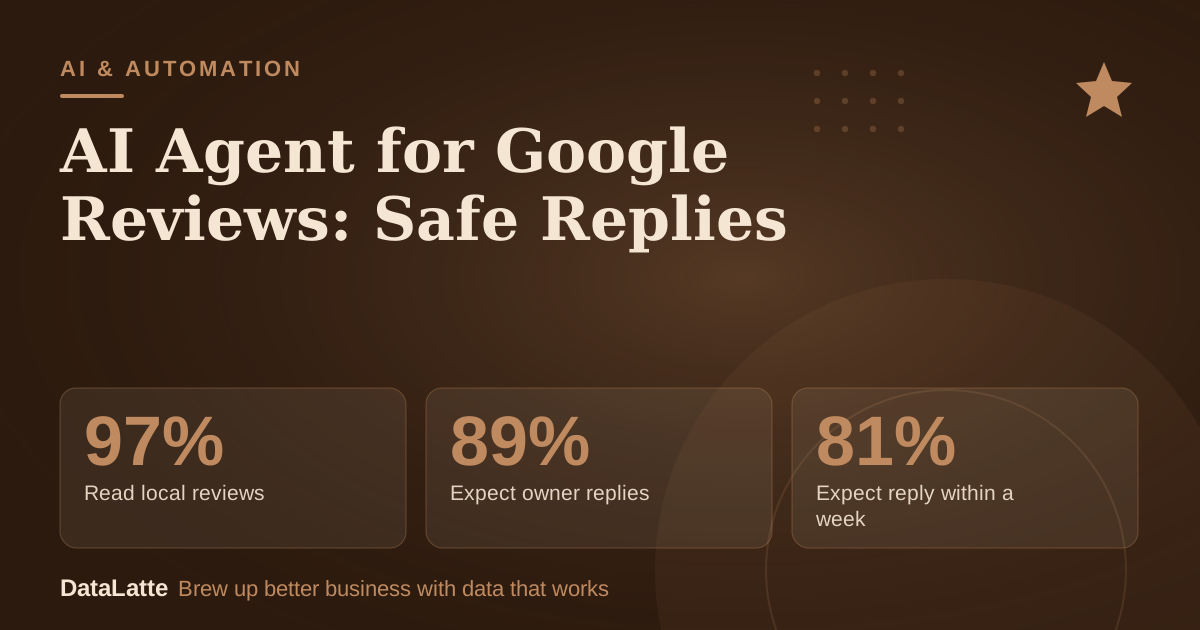
BrightLocal 2026: 1,002 US adults. 89% expect owner replies at all; 81% expect one within a week.
BrightLocal Local Consumer Review Survey, published 11 February 2026
What Do Consumers Expect From Review Replies?
Read local reviews
BrightLocal 2026
Expect owner replies
BrightLocal 2026
Expect reply within a week
BrightLocal 2026
Only trust reviews under 3 months old
BrightLocal 2026
See Sources at the end of the article. Cards marked Assumption are examples, not results.
What consumers say about reviews and replies
BrightLocal Local Consumer Review Survey 2026, 1,002 US adults, published February 2026.
How Does a Review Agent Work?
- Fetch. Check your Business Profile for new reviews every few hours.
- Classify. Label each review by star rating and topic (praise, slow service, price, staff, safety, possible fake).
- Draft. Write a reply using your tone notes and details from the review.
- Route. Send low-risk drafts to a quick approval queue, and anything sensitive to you personally.
What Access Does Google Require?
- A Business Profile that has been verified and active for 60 or more days (yours or a client's)
- A website for the business, listed on the Profile
- A Google Cloud project and a submitted "Application for Basic API Access" from an email that owns or manages the Profile
/reply endpoint with a JSON body that has a single comment field. The same request creates the reply if none exists or updates the existing one.Which Rules Must the Agent Follow?
Replies
Requests
Fake reviews
What Should You Automate and What Not?
| Situation | Handling |
|---|---|
| 5-star with a comment | Agent drafts; owner approves in bulk for the first month, then optionally auto-post |
| 5-star, no text | Short thank-you, can be automated |
| 3-4 stars or mixed | Agent drafts; owner edits and approves |
| 1-2 stars or complaint | Owner writes or heavily edits; agent only summarises the issue |
| Possible fake or competitor | Owner decides; neutral reply and report through your Profile |
| Health, injury, legal or discrimination claims | Human only |
What Prompt Keeps Replies Safe?
You write replies for [Business] in [Town]. Tone: warm, brief, no exclamation marks overload. Use the customer's first name and one specific detail they mentioned. Never offer discounts, never admit fault, never mention staff by surname. For 1-3 stars, thank them, apologise that the visit fell short, and invite them to contact [phone/email]. Output the reply only. If the review mentions health, safety, money or legal action, output HOLD.
Is a Review Agent Worth It? A Worked Example
| Quiet | Typical | Busy | |
|---|---|---|---|
| Reviews per month (assumption) | 20 | 60 | 150 |
| Model cost at $0.005 per reply | $0.10 | $0.30 | $0.75 |
| Manual time at 4 min per reply (assumption) | 1.3 h | 4 h | 10 h |
| Time with agent at 1 min review per reply (assumption) | 0.3 h | 1 h | 2.5 h |
| Hours saved | 1.0 | 3.0 | 7.5 |
| Value of your time at $30/h (assumption) | $30 | $90 | $225 |
| Hosted tool or setup cost per month (assumption) | $30 | $30 | $30 |
| Net monthly gain | $0 | $60 | $195 |
What Is a 15-Minute Weekly Routine?
- Clear the approval queue and edit any draft that does not sound like you.
- Read every 1-3 star review personally and decide on the real-world fix.
- Spot-check five posted replies for wrong names or details.
- Look for patterns: three mentions of waiting time is an operations problem, not a reply problem.
- Check the request log to confirm every customer received the same message.
What Should You Do First?
- Count your reviews from the last 90 days and how many have no reply. That is your backlog and your volume estimate.
- Write a one-paragraph voice guide with three example replies you are proud of and three phrases you never use.
- Check whether your Business Profile has been verified for 60 days and lists a website, which is the API prerequisite.
- Run the prompt above on ten old reviews in a chat window and note which ones should have been HOLD.
- Decide your approval rule (everything for the first month) and block out 15 minutes on your calendar each week.
FAQ
Will AI replies sound fake?
Can an AI agent post replies automatically?
Is it allowed to offer a discount for a review?
Can I use AI to write the reviews themselves?
How do I handle a suspected fake review?
Sources
- BrightLocal: Local Consumer Review Survey 2026
- Google Business Profile Help: Reply to reviews
- Google Business Profile Help: Ask for reviews
- Google Maps contributor policy: Prohibited and restricted content
- Google Business Profile APIs: Prerequisites
- Google Business Profile APIs: Review data
- FTC: Final rule banning fake reviews and testimonials
- FTC: Consumer Reviews and Testimonials Rule Q&A
- Anthropic: API pricing
Related guides
Free for local businesses
Want this applied to your business?
I'll review your Google presence, local SEO, and ad accounts — and send you a specific action plan within 48 hours. No pitch, no pressure.
Want hands-on help?
See how DataLatte handles AI Agents & Automation for local businesses.

Local marketing strategist with 10+ years at global agencies — OMD, Dentsu, GroupM, and BBDO. Now helping small businesses get the same data-driven edge. Based in Europe, working with clients in the US, UK, Australia, and beyond.
Related articles
Make.com vs Zapier for Local Business: Which Wins?
13 min read
Build an AI Agent Without Code: Local Business Guide
8 min read
AI Automation for Hair Salons: What to Automate
10 min read
AI Agent for Lead Generation: Capture Leads 24/7
14 min readWant this applied to your business?
Let's review your current marketing setup together — free, no obligations.
Get Your Free Marketing Audit