November 10, 2026·Nataliia Rumiantsewa· 9 min read All posts
Measuring CTV ads for a local business works best as a layered system. Record a 4-8 week baseline of branded search, site traffic and bookings. Give the ad a trackable hook, such as a promo code, vanity URL or QR code. Then compare ZIP codes that saw the ads with similar ZIP codes that did not. No single method proves anything alone, but together they show whether bookings rose because of the ads, not just after them.
Assumption
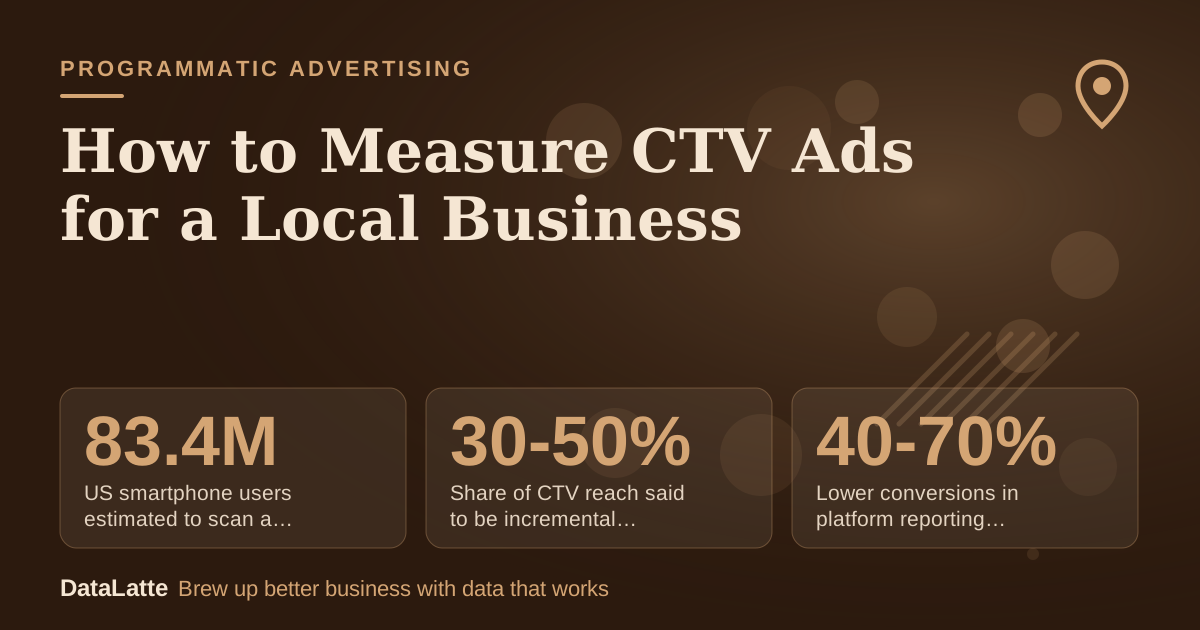
83.4M→
US smartphone users estimated to scan a QR code in 2022
Origin Media (secondary)
30-50%↑
Share of CTV reach said to be incremental and exclusive
Adjust citing Beatgrid (secondary)
40-70%↓
Lower conversions in platform reporting than reality (claimed)
Attn Agency (secondary)
14-30+ days→
Attribution window suggested for CTV
Attn Agency (secondary)
See Sources at the end of the article. Cards marked Assumption are examples, not results.
The viewer's path also breaks across screens. The same agency notes that people see the ad on a smart TV, then act on a phone or computer, and that the effect can take days or weeks to show up. A one-day window misses most of it, so the guide suggests windows of 14-30+ days.
For a salon or studio, the typical result is that a booking lands in "direct" or "branded search" and the TV ad gets no credit. The same agency claims platform reporting often shows 40-70% fewer conversions than actually happen (secondary, and not independently verified). Reading bookings in Google Analytics 4 next to the ad calendar is more useful than trusting a dashboard alone.
What does incrementality mean for a small business?
For a salon, the "would have booked anyway" group is large: regulars, referrals, people who walk past. An ad can look successful simply because it ran during a busy month. Incrementality testing separates paid lift from demand that was already there, which Adjust says helps spot efforts that cannibalize organic traffic (secondary).
What baseline should be recorded before the first impression?
A baseline is the normal weekly pattern before any CTV spend. Four to eight weeks is long enough to see the usual ups and downs, and it gives the later test something to be compared against. Without it, any increase after launch is a guess.
Record these once a week, in the same place, on the same day:
Branded search: impressions and clicks for the business name, from Google Search Console
Website sessions, split into direct, organic and paid
Bookings, split into new clients and returning clients
Phone calls and walk-in mentions of "saw you on TV" if staff log them
Anything unusual: holidays, local events, a competitor sale, the business's own promotions
Heavier approaches exist, but they need data a small shop lacks. One agency guide says marketing mix modeling requires daily sales data for 2+ years (secondary). A simple weekly log is the small-business substitute. Pause other new promotions during the test so the baseline stays clean.
Can promo codes and vanity URLs track CTV?
Yes, with a built-in limit. A promo code such as a short word spoken and shown on screen, and a vanity URL such as a short page on the business site, give viewers a way to respond that can be traced back to the ad. Use them only in the CTV creative, never in email, Instagram or flyers.
The limit is that they undercount. Plenty of viewers will skip the code, search the business name on a phone and book directly. Those bookings never touch the code. Treat code redemptions and vanity-page visits as a floor, the minimum the ad produced, not the total.
Two practical habits help. Make the vanity page a real booking page, not a homepage redirect, so analytics can show visits and completed bookings. And ask at checkout or on the booking form: "How did you hear about us?" with "TV" as an option. Creative layout matters here, and the creative specs guide covers how to keep on-screen text readable.
Do QR codes work for measuring CTV ads?
They can, within limits. Origin Media, a CTV ad-format vendor, argues that QR codes let advertisers measure campaigns in a privacy-safe manner without navigating CTV attribution systems, and that the direct connection keeps competitors' sponsored search results out of the path (secondary). It also cites an estimate that 83.4 million US smartphone users would scan a QR code in 2022, a 10% rise from the prior year.
The same source lists the weak points. A code placed badly on screen, or shown too briefly for someone to pick up a phone and scan, becomes useless. It also suggests the best location may not be over a visually busy creative.
To make a QR code measurable, point it at its own landing page, separate from the vanity URL, so scans can be counted on their own. Formats built around this idea are covered in new CTV ad formats with pause ads and QR codes.
How does a geographic holdout test work for a local business?
A scaled-down version is still useful as a directional read:
Split the service area's ZIP codes into two groups of similar size and booking history.
Run the CTV campaign in group A only. Confirm first that the platform can target by ZIP code.
Compare the change from baseline in A against the change in B.
Spillover is the same issue the agency guide flags: neighbors in group B may still see the ads. Keep a gap between the groups where possible. Platform choices are compared in CTV advertising platforms compared.
Which measurement method fits which budget?
The table compares methods on cost, effort and reliability. Ratings are editorial judgments, built from the limits described in the sources above, not measured values.
For most local businesses, the practical stack is the first four rows run together. Whether the spend is justified at all is a separate question, covered in is CTV advertising worth it on a small budget.
What does a 6-week CTV test calendar look like?
The calendar assumes the 4-8 week baseline is already logged. Six weeks covers a four-week flight plus a tail for late bookings. The agency guide's suggested 14-30+ day windows (secondary) are the reason for the tail. A longer tail is better if budget and patience allow.
Week
Action
Check
1
Launch in test ZIPs only. Go live with code, vanity URL and QR landing page.
Do the code, URL and QR page each record a test visit? Is the "TV" option on the booking form?
2
Leave creative and budget alone. Log the weekly numbers.
Are branded search and bookings moving in test ZIPs versus control ZIPs?
3
Log the numbers again. Note any weather, event or competitor change.
Any outside event that could distort one group?
4
Final flight week. Do not launch a new promotion.
Count code redemptions, vanity visits and QR scans so far
5
Ads off. Keep logging.
Do bookings in test ZIPs stay above baseline? Late bookings land here
6
Read-out: compare change from baseline, test versus control
Write down the incremental estimate and the tracked floor side by side
Do not change the offer, the price or the creative mid-test. Every change makes the read-out harder to interpret.
What does a worked salon example look like?
The inputs below are assumptions, chosen to show the arithmetic. They are not benchmarks or real results.
Input
Value (assumption)
Baseline new-client bookings, test ZIPs (A)
10 per week
Baseline new-client bookings, control ZIPs (B)
10 per week
Average weekly new-client bookings in A during the 4-week flight
13
Average weekly new-client bookings in B during the same weeks
11
CTV spend in A for the flight
$1,200
First-visit revenue per new client
$120
Visits per new client in the first year
3
Bookings credited to the promo code
3
Group A rose by 3 per week. Group B also rose by 1 per week, from something unrelated to the ads, such as the season. The incremental lift is 3 minus 1, or 2 bookings per week, which is 8 over four weeks. Crediting A's full rise would claim 12 and overstate the ads by 4.
Cost per incremental new client is $1,200 divided by 8, or $150. First-visit revenue is 8 times $120, or $960, which is below spend. With three visits in the first year, value is 8 times $360, or $2,880, about 2.4 times spend.
The promo code captured 3 of the 8, which shows why codes alone undercount.
Weekly counts of 10 are small. A swing of 2-3 in a week can happen by chance, so this result is directional. Repeating the test before scaling is a safer move. A studio can use the same structure with trial sign-ups in place of salon bookings, as outlined in CTV ads for fitness studios.
FAQ
Can a small business measure CTV without a big budget?
Yes, at a directional level. A weekly baseline log, a code, a vanity URL, a QR landing page and a ZIP-level split cost little beyond the ad spend. The formal holdout design in the agency guide assumes $100K+ monthly spend (secondary), so a local version should be read as a signal, not proof.
How long should a business wait before judging CTV results?
Longer than the flight itself. One agency guide suggests attribution windows of 14-30+ days (secondary), since impact can take days or weeks to show up. The six-week calendar above keeps a tail after the ads end so late bookings are counted.
Are QR codes enough to measure CTV?
No. Origin Media's own write-up notes that a badly placed code or too little screen time makes the code useless (secondary). Scans also capture only viewers who act on the spot. Use QR codes as one floor measurement next to the baseline and the geo split.
What if the ad platform report shows very few conversions?
Compare it with the business's own bookings data. An agency claims platform reports often show 40-70% fewer conversions than reality (secondary). That figure is unverified, but the direction is plausible given the missing click and the cross-device path. The baseline and test-versus-control comparison do not depend on the platform's attribution.
For help setting up the baseline, tracking and a ZIP-level test before spending on CTV, request a free marketing audit from DataLatte.
Local marketing strategist with 10+ years at global agencies — OMD, Dentsu, GroupM, and BBDO. Now helping small businesses get the same data-driven edge. Based in Europe, working with clients in the US, UK, Australia, and beyond.