Unlinked Brand Mentions: Turn Them Into Local Links
November 14, 2026·Nataliia Rumiantsewa· 8 min read All posts
An unlinked brand mention is a web page that names a business without linking to its website. A small business can turn these into links by finding the pages with an exact-name search or an alert, checking that the page is a real local or industry site, and sending a short, polite request that includes the exact URL to link to. A steady routine of a few hours per month is enough to start.
What is an unlinked brand mention?
A mention happens when a blog, local news story, event page, school newsletter or directory writes the business name in plain text. A linked mention goes one step further and makes that name clickable. The unlinked version is common because writers often type a name from memory and skip the extra step of looking up a web address.
For a coffee shop, that might be a neighborhood guide listing "the best flat white on Main Street." For a salon, it could be a wedding vendor roundup. For a pet groomer, a rescue group's thank-you post. For a fitness studio, a charity 5K sponsor page.
Each of these pages already did the hard part: someone chose to name the business. Asking for a link is a small, reasonable follow-up compared with pitching a stranger from scratch. That is the core appeal for businesses without a marketing team.
Mentions are not all equal. A page that has real readers in the same city is worth a request. An auto-generated scraper page or a spam directory is not, and replying to those wastes time.
Do unlinked mentions help with Google?
The sources used for this article do not document how Google treats unlinked mentions. No claim is made here that a mention counts as a ranking signal, or that adding a link produces a specific result. Anyone selling a guaranteed outcome from mention outreach is asserting something that is not documented in these sources.
What can be said without a ranking claim is practical. A linked mention gives a reader something to click. Someone reading a neighborhood guide can reach the shop's menu, booking page or hours in one step instead of searching again.
For current statements on how Google handles links and mentions, the reliable place to check is Google's own Search Central documentation and Business Profile help pages, which change over time.
Local search involves more than links, too. A Per Diem guide (secondary, published June 19, 2025) says that without verification, Business Profile updates will not show up publicly and customers may not find the business. Links from other sites are one piece of a local presence, not a replacement for a complete profile.
What should be ready before asking for a link?
A link request sends people to a page, so that page needs to be worth visiting. Before any outreach, three things are worth checking.
First, the destination. Pick the single URL a writer should link to: usually the homepage, a booking page or a menu page. One clear URL makes the request easy to fulfil.
Second, the Google Business Profile. The Per Diem guide (secondary) notes that Google verifies a listing before it goes live, usually with a postcard containing a code mailed to the business address, though some businesses can verify by phone or email. It also says that skipping hours, categories or the business description can limit visibility in searches. Fixing those gaps first means new visitors find consistent details.
Third, the category and Q&A. The same guide recommends a specific category such as "Coffee shop" instead of a broad one like "Restaurant," and suggests answering common questions in the Q&A section, such as free Wi-Fi, dairy-free options or dogs on the patio. A groomer or studio can apply the same logic with its own common questions.
A short list of facts also helps: exact business name spelling, address, and the one-sentence description a writer can paste.
How can a small business find unlinked mentions?
Finding mentions takes patience more than software. The table compares five methods. Time figures are assumptions for planning, not measured results.
Find method
What it surfaces
Weekly effort (assumption)
Setup
Exact-name search with the shop's own site excluded, for example "Corner Bean Coffee" -site:cornerbean.example
Pages that name the business in plain text
20 minutes
None
Same search using name variants: owner name, signature product, old spelling
Mentions the first search misses
10 minutes
A saved list of variants
Alert on the business name through a search alert or a monitoring tool
New mentions as they appear
5 minutes to review
About 10 minutes once
Manual check of local sources: chamber of commerce, neighborhood blogs, event pages, school and charity sites
Mentions search engines surface poorly
30 minutes
A bookmarked list
Social media dashboard
Social comments and messages only
Not applicable
Not a substitute
The last row matters. One social publishing vendor states that its sentiment analysis covers only messages, comments and replies on connected accounts and does not monitor web-wide brand mentions or third-party sites (secondary). A social scheduling tool, in other words, does not replace a mention search.
Every search result needs a quick check. Does the page load, does it have real local readers, and is the business name actually unlinked? Record the page, the contact person and the date in one spreadsheet.
How should the link request be worded?
A good request is short, specific and easy to say yes to. It thanks the writer first, names the page, gives the exact URL and offers a reason the link helps readers. It does not demand, threaten or mention search rankings.
A working template, written for a fictional shop:
Subject: Thank you for the mention in the neighborhood guide
Hello Dana,
Thank you for including Corner Bean Coffee in the Main Street guide. Would adding a link to https://cornerbean.example be possible? Readers could then find the menu and opening hours in one click.
Thanks again for supporting local shops.
Maria, owner
A few habits keep outreach polite. Send one request per page and one follow-up at most. Correct any factual error in the mention at the same time, since that gives the writer a second useful reason to reopen the page. Accept a no without argument. Never offer payment for a link in a first message, since paid placement is a different arrangement with different expectations.
Writers on small local sites are often one person with a day job. A reply may take a week or never arrive, so the routine below spaces messages out.
What does a worked example look like for a coffee shop?
All inputs below are assumptions for a fictional shop, Corner Bean Coffee, and not results from a real business.
Assumed inputs for one month:
Mentions found across searches and local sources: 14 (assumption)
Mentions on real local pages with no link: 6 (assumption)
Requests sent: 6 (assumption)
Replies received: 3 (assumption)
Links added: 2 (assumption)
Owner time: 4 hours at a valued rate of $25 per hour (assumption)
Calculation: 4 hours × $25 = $100 of owner time. $100 ÷ 2 links = $50 per link. The reply rate is 3 ÷ 6 = 50%, and the link rate is 2 ÷ 6, about 33%.
Those numbers are illustrative, and a single month can swing widely. A quiet month may produce zero links; a month after a local festival may produce more mentions than the shop can handle.
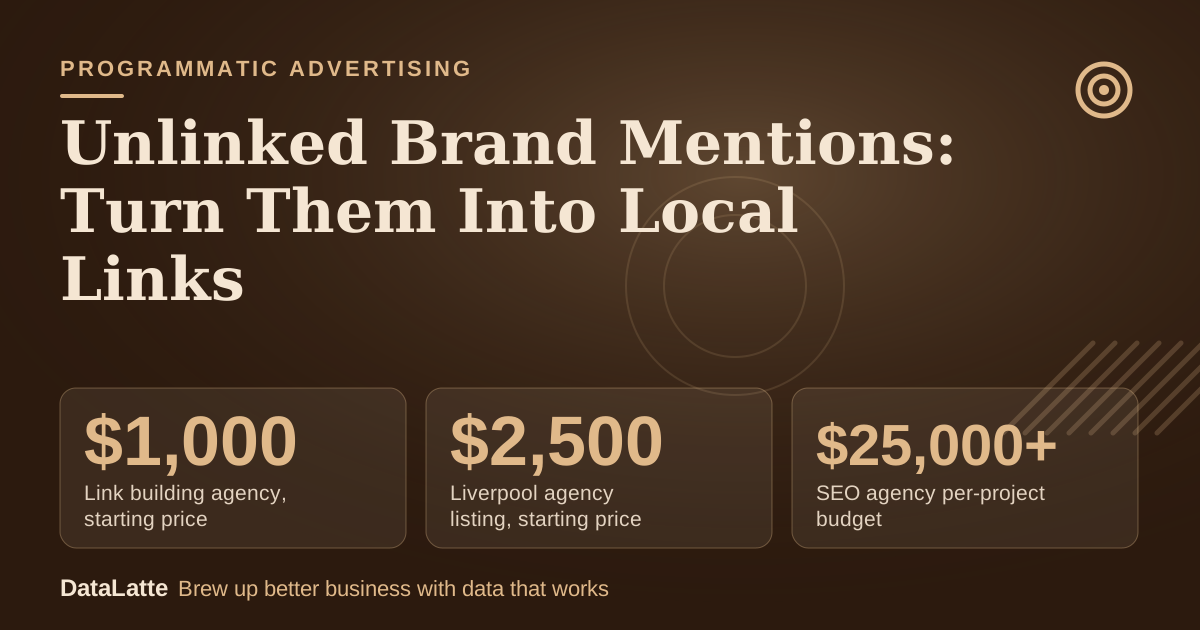
The comparison point is outsourcing. The Semrush agency directory lists a link building agency with a starting price of $1,000 (secondary, a UK-active listing, price basis not specified). The listing does not say what that price covers, so it is not a like-for-like comparison with the $100 above. It is a reminder that the DIY route is mainly a time cost.
What does a 4-week routine look like?
A routine turns a one-off clean-up into a habit. The plan below fits a few hours across a month.
Week 1: set up and baseline
Choose the one destination URL and confirm it loads on a phone
Check the Google Business Profile for hours, category and description
List name variants: owner name, product names, old spellings
Run the exact-name search with the site's own domain excluded
Create alerts for the business name
Start the tracking spreadsheet: page, contact, date, status
Week 2: first outreach batch
Remove spam and scraper pages from the list
Find a named contact or contact form for each remaining page
Send the first batch of requests, a handful at most
Log each send date
Week 3: follow-up and local sources
Send one polite follow-up to pages with no reply after about a week
Check chamber, event, school and charity pages by hand
Thank anyone who added a link
Review new alerts and add fresh pages to the sheet
Week 4: review and repeat
Confirm each promised link is live and points to the right URL
For most single-location shops, a few hours of owner or staff time is the starting point. Agencies become relevant when there are many locations, hundreds of mentions, or no time at all.
The Semrush agency directory shows how wide the price spread is. All entries below are vendor listings (secondary), many UK-active, and none are quotes.
$1,000→
Link building agency, starting price
Semrush agency directory (secondary)
$2,500↑
Liverpool agency listing, starting price
Semrush directory, Quirky Digital listing (secondary)
$25,000+↓
SEO agency per-project budget
Semrush directory, LASEO listing (secondary)
$29/mo→
Social tool plan without web-wide mention tracking
Turrboo Essentials, vendor page (secondary)
See Sources at the end of the article. Cards marked Assumption are examples, not results.
Directory prices are starting points and say little about scope. Before signing anything, ask for a written list of deliverables, how links are earned, and whether any contract locks in a minimum term.
What is the difference between a mention and a backlink?
A mention names the business in text. A backlink is a clickable link to the business website. An unlinked mention becomes a backlink once the page owner adds the link.
How many requests should be sent each month?
No source supplied for this article sets a benchmark. The worked example uses six requests as an assumption. A sensible approach is to start with the handful of pages on real local sites and adjust based on replies.
Does Google count unlinked mentions?
How Google weighs unlinked mentions is not documented in the sources used here, so no claim is made. Check Google's Search Central documentation for current statements.
Can a social media tool find these mentions?
Not reliably. One social vendor states that its sentiment analysis does not monitor web-wide brand mentions or third-party sites (secondary), so a separate search or alert is needed.
Should a business pay for links?
A first outreach message should not offer payment. If paid help is considered, ask the provider for scope, method and contract terms in writing.
A free audit can show whether mention outreach or another channel deserves the next hours of effort. Start with the free marketing audit.
Local marketing strategist with 10+ years at global agencies — OMD, Dentsu, GroupM, and BBDO. Now helping small businesses get the same data-driven edge. Based in Europe, working with clients in the US, UK, Australia, and beyond.