Local Link Building for Small Business: What Works
November 14, 2026·Nataliia Rumiantsewa· 8 min read All posts
The local links worth earning come from real organizations in the same town: the chamber of commerce, a sponsored youth team, local press, suppliers, and neighboring partners. A logo on a little league team's website may cost $250-$500 for the season (secondary). A festival or scholarship sponsorship may run $1,000 to $3,000. Bulk links from unrelated blogs are the weakest option. This guide covers costs, risk, outreach and a 6-week plan.
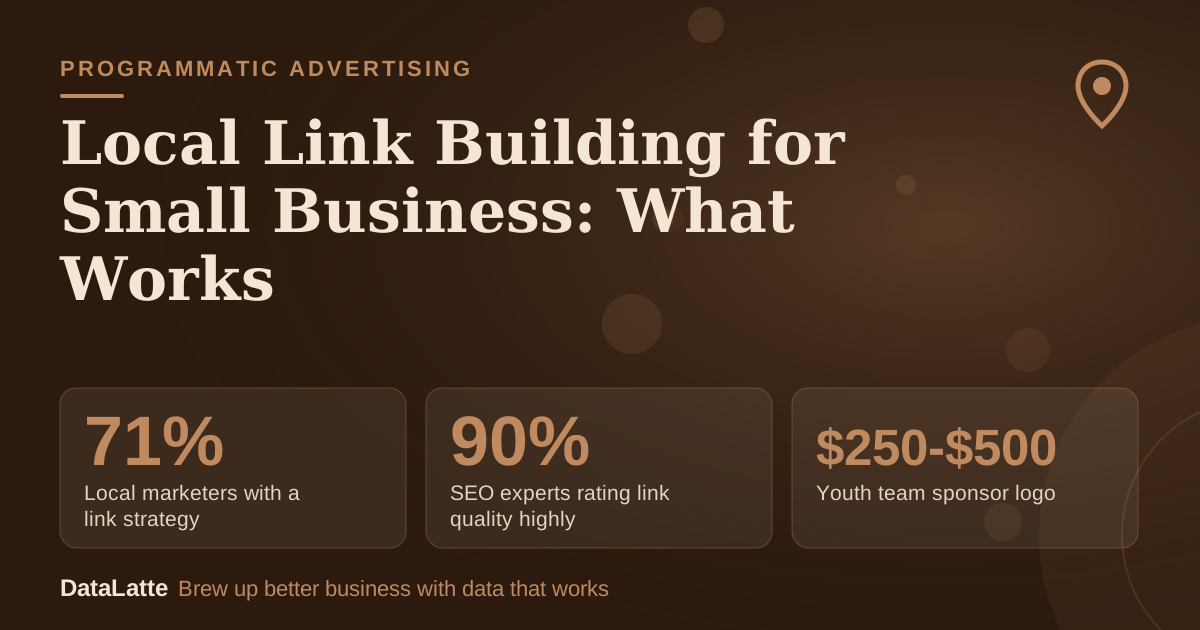
71%→
Local marketers with a link strategy
AdWave, citing Wytlabs (secondary)
90%↑
SEO experts rating link quality highly
AdWave (secondary)
$250-$500→
Youth team sponsor logo
AdWave, per season (secondary)
$1,000-$3,000→
Festival or scholarship sponsorship
AdWave, sometimes more (secondary)
See Sources at the end of the article. Cards marked Assumption are examples, not results.
Why does local link building matter for a small business?
A backlink is a link from another website to yours. For a coffee shop, salon, groomer or studio, the useful ones come from sites that already belong to the local community.
AdWave's guide reports that 71% of local marketers have a dedicated link-building strategy to increase search traffic. It also states that 90% of local SEO experts rate link quality and diversity as one of the most valuable ranking factors. Both figures come from a vendor page, so treat them as directional (secondary).
Links also show up in professional audits. One Sydney agency article lists local backlinks next to website performance, Google Business Profile accuracy and local citations as the parts of a local SEO audit (secondary). Link building is one part of local search work, not a replacement for the rest.
Which local links are worth earning?
The AdWave page makes a vendor claim that one link from a respected local institution is worth 10x more than a dozen links from irrelevant blogs. The multiplier is not independently verified, but the direction is sensible: relevance and reputation beat volume.
Five sources fit most small local businesses:
Chamber of commerce membership and directory listings.
Sponsorships of youth teams, festivals and scholarships.
Local press, including neighborhood news sites and event listings.
Suppliers and brands that stock or use the business, which may list stockists or "where to find us" pages.
Neighboring partners such as a gym and a physical therapist, or a groomer and a vet clinic.
A Canadian case study gives a sense of what a chamber network can move. The 6P Marketing write-up of #BuyLocalMB says branded tote bags went to all 67 Manitoba Chambers, the network could download over 80 files, and the media event received coverage in eight outlets (secondary). The study does not say whether any of that produced backlinks, so it shows reach, not link results.
What does Google say about link schemes and paid links?
The sources used for this article do not quote Google's link scheme or paid link rules, so no claim about them is made here. Before paying for any placement, read Google Search Central's current spam policies directly and check that the arrangement fits them.
The risk ratings in the table below are an editorial judgment, not a Google ruling. A practical test: would the link exist if search engines did not? A team sponsor page thanking local businesses exists for the community. A page of unrelated paid links exists only for rankings.
AdWave also advises taking 30 seconds to check the organization's website before sponsoring: does it look professional and current? An abandoned site is a poor place for a brand name, whatever the link does.
Which tactics take the least effort and carry the least risk?
Costs below come from the sources where available. Effort and risk are editorial judgments (assumption) and should be adjusted for the local market.
Tactic
Typical cost
Effort
Risk (editorial)
Notes
Chamber listing
Dues not in sources; ask the chamber
Low
Low
Check that the member directory links to websites
Youth team sponsorship
$250-$500 per season (secondary)
Low
Low
Confirm the logo links to the business site
Festival or scholarship sponsorship
$1,000-$3,000, sometimes more (secondary)
Medium
Low
Larger spend; ask what web exposure is included
Local press pitch
No fee documented
High
Low
Needs a real story: opening, event, community project
Supplier or stockist page
No fee documented
Medium
Low
Ask the supplier for a listing
Partner cross-links
No fee documented
Medium
Low
Works best with a real shared event or offer
Link building agency
Listings from $1,000; period not stated (UK directory, secondary)
Low for the owner
Depends on methods
Ask exactly how links are obtained
Links from unrelated blogs
Not documented
Low
High
Weakest relevance, per AdWave's claim
The agency figure comes from a Semrush directory of UK-active agencies, which shows a link building agency starting at $1,000. That is a directory starting price, not a US quote.
How should outreach to local organizations be written?
Outreach does not need to be elaborate, but it needs to be specific. AdWave's advice is to spend 30 seconds finding the right person's name on the organization's website instead of sending a generic greeting. It also says never to use "To Whom It May Concern" or "Dear Webmaster."
A short message works best:
Name the contact and the organization.
State the connection: a customer, a neighbor, a member.
Make a clear offer, such as a sponsorship, a listing request or a story.
Ask where the business name and website would appear.
Sponsorship and press pitches fit best when tied to something real, such as an opening, a charity class or a seasonal event. Paid sports and event sponsorships are a related decision; the live sports advertising guide covers the broader side of that.
What does a worked example look like for a fitness studio?
The numbers below are assumptions for illustration, not a forecast or a sourced result. The sponsorship amount sits inside the AdWave range.
Input
Value
Youth team sponsorship (assumption, within sourced range)
$400
Chamber dues for one year (assumption)
$350
Owner time: 2 hours per week for 6 weeks (assumption)
At four links, that is $1,110 ÷ 4 = $277.50 per link. The four assumed links are the team page, the chamber directory, one supplier listing and one local news mention. If the news mention does not land, the same spend yields three links, or $370 each.
This is not a like-for-like comparison with an agency's $1,000 starting price, because the agency's billing period and deliverables are not stated. A studio weighing this against paid media can see CTV advertising for fitness studios for a different channel, and the small-budget CTV worth-it breakdown for how paid reach compares.
Week 1: Audit. List existing mentions and links to the business. Search the business name and note which local sites already link and which do not.
Week 2: Target list. Build a list of 10 to 15 local organizations: chamber, teams, schools, suppliers, partners, local news. Check each site for a professional, current look.
Week 3: Contact research. Find a named contact for each target. Draft outreach that names the person and states a specific offer.
Week 4: Send and sponsor. Send the first batch. Confirm sponsorship terms in writing, including where the logo and link will appear.
Week 5: Press and partners. Pitch one local story to a news outlet and ask one supplier and one neighboring business about cross-listings.
Week 6: Follow up and record. Follow up with non-responders once, then log every live link, its URL and its cost.
How can new local links be tracked?
Wait before judging results. AdWave suggests giving a new backlink a few weeks for Google's bots to find it, then checking the Links report in Google Search Console, which it describes as a completely free service.
Referral traffic from a new link can be viewed in analytics. The Google Analytics 4 guide for small businesses covers setup. A simple log of link, date, cost and referral visits is enough to compare tactics after a quarter.
Local links work alongside other local marketing. Businesses exploring paid reach can compare OTT advertising for local business with the link work above.
FAQ
Are paid sponsorship links safe?
Google's link scheme and paid link rules are not quoted in the sources used here, so no verdict is given. Read Google Search Central's current spam policies first. A sponsorship tied to a genuine community relationship is a different proposition from buying links on unrelated sites, but that distinction is an editorial view, not a Google statement.
How much does a local sponsorship link cost?
AdWave reports about $250-$500 for a logo on a little league team's website for a season, and $1,000 to $3,000, sometimes more, for a large festival or a community college scholarship (secondary). Prices vary by town, so ask each organization for its current rates.
How many local partnerships should a small business pursue?
AdWave recommends 2-4 new, high-quality community partnerships per quarter (vendor recommendation). Quality and relevance matter more than count, so a small business can start at the low end.
How long until a new link shows up in Search Console?
AdWave says to allow a few weeks after landing a link before checking the Links report in Google Search Console. No exact number of days is documented.
Local marketing strategist with 10+ years at global agencies — OMD, Dentsu, GroupM, and BBDO. Now helping small businesses get the same data-driven edge. Based in Europe, working with clients in the US, UK, Australia, and beyond.